


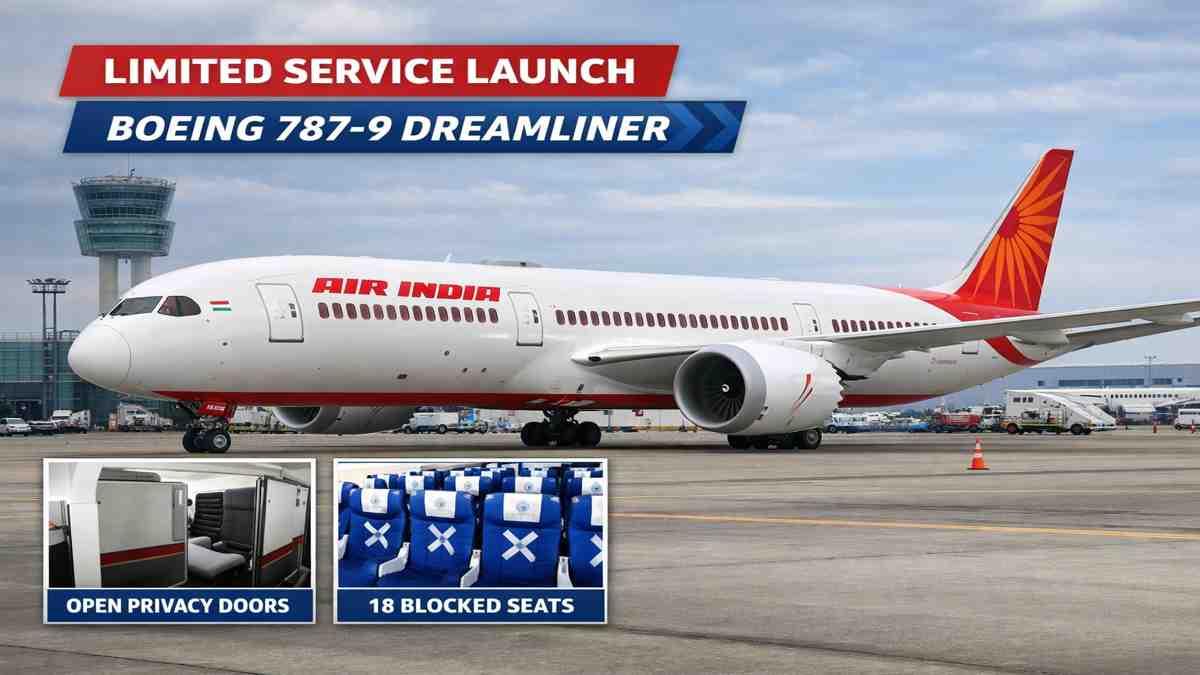
Air India will begin operating its first custom-built Boeing 787-9 Dreamliner on Feb. 1, 2025, on the Mumbai Chhatrapati Shivaji Maharaj International Airport (BOM) to Frankfurt Airport (FRA) route, but with certain onboard features limited while regulatory approvals are finalized.
The Tata Group-owned carrier said the aircraft is fully delivered and airworthy, yet some business and economy class elements will remain restricted due to certification timelines involving the U.S. Federal Aviation Administration (FAA).
A Milestone Aircraft After the Tata Group Takeover
The Boeing 787-9 is the first Dreamliner specifically built for Air India after the Tata Group takeover in January 2022. The delivery represents a key step in the airline’s broader fleet modernization effort, which includes new aircraft induction and retrofits across existing widebody jets.
While the new aircraft is entering commercial service as scheduled, Air India said certain cabin features are operating under temporary constraints linked to pending approvals.
Business Class Privacy Doors Remain Locked Open
One of the most visible limitations affects the business class product, where sliding privacy doors are currently locked in the open position.
According to Air India, this is due to pending FAA approval for the specific seat feature rather than the seat itself.
Air India said all other business class seat functions remain available for passenger use, and it expects the privacy doors will be activated once regulatory clearance is granted.
Eighteen Economy Seats Blocked From Sale and Use
In the economy class cabin, 18 seats will not be available for sale or use when the aircraft begins service.
Out of the aircraft’s total 296 seats, 18 economy class seats are not available for sale or use. These seats are physically blocked until certification is completed.
Air India said the issue is not related to the underlying seat model being unproven in the market.
Air India clarified that the RECARO 3710 seat model is already certified and used by multiple airlines globally. However, a regulatory interpretation affecting these 18 specific seats is under review in coordination with the manufacturer and the regulator.
FAA and Boeing Offer No Timeline on Pending Approvals
The FAA has not provided a timeline for the pending approvals and declined to comment on ongoing certification work. Boeing also did not state the matter.
For Air India, the lack of a clear schedule means the airline is moving forward with service while keeping affected seat features temporarily restricted.
Restrictions Limited to This Specific 787-9 Variant
Air India emphasized that the limitations are isolated to the new Boeing 787-9 variant. The retrofitted Boeing 787-8 aircraft in the fleet have completed all required certifications and offer full seat functionality.
The airline’s clarification is aimed at reassuring travelers that the restrictions are not fleetwide and do not reflect broader operational issues with its Dreamliner lineup.
Dreamliner Fleet Size and Near-Term Expansion Plans
Air India currently operates 33 Boeing 787 aircraft, including 26 legacy 787-8s and seven 787-9s. Six of the 787-9s were inducted from Vistara, along with the newly delivered aircraft.
Looking ahead, the airline plans to induct five additional widebody aircraft in 2026, including three Boeing 787-9s and two Airbus A350-1000s. The existing 787-8 fleet continues to undergo phased retrofitting.
The expansion reflects Air India’s push to strengthen its long-haul network and compete more aggressively on international routes.
Industry-Wide Seat Certification Delays Add Pressure
Industry sources noted that Air India is not alone in facing seat certification delays. Lufthansa is also awaiting regulatory clearance for certain business class seats on its new Boeing 787-9 aircraft.
These delays reflect broader regulatory scrutiny around new cabin designs, particularly for premium seating products.
For airlines, such delays can complicate fleet entry timelines and force carriers to balance customer experience expectations with the practical realities of certification and compliance.
What Passengers Can Expect Starting Feb. 1
Air India said it will operate the new aircraft on the Mumbai–Frankfurt route beginning Feb. 1, 2025, with restrictions clearly communicated to customers. Until approvals are completed, passengers should expect locked-open privacy doors in business class and reduced seat availability in economy.
Despite the limitations, the aircraft’s entry into service signals continued progress in Air India’s post-acquisition transformation, as the airline works to bring more new-generation widebody capacity into its long-haul operations.
