


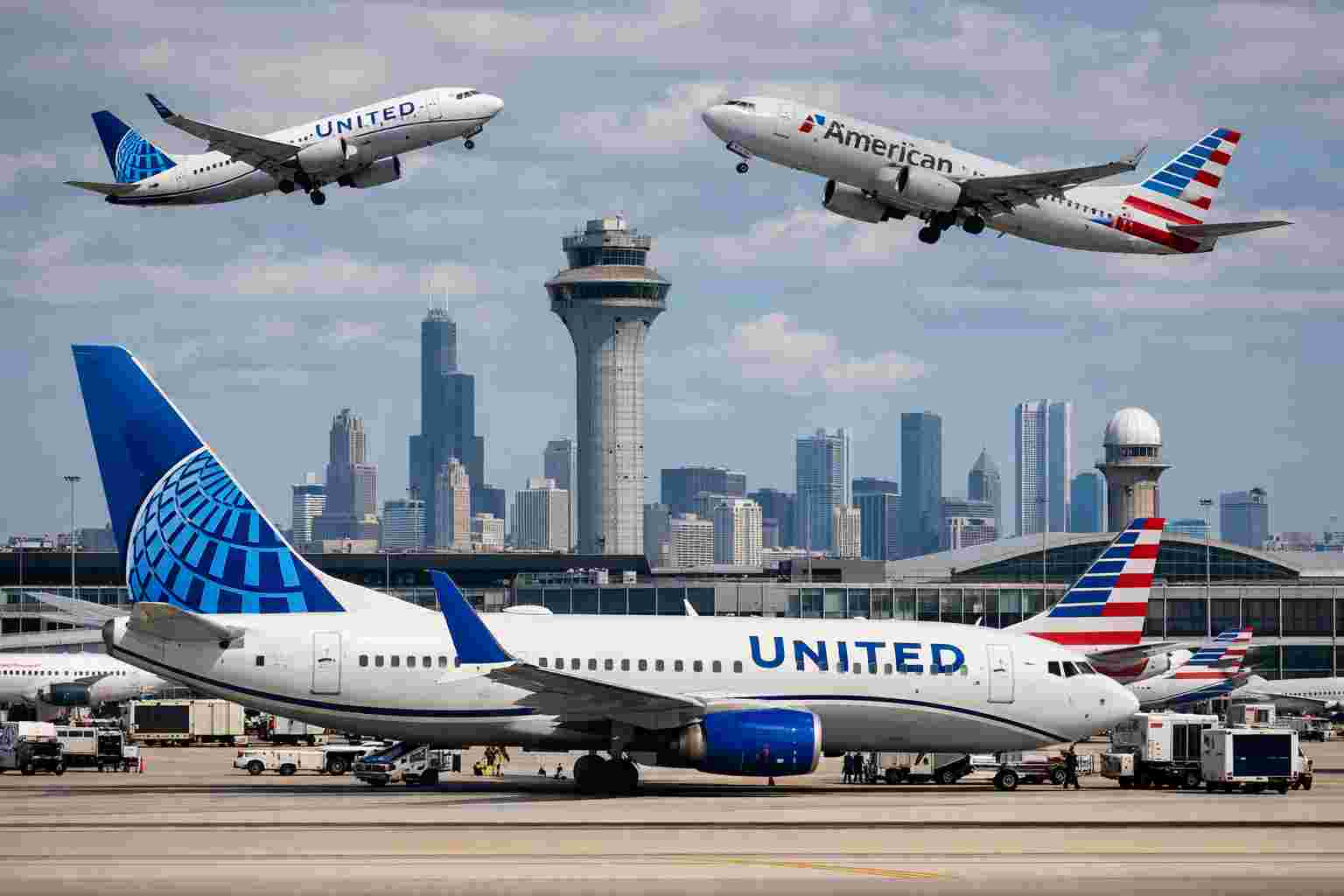
CHICAGO — Chicago O’Hare International Airport is emerging as one of the most closely watched battlegrounds in U.S. aviation as United Airlines and American Airlines intensify a high-stakes competition at their shared hub. What began as a gradual shift in market share has evolved into a direct confrontation over gate access, capacity levels, and long-term strategic control of one of the nation’s busiest airports.
With both carriers signaling a willingness to add flights to defend their positions, the fight is shaping pricing, schedule frequency, and the future balance of power at O’Hare. Industry analysts say the outcome could influence how airlines approach contested hub markets nationwide.
A Rare Two-Hub Showdown at O’Hare
O’Hare is one of the few major U.S. airports where two legacy airlines operate full-scale hubs. That alone makes it a strategic prize, particularly for corporate travel, international connections, and domestic network reach. However, what has made the current situation more intense is how sharply the competitive balance has shifted over the last decade.
United has steadily expanded its local and business traveler share since 2016. Company leadership has credited a long-term focus on brand loyalty, premium customers, and operational consistency. By 2025, United reported a significant lead among Chicago-based passengers and corporate travelers, while also claiming strong profitability at the airport.
American, meanwhile, has faced greater challenges defending its position. Internal struggles and weaker premium demand have reduced its competitiveness in Chicago, even as it remains strong at other hubs. Still, American has not shown signs of retreat and has signaled renewed commitment through aggressive capacity growth, OMAAT reported.
Gate Allocation Becomes the Real Battlefield
While fare competition and schedule expansion are visible to travelers, the deeper conflict is rooted in gate access. At O’Hare, gate allocation is largely governed by historical usage. Airlines that operate more flights earn more gates in future allocation cycles, with a built-in lag in the system.
This structure can encourage airlines to boost short-term capacity to secure long-term infrastructure advantages, even if profitability suffers in the near term. In other words, flying more today can help an airline lock in more operational flexibility tomorrow.
United currently controls roughly 95 gates at O’Hare, compared to about 60 for American. In 2025, American added flights and is expected to regain three gates under the allocation formula. United allowed that shift to happen, choosing not to match capacity at the time.
That approach is expected to change in 2026. United’s leadership has stated it will add whatever capacity is required to prevent any further gate losses. The objective, executives have indicated, is not expansion but defense—setting up a new wave of heavier competition and increased flight volumes across key routes.
Profitability Claims Raise Competitive Pressure
The fight has also sparked sharply different claims about profitability. United CEO Scott Kirby has been unusually direct about the financial impact of the Chicago battle. He claims United earned roughly $500 million in profit at O’Hare in 2025 and could have earned more without American’s expansion. At the same time, he estimates American’s losses at the airport could approach $1 billion as capacity ramps up.
American disputes those figures. While the airline acknowledges Chicago is not its strongest hub, it rejects claims of losses at the scale suggested by United. American points to long-term investment in Chicago, new destinations, and continued market share gains as evidence that it remains committed to the airport.
Independent analysts note that American’s broader network profitability and loyalty program revenues provide flexibility to absorb losses in competitive markets like Chicago. That reduces the likelihood of a withdrawal, even if margins remain thin during the most aggressive phases of the rivalry.
Brand Loyalty Versus Price Competition
At the core of the conflict is a strategic question with implications far beyond Chicago: can brand loyalty outweigh lower fares in a head-to-head hub market?
United believes it can. The airline argues that premium customers and corporate contracts are less sensitive to short-term price cuts, giving United room to defend market share without sacrificing profitability.
If that assumption holds, United could maintain its lead even as competition intensifies. If it does not, sustained fare pressure could erode margins for both carriers. In that scenario, United’s confidence would be tested, and American’s willingness to endure prolonged losses could become the deciding factor.
What It Means for Travelers
In the near term, passengers stand to benefit. More flights and aggressive competition typically lead to lower fares, expanded schedules, and more nonstop options. For Chicago, the duel reinforces O’Hare’s role as a major global gateway, with both airlines motivated to keep capacity high and connectivity strong.
For business travelers, the battle could also bring improved service offerings as both carriers attempt to retain corporate contracts and loyalty program customers. However, industry observers caution that prolonged fare wars can eventually lead to cuts in less profitable routes if either airline decides the financial pressure has become too heavy.
A Defining Test for Hub Strategy Nationwide
For United and American, the stakes extend well beyond Chicago. The outcome will help define how airlines evaluate shared-hub markets and how aggressively they will defend infrastructure like gates.
A clear win for United would validate its loyalty-driven strategy and strengthen its claim that premium positioning can withstand price competition. A more balanced result would suggest that even dominant carriers cannot fully insulate themselves from capacity-driven fare wars at contested hubs.
Bottom Line
United and American are entering a decisive phase in their long-running Chicago rivalry. United is determined to protect its gate count and claims it can do so profitably. American is betting that sustained capacity growth will restore relevance and long-term leverage at one of the most competitive airports in the world.
The 2026 schedule year will reveal whether brand loyalty or endurance proves more powerful at Chicago O’Hare.
