


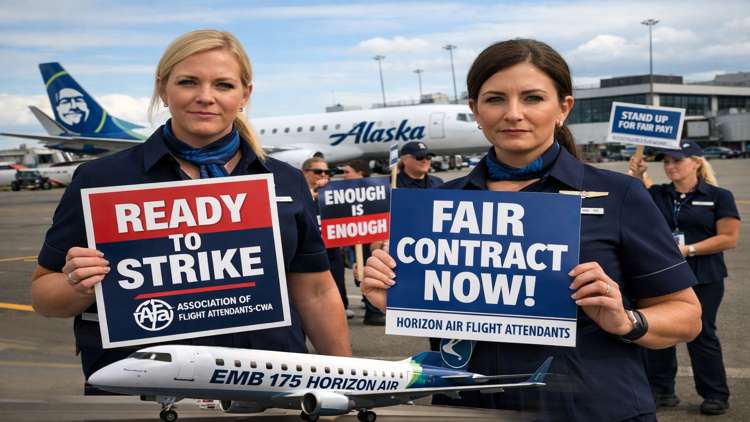
Horizon Air flight attendants are signaling growing frustration with contract negotiations, warning that a strike authorization vote could come sooner rather than later after more than 18 months of talks have failed to produce an economic proposal from management. The dispute places renewed labor pressure on Alaska Airlines Group as it navigates broader workforce integration following its acquisition of Hawaiian Airlines.
The regional carrier, which operates as a wholly owned subsidiary of Alaska Airlines, employs flight attendants who primarily serve routes operated by Embraer 175 aircraft out of Seattle–Tacoma International Airport. Those regional flights play a key role in supporting Alaska’s mainline network, making labor stability at Horizon an important operational consideration for the broader airline group.
Contract Talks Stall After 18 Months
Negotiations between Horizon Air and the Association of Flight Attendants began more than a year and a half ago, yet union officials say progress has been limited. The contract became amendable in April 2024, but management has not presented an economic offer that addresses wages, work rules, or the long-term cost structure of a new agreement.
Union leaders say the absence of an economic proposal has restricted talks largely to non-economic sections of the contract. While some of those provisions have been discussed, many are interconnected with compensation and scheduling, leaving key issues unresolved until financial terms are addressed.
According to the union, the list of open items is shrinking, increasing urgency at the bargaining table. That dynamic, leaders say, is driving consideration of a strike authorization vote as a way to demonstrate member dissatisfaction and apply pressure on management to move negotiations forward.
Strike Vote as a Strategic Signal
In a memo circulated to flight attendants, the union indicated that it may pursue a strike authorization vote even before receiving Horizon’s first economic offer if delays continue. Union leadership stressed that such a vote would not result in an immediate work stoppage but would instead serve as a signal of unity and resolve among the workforce.
The move reflects a broader trend across the airline industry, where unions increasingly rely on strike authorization votes as leverage during protracted negotiations. While these votes rarely lead directly to strikes, they can influence the tone and pace of bargaining.
Legal Barriers to a Work Stoppage
Any potential strike by Horizon Air flight attendants would be governed by the Railway Labor Act, the federal law that regulates airline and railroad labor relations. The act establishes a lengthy process that makes actual strikes uncommon, even in highly contentious disputes.
Under the statute, negotiations must proceed through mediation overseen by the National Mediation Board. Only if mediation fails and the board formally releases both parties can either side engage in self-help actions such as strikes or lockouts.
Past airline labor disputes illustrate how challenging it is to reach that stage. In many cases, unions have secured strike authorization votes but remained in mediation for extended periods until a tentative agreement was reached.
Union officials at Horizon have emphasized that a strike vote would be a strategic step within this framework, not an immediate escalation toward a walkout.
Union Warns Against Unilateral Actions
As tensions rise, the Association of Flight Attendants has cautioned members against taking independent or informal job actions. Union leadership warned that refusing assigned duties, coordinating slowdowns, or engaging in unsanctioned actions could expose individual flight attendants to discipline and create legal risks for the union.
The guidance reflects lessons learned from recent labor disputes across the U.S. airline industry, where unions have sought to maintain strict compliance with federal labor law to preserve leverage and avoid penalties.
Broader Labor Context at Alaska Airlines Group
The Horizon negotiations are unfolding alongside broader labor developments within Alaska Airlines Group. Alaska Airlines flight attendants recently ratified a new contract, and attention is shifting toward joint negotiations involving Alaska and Hawaiian Airlines crews following the completion of the merger.
Union officials have said the Alaska agreement will serve as a baseline as negotiators work to combine provisions from both carriers into a single joint contract. Of the 37 sections in the proposed combined agreement, negotiators have reached consensus on 12 so far, highlighting both progress and the complexity of the task ahead.
Bottom Line
Horizon Air flight attendants appear to be edging closer to a strike authorization vote as prolonged negotiations continue without an economic proposal from management. While a work stoppage remains unlikely in the near term due to federal labor law constraints, the situation underscores mounting labor pressures within Alaska Airlines Group at a time of significant organizational change.
For investors and industry observers, the dispute is a reminder that labor relations remain a critical variable for airlines seeking stability and growth in a highly competitive market.
