


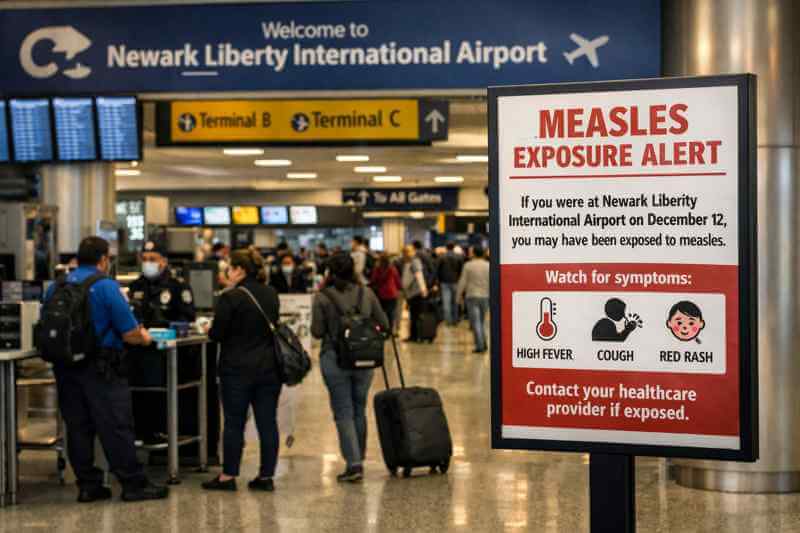
NEW JERSEY — Health officials are reviewing potential public exposure after a traveler infected with measles spent approximately 12 hours inside Newark Liberty International Airport (EWR) during one of the busiest travel periods of the year, raising concerns about disease transmission at a major U.S. transportation hub.
The individual moved through multiple areas of the airport on Dec. 12, including Terminal B and Terminal C, from early morning until evening, according to the New Jersey Department of Health. Newark Liberty, a critical gateway for domestic and international travel into the New York City metropolitan area, handled nearly 49 million passengers in 2024, underscoring the scale of potential exposure.
Extended Airport Presence Raises Transmission Concerns
Health officials said the length of time the infected traveler spent inside the airport significantly increases the likelihood of exposure. Measles is considered one of the most contagious viral diseases in the world and can remain airborne for up to two hours after an infected person leaves an area.
This characteristic poses heightened risk in enclosed, high-traffic environments such as airport terminals, security checkpoints, boarding gates, lounges, and retail corridors. During peak travel seasons, passenger density further amplifies the chance of indirect transmission.
Authorities confirmed the traveler was not a New Jersey resident. No additional identifying details were released, citing medical privacy protections.
Cross-State Coordination Underway
Because Newark Liberty serves as a major regional aviation hub with substantial cross-border traffic, New Jersey health officials are coordinating closely with counterparts in New York. The airport plays a central role in regional business travel and international connectivity, making disease monitoring a priority for both states.
Officials confirmed that at least two New York residents were known to have been exposed during the traveler’s time at the airport. As of the latest update, New York health authorities reported no confirmed measles cases directly linked to the incident.
Health agencies continue to track potential exposures and are monitoring individuals who may have been present in the same airport areas during the relevant time window.
Symptoms May Appear Weeks After Exposure
Public health officials cautioned that measles symptoms do not appear immediately. Individuals exposed on Dec. 12 may develop symptoms as late as Jan. 2, according to health authorities.
Early symptoms typically include a high fever, cough, and watery or red eyes. These are often followed several days later by a distinctive rash that begins on the face and spreads downward across the body.
Officials advised anyone who believes they may have been exposed to contact a healthcare provider or local health department before visiting a medical facility. This approach helps prevent further spread in clinics, hospitals, and emergency rooms, where vulnerable populations may be present.
Vaccination Status Under Review
The incident has renewed public health messaging around vaccination, particularly for frequent travelers. According to the Times Union, the New Jersey Department of Health urged travelers who were at Newark Liberty on Dec. 12 to review their immunization records.
Health officials emphasized that full vaccination with the measles, mumps, and rubella (MMR) vaccine is the most effective way to prevent infection and limit outbreaks. While measles complications are relatively uncommon, they can be severe, especially for infants, pregnant individuals, and people with compromised immune systems.
Business and Travel Implications
Beyond public health concerns, the exposure highlights how infectious diseases can intersect with global travel networks and economic infrastructure. Airports like Newark Liberty are not only transportation centers but also critical economic engines that support tourism, commerce, and international business activity.
Health-related incidents can create operational challenges for airports, airlines, and employers, particularly if they lead to staffing disruptions, travel hesitancy, or heightened regulatory scrutiny.
Monitoring Continues as Officials Urge Vigilance
Health authorities said monitoring efforts will continue through the end of the incubation period. Travelers are being encouraged to stay alert for symptoms, verify vaccination status, and follow guidance from public health agencies.
The measles exposure at Newark Liberty International Airport serves as a reminder of the ongoing intersection between public health and global mobility, particularly during high-volume travel seasons when the consequences of a single case can extend far beyond one terminal.
