


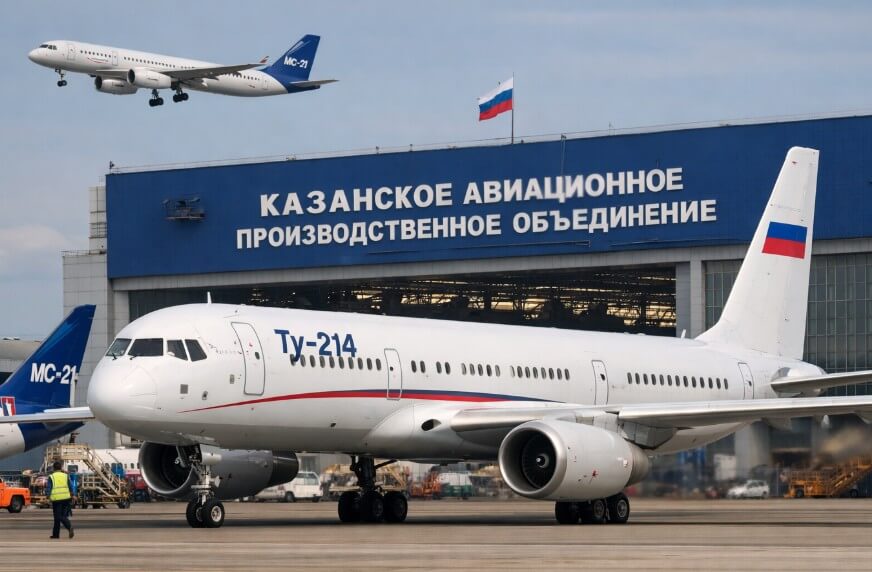
MOSCOW — Russia has approved the serial production of the upgraded Tupolev Tu-214, a medium-haul commercial aircraft that once competed with Boeing’s 757, marking a significant step in the country’s effort to rebuild its domestic civil aviation industry amid ongoing Western sanctions.
United Aircraft Corporation (UAC), part of state-owned Rostec, confirmed that Russia’s federal air transport regulator Rosaviatsia has certified major design modifications to the Tu-214, allowing the aircraft to move from limited production to full-scale manufacturing. Officials say output could rise to as many as 20 aircraft per year by 2027, with deliveries aimed primarily at Russian airlines including Aeroflot.
The approval underscores Moscow’s broader strategy to replace Western-built aircraft with domestically produced alternatives after sanctions sharply reduced access to Boeing and Airbus jets.
Certification Enables Import Substitution Push
Rosaviatsia’s certification covers extensive design changes focused on replacing foreign-made systems with Russian-built components. The effort is part of a long-running import-substitution campaign designed to reduce dependence on Western aerospace suppliers.
Test flights of the modified Tu-214 began in November last year, using a dedicated prototype aircraft to validate new onboard systems under real operating conditions. The aircraft is powered by Aviadvigatel PS-90A engines and now features Russian-made avionics, collision-avoidance systems, and ground-proximity warning equipment.
Regulators also approved a domestically produced equivalent to the ACAS collision-avoidance system after evaluation alongside foreign hardware. According to industry officials, the same technologies will be used on other Russian aircraft programs, including the Yakovlev MC-21-310, the Sukhoi SJ-100, and the Ilyushin Il-114-300.
Russian aerospace executives described the certification as a key milestone in restoring technological independence in civil aviation.
Production Ramp-Up Planned at Kazan Facility
The Tu-214 is manufactured at facilities near Kazan International Airport by the Kazan Aircraft Production Association. UAC said the plant is undergoing modernization to support higher output levels, including upgrades to tooling, assembly lines, and workforce training.
Officials say serial production will help create skilled industrial jobs, strengthen regional economies, and rebuild Russia’s aerospace manufacturing capacity. Under current plans, production volumes will rise gradually through the decade as airlines prepare to integrate the aircraft into domestic fleets.
The Tu-214 seats up to 210 passengers and serves medium-haul routes. While it has been produced in limited numbers since the mid-1990s, sanctions-driven fleet shortages prompted Moscow to revive large-scale assembly.
A Variant Designed for Greater Range and Weight
The Tu-214 is a variant of the Tu-204 family, which first flew in March 1996. Although technically designated the Tu-204-200, the Tu-214 is built at a different factory and incorporates several structural differences.
Tu-204 aircraft are produced in Ulyanovsk by Aviastar-SP, while the Tu-214 is assembled in Kazan. Each factory operates independently of the Tupolev design bureau and maintains some influence over aircraft configuration.
Externally, the Tu-214 can be distinguished by its door layout. Unlike the Tu-204, which has two main doors and two emergency exits, the Tu-214 features three main passenger doors and one emergency exit, including a full-size door ahead of the wing on the left side of the fuselage.
The aircraft is designed for a higher maximum takeoff weight than the Tu-204, with additional fuel tanks and reinforced structures. These characteristics have made it a preferred platform for Russian government and special-mission aircraft, some of which are reported to have non-stop ranges of up to 10,000 kilometers.
Sanctions Drive Renewed Interest
As of mid-2018, only three Tu-214 aircraft were in airline service with Rossiya Airlines. Interest in restarting production intensified after March 2022, when Rostec CEO Sergey Chemezov said sanctions linked to the Russo-Ukrainian War made reviving the program necessary.
In April 2022, UAC announced that production of 20 Tu-214 aircraft had already begun to help replace Russia’s Boeing and Airbus fleets. Later that year, the company confirmed plans to increase annual output to at least 10 to 12 aircraft, targeting 70 units by 2030.
The first commercial Tu-214 deliveries were initially expected in 2024, then delayed to 2025. In November 2025, a fully Russian-built prototype completed its first flight as a test aircraft, marking another milestone toward serial production.
Broader Civil Aviation Strategy Continues
UAC said progress continues across other domestic aircraft programs. The MC-21 and SJ-100 remain in testing, while the Il-114-300 has completed nearly all required certification flights. Authorities expect formal approvals to follow, supporting a broader renewal of Russia’s civil aviation fleet in the coming years.
Together, the programs reflect Moscow’s determination to rebuild a self-reliant commercial aviation sector as geopolitical and economic pressures reshape the global aerospace market.
