


CHENGDU, China — China is intensifying its drive to become a major supplier in the global combat aircraft market, leveraging three active fighter programs that are increasingly attracting international attention. According to a recent assessment by the U.S. Department of Defense, Beijing’s expanding aerospace capabilities are positioning Chinese-made fighters as cost-effective and politically accessible alternatives to Western aircraft, particularly in regions facing procurement constraints.
The Pentagon assessment highlights the FC-31 stealth fighter, the Chengdu J-10C, and the JF-17 Thunder as the backbone of China’s export-oriented military aviation strategy. Together, these platforms span multiple price points and capability levels, strengthening China’s competitiveness in markets long dominated by U.S. and European manufacturers.
Aerospace Expansion Anchored in Dual-Use Strategy
China’s military aerospace sector is undergoing rapid growth, marked by simultaneous investment in domestic force modernization and export-driven production. An unclassified Pentagon report to Congress notes that this approach is evident across China’s fighter portfolio, with expanding production capacity, fewer export restrictions, and steady improvements in avionics, weapons integration, and stealth design.
The report also confirms the emergence of two stealth aircraft with tailless configurations, informally designated J-36 and J-XDS. These designs emphasize reduced radar cross-sections and improved survivability against advanced air defense systems. Additional developments include the land-based J-35A fifth-generation fighter, the J-15D carrier-based electronic warfare aircraft, and a new airborne early warning and control platform derived from the Y-20B transport aircraft, designed to track advanced stealth targets.
Carrier Ambitions Signal Long-Term Naval Power
One of the most strategically significant disclosures in the assessment is China’s stated objective to operate six aircraft carriers by 2035. If achieved, this would bring its total carrier fleet to nine, including the Fujian, which began sea trials in May. Satellite imagery also suggests progress on a fourth carrier, widely expected to feature nuclear propulsion, alongside indications of at least one additional conventionally powered vessel under development.
These efforts would narrow the numerical gap with the U.S. Navy’s 11 nuclear-powered supercarriers and substantially expand China’s capacity for sustained carrier-based air operations, reinforcing demand for carrier-capable fighters such as the J-35.
FC-31 Targets High-End Export Customers
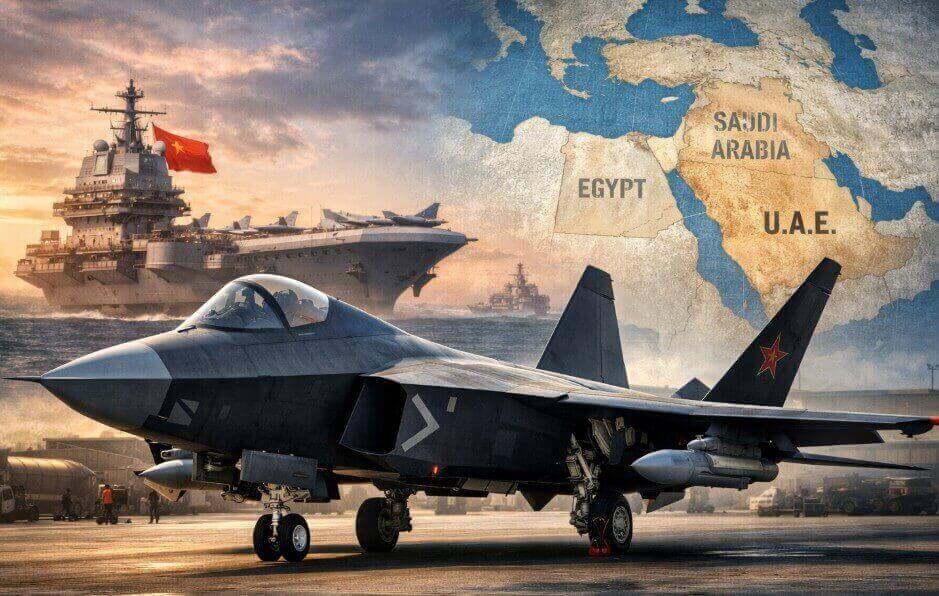
For exports, the Pentagon identifies the fifth-generation Shenyang FC-31 as China’s most ambitious offering. As of May 2025, the aircraft has not secured confirmed foreign orders, but Egypt, Saudi Arabia, and the United Arab Emirates are cited as interested parties.
First flown in 2012 and redesigned in 2016, the FC-31 has since influenced the development of the carrier-capable J-35 and land-based J-35A for domestic use. Despite this focus, foreign sales remain a central objective, as the original FC-31 concept was intended primarily for export. Notably absent from the Pentagon’s list of potential buyers is Pakistan, despite earlier official statements suggesting interest.
Middle East Interest Reflects Shifting Procurement Policies
Interest from Middle Eastern states reflects evolving regional procurement dynamics. Egypt’s attempt to acquire Russian Su-35s was halted by potential U.S. sanctions, while Saudi Arabia continues to evaluate options amid stalled Eurofighter Typhoon negotiations and uncertain access to the F-35. Exporting U.S. stealth fighters to Saudi Arabia or the UAE would require major policy shifts, making the FC-31 a potentially attractive alternative.
The UAE previously approved a $23.37 billion package that included F-35As but later expressed concerns over stringent safeguards aimed at limiting Chinese access to sensitive technologies.
J-10C and JF-17 Build Track Records
The fourth-generation Chengdu J-10C has so far been exported only to Pakistan, which has ordered 36 aircraft since 2020. Its combat use during recent India–Pakistan clashes has drawn attention, particularly its integration with PL-15 long-range air-to-air missiles. China has actively highlighted these engagements to promote the platform internationally.
Meanwhile, the JF-17 Thunder remains China’s most commercially successful fighter export. Co-developed with Pakistan, it is currently operated by Pakistan, Azerbaijan, Myanmar, and Nigeria, with Iraq in negotiations. The aircraft’s lower cost, fewer sustainment constraints, and upgraded avionics in later variants have broadened its appeal.
Outlook: China’s Growing Role in Fighter Exports
With three distinct fighter platforms covering a wide range of capabilities and budgets, China is increasingly well positioned to compete at the upper tiers of the global combat aircraft market. Securing an FC-31 export order would mark a significant milestone, helping to offset development costs and reduce unit prices through higher production volumes.
Taken together, these trends suggest China’s influence as a global fighter supplier will continue to expand, reshaping competition in markets traditionally dominated by Western defense firms.
