


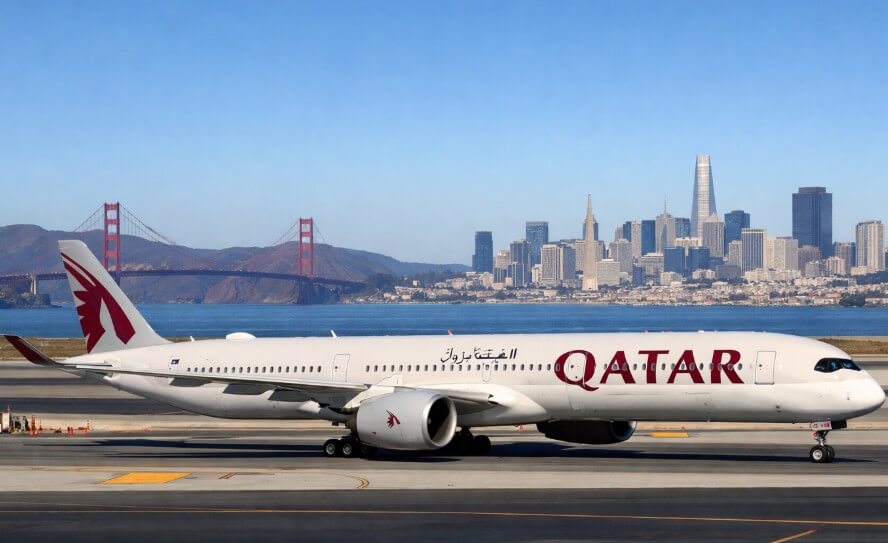
Qatar Airways will significantly reduce its service to San Francisco next summer, trimming nearly 30% of flights on the ultra-long-haul route as the airline recalibrates capacity amid softer demand and intensifying global competition.
Beginning in late March 2026, the Doha-based carrier will operate five weekly flights between Hamad International Airport (DOH) and San Francisco International Airport (SFO), down from a previously planned daily schedule. The change applies to the 2026 northern summer season and represents a notable shift for one of the airline’s key U.S. gateways.
The adjustment underscores the challenges airlines face in balancing capacity, profitability, and competition on some of the world’s longest international routes.
San Francisco Becomes Qatar Airways’ Least-Served U.S. Market
With the reduced schedule, San Francisco will become Qatar Airways’ only U.S. destination without daily service and its least-served city in the country. Flights will operate on Mondays, Tuesdays, Thursdays, Saturdays, and Sundays, breaking a pattern of near-daily operations that has largely held since the route’s launch.
Qatar Airways began flying to San Francisco in December 2020, an unusual expansion during the height of the global aviation downturn. Despite pandemic-related disruptions, the airline managed to maintain daily or near-daily service on the route through most peak travel seasons in the years that followed.
That consistency will end next summer as the carrier takes a more cautious approach to capacity deployment.
Long-Haul Connectivity Maintained
Despite the frequency reduction, Qatar Airways is preserving flight timings designed to support long-haul connectivity through its Doha hub. The outbound flight will continue to depart Doha in the morning, arriving in the San Francisco Bay Area in the early afternoon local time.
The return flight will operate later the same day, allowing passengers to connect onward to destinations across the Middle East, South Asia, and Africa. Maintaining these timings suggests the airline remains focused on protecting its role as a global connector rather than treating San Francisco as a purely point-to-point market.
Aircraft Deployment Remains Unchanged
Qatar Airways will continue to deploy the Airbus A350-1000 on the San Francisco route, according to industry reports from Simple Flying. The widebody aircraft offers a total of 327 seats per flight, including 46 QSuite business class seats and 281 economy seats.
The decision to retain the same aircraft while cutting frequency indicates the airline has not lost confidence in premium demand on the route. However, fewer weekly flights will result in a substantial reduction in total available seats during the peak summer travel period, a time when airlines typically aim to maximize capacity.
For now, Qatar Airways still plans to restore daily service during the winter 2026–27 season.
Softer Demand and Rising Competition
Traffic data points to signs of softening demand on the Doha–San Francisco route. Passenger volumes declined slightly year over year during the 2025 peak summer period, while seat load factors also dipped. Although those load factors remained strong by international standards, the downward trend has raised questions about long-term sustainability at current capacity levels.
Competition on the route has also intensified. Emirates continues to operate daily flights to San Francisco, while multiple European carriers maintain at least daily service to the Bay Area from their respective hubs. The crowded long-haul market puts pressure on airlines to defend market share while protecting yields.
Reducing capacity can help stabilize load factors and improve pricing power, both of which are critical for ultra-long-haul routes with high operating costs.
A Broader U.S. Network Recalibration
The San Francisco reduction aligns with a broader trimming of Qatar Airways’ U.S. network, which is expected to reach its smallest peak summer footprint in 2026. Rather than signaling a retreat from the American market, the move reflects a targeted recalibration aimed at improving route performance.
The five-weekly schedule will serve as a test of whether tighter capacity can restore profitability while preserving the airline’s premium appeal.
Bottom Line
Qatar Airways’ decision to cut San Francisco flights highlights the delicate balance airlines must strike in today’s long-haul markets. If the strategy succeeds, it could influence future network planning across North America as global carriers continue to adjust to shifting demand and competitive pressures.
