


A Shift in Executive Travel Policy
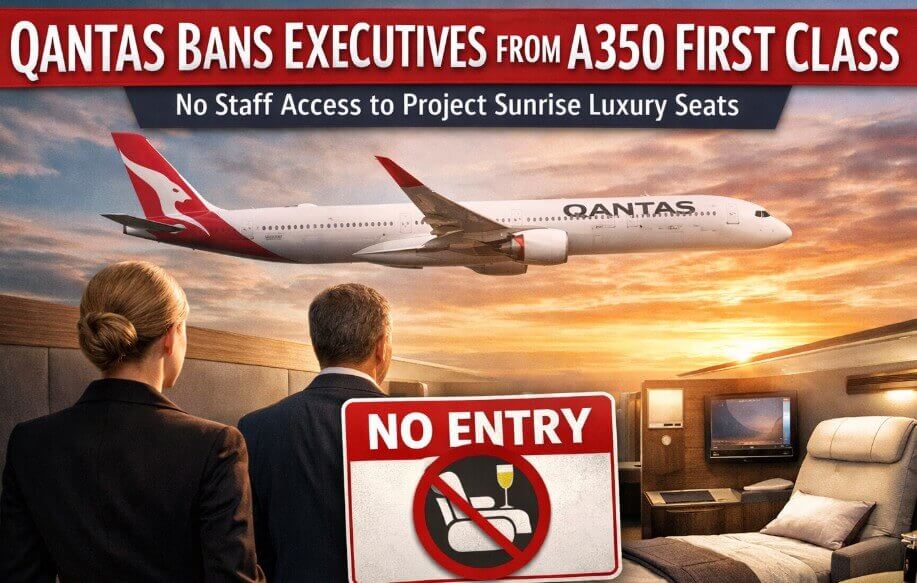
Qantas Airways is drawing a firm line between internal privileges and commercial priorities as it prepares to launch its Airbus A350-1000 fleet under Project Sunrise. In a notable policy change, the airline has confirmed that no staff members—including senior executives, board directors, or the Group CEO—will be permitted to use first class travel privileges on the new aircraft.
The move comes as Qantas readies nonstop flights from Sydney and Melbourne to London and New York, routes that will rank among the longest commercial services in the world. With flight times expected to exceed 20 hours, the airline is positioning the A350 as a premium-heavy aircraft designed to maximize revenue from high-paying customers.
According to OMAAT, the restriction reflects a deliberate effort to protect the commercial viability of these ultra-long-haul routes.
End of Generous First Class Access
Historically, Qantas has offered generous “positive space” travel benefits to its executives and board members. These benefits allowed confirmed seating—rather than standby travel—across domestic and international routes, including premium cabins.
Until now, current and former executives, directors, and their immediate family members could access both business and first class cabins, including unrestricted use of the Airbus A380 first class product on long-haul flights. That long-standing arrangement is ending with the introduction of the A350.
Qantas International CEO Cam Wallace formally advised eligible travelers that first class privileges will not apply on the A350 fleet. The policy applies uniformly, including to Qantas Group CEO Vanessa Hudson, signaling a rare example of executive travel parity with rank-and-file staff.
Executives will retain access to first class seating on the Airbus A380, where capacity and demand dynamics differ significantly.
Project Sunrise and Cabin Constraints
The Airbus A350-1000 aircraft will operate Project Sunrise nonstop flights from Sydney and Melbourne to London Heathrow and New York JFK. These routes are central to Qantas’ long-term international strategy, offering travelers direct connections between Australia and major global financial centers.
However, the aircraft’s configuration leaves little margin for non-revenue travel. The A350 first class cabin will consist of just six seats, making it the smallest and most exclusive first class product Qantas has ever offered. The new design features a separate seat and bed, reinforcing its positioning at the very top of the airline’s premium portfolio.
By comparison, the Airbus A380 includes 14 first class seats, providing greater flexibility to accommodate staff travel without materially affecting revenue.
Economics of Ultra-Long-Haul Flying
Operating flights exceeding 20 hours presents substantial economic challenges. Aircraft on these routes are configured with a high proportion of premium seating, while fuel consumption, crew costs, and operational complexity rise sharply with distance.
Profitability, therefore, depends heavily on selling first and business class seats at high fares. With only six first class seats available, allocating even a small number to non-paying travelers would significantly undermine revenue potential.
Allowing executives or their family members to occupy a majority of the cabin under positive space privileges could materially weaken the commercial performance of Project Sunrise services. That risk is far less pronounced on the A380, where first class seats are rarely sold out at full fares despite higher capacity.
The A350 policy reflects a more disciplined approach to premium inventory management, prioritizing fare-paying customers over internal benefits.
A Cultural and Symbolic Shift
Airline executives have often faced criticism for maintaining travel perks that appear disconnected from financial realities. In this context, Qantas’ decision represents a clear departure from its traditionally insular management culture.
The restriction also applies to former Qantas Group CEO Alan Joyce, who will not be eligible to access the new A350 first class cabin under legacy travel privileges. Given the reputational and operational challenges the airline faced during his tenure, the exclusion carries symbolic weight.
By removing executive access entirely, Qantas is signaling a broader cultural shift toward cost discipline and commercial accountability.
Bottom Line
Qantas Airways has formally excluded all staff, including current and former executives, from using first class travel privileges on its Airbus A350-1000 fleet. These aircraft will operate Project Sunrise nonstop services linking Australia with Europe and the United States.
With just six first class seats and the high operating costs associated with 20-plus-hour flights, the airline is prioritizing full-fare premium sales to ensure long-term sustainability. The policy underscores a pragmatic, revenue-focused approach as Qantas enters a new era of ultra-long-haul aviation.
