


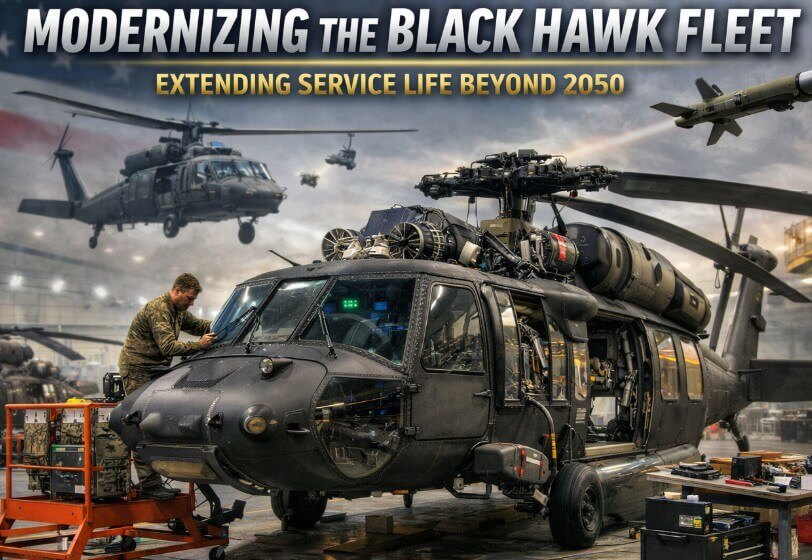
WASHINGTON — The U.S. Army has launched early planning efforts to sustain its fleet of UH-60M Black Hawk helicopters well beyond mid-century, signaling a long-term commitment to one of the military’s most critical aviation platforms. Through a formal Request for Information (RFI) issued on December 19, the Army is exploring options to overhaul and modernize more than 2,300 aircraft as it balances legacy fleet sustainment with the introduction of future vertical lift systems.
The initiative underscores a pragmatic approach to force readiness, ensuring the Army retains sufficient lift, medical evacuation, and utility capacity as modernization programs mature.
Overhaul Strategy Takes Shape
The RFI represents a non-binding step intended to gather industry feedback before any formal procurement process begins. Managed from Washington, DC, the effort will help the Army assess whether a long-term commercial production line could be established to support large-scale refurbishment of the UH-60M fleet.
Army planners are considering a program capable of overhauling between 12 and 24 helicopters annually. In addition to standard UH-60M models, the framework could also include an unspecified number of HH-60M medical evacuation variants, expanding the program’s operational impact.
Each aircraft selected for overhaul would undergo full disassembly and inspection. Structural components would be repaired or replaced as required, with a focus on corrosion control and fatigue mitigation to significantly extend airframe life.
Focus on Efficiency and Execution
According to the draft statement of work referenced in the planning materials, the Army intends to limit the program’s scope to essential sustainment and modernization tasks. Solution development and system integration are expected to be mature before contract award, allowing industry partners to focus on execution efficiency and predictable delivery schedules.
Officials see this approach as a way to control lifecycle costs while maintaining operational availability across a large and heavily utilized fleet.
Adding New Mission Capabilities
Beyond basic service-life extension, the Army aims to enhance the UH-60M’s relevance in future combat environments. A key modernization objective is the integration of “launched effects,” which would allow Black Hawks to deploy uncrewed aerial systems while in flight.
These systems—ranging from small to medium-sized drones—could conduct reconnaissance or strike missions, extending the aircraft’s reach while reducing exposure to ground-based threats. Flight testing has already demonstrated the concept using modified Black Hawks to deploy surrogate systems, including Anduril’s Altius uncrewed aircraft.
Army planners view launched effects as a critical capability for operations in contested and highly defended airspace.
A Proven Platform with Global Reach
The UH-60M Black Hawk is the latest production variant of Sikorsky’s iconic Black Hawk family and serves as the U.S. Army’s primary medium-lift helicopter. Designed for high-threat, high-altitude, and high-temperature environments, the aircraft is powered by twin T700-GE-701D engines and features wide-chord composite rotor blades for increased lift and fuel efficiency.
With a maximum gross weight of nearly 10,000 kilograms, the helicopter can transport up to 12 fully equipped troops or more than 4,000 kilograms of cargo. Globally, the Black Hawk fleet has accumulated more than 15 million flight hours, demonstrating long-term durability across combat, humanitarian, and peacetime missions.
Modernization Through Black Hawk Next
The Army’s sustainment strategy aligns closely with Sikorsky’s Black Hawk Next program, a long-term modernization effort tied to the service’s Future Vertical Lift vision. Planned upgrades include significantly increased engine power, a modular open-systems digital backbone, expanded drone deployment capabilities, and improved autonomy features.
Together, these enhancements are intended to keep the UH-60M operationally relevant into the 2070s while reducing maintenance burdens and improving readiness.
Bottom Line
With more than 2,300 UH-60Ms in service and some aircraft approaching two decades of operational use, the Army’s overhaul initiative reflects a deliberate effort to preserve capacity during a period of aviation transition. By extending the Black Hawk’s service life beyond 2050, the Army is ensuring that a proven, versatile platform remains available alongside emerging next-generation aircraft.
