


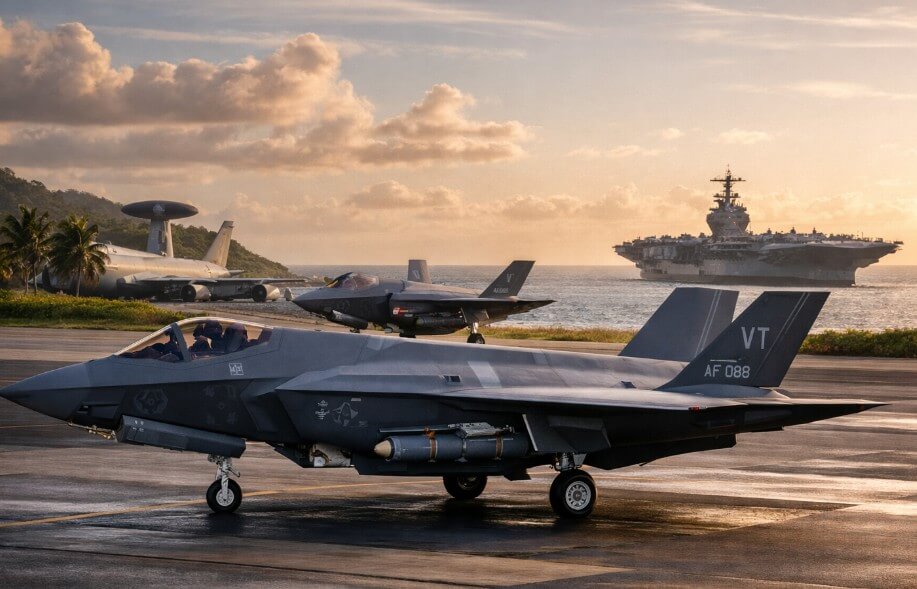
The United States has deployed Air Force F-35A Joint Strike Fighters to Puerto Rico, significantly expanding its airpower footprint in the Caribbean as part of Operation Southern Spear, a regional security mission unfolding amid heightened tensions with Venezuela. The move marks a notable escalation in U.S. military posture, combining advanced combat capability with sustained surveillance and maritime enforcement operations
F-35A Fighters Arrive in Puerto Rico
F-35A aircraft from the Vermont Air National Guard’s 158th Fighter Wing arrived earlier this week at the former Roosevelt Roads Navy base in Puerto Rico. The deployment represents a rotational detachment rather than a full squadron, according to defense officials familiar with the operation. The Department of Defense has not disclosed the number of aircraft involved or the expected duration of the mission, underscoring the flexible nature of the deployment
A Vermont National Guard spokesperson confirmed the move, stating that the mission supports U.S. Southern Command objectives while enhancing joint force readiness. No additional operational details were released. The War Zone reported that this is the first time U.S. Air Force tactical fighters have operated in the Caribbean under Operation Southern Spear, signaling a shift in the scope of the mission
Why the F-35A Changes the Strategic Equation
The introduction of the Air Force’s F-35A significantly expands the range and strike capabilities available to U.S. commanders in the region. Unlike the Marine Corps’ F-35B variant previously deployed to Puerto Rico, the F-35A can internally carry 2,000-pound class precision-guided munitions while maintaining stealth characteristics.
The F-35B, by contrast, is limited to 1,000-pound class weapons when carried internally and has reduced range and agility. These differences make the Air Force variant better suited for deep-strike missions, high-end deterrence, and operations in contested airspace. Defense analysts say the presence of the F-35A moves the U.S. posture from a symbolic show of force to one of credible strike readiness, even if no immediate military action is planned
Expanding Air and Surveillance Operations Near Venezuela
The F-35A deployment adds to a growing list of U.S. assets already operating in support of Operation Southern Spear. These include MQ-9 Reaper drones, AC-130 Ghostrider gunships, combat search and rescue aircraft, and E/A-18G Growler electronic warfare platforms.
Open-source flight tracking data from FlightRadar24 has shown a marked increase in U.S. activity near Venezuela’s northern coast. Recent flights include an E-3 Sentry Airborne Warning and Control System aircraft conducting surveillance near Venezuelan airspace. U.S. Navy F/A-18E Super Hornets and E/A-18G Growlers have also been observed flying repeated patterns along the outer edge of Venezuelan-controlled airspace.
Additionally, an E-2D Advanced Hawkeye airborne early warning aircraft was tracked in the region, pointing to sustained command, control, and electronic warfare operations designed to provide comprehensive situational awareness
Carrier Strike Group Adds Maritime Power
Complementing land-based aircraft, the USS Gerald R. Ford carrier strike group is currently operating in the Caribbean. The carrier brings four squadrons of F/A-18 Super Hornets, an E/A-18G Growler squadron, E-2D Advanced Hawkeye aircraft, MH-60S and MH-60R Seahawk helicopters, and C-2A Greyhound logistics planes.
The carrier’s presence enhances maritime security while providing additional strike capacity and airborne command and control. Together, these capabilities allow the United States to conduct coordinated air and sea operations across multiple domains simultaneously
Political Pressure and Maritime Enforcement
The military buildup coincides with continued economic and maritime enforcement actions targeting Venezuela. Over the weekend, U.S. personnel boarded another oil tanker off the Venezuelan coast as part of efforts to enforce sanctions. The action follows the December 10 seizure of the tanker M/T Skipper, an operation led by the U.S. Coast Guard with military support.
These actions stem from directives issued by President Donald Trump authorizing the interception of tankers linked to sanctioned Venezuelan oil exports. Venezuelan officials have condemned the deployments and seizures as acts of intimidation, though no direct military response has been reported.
Strategic Implications of Operation Southern Spear
Operation Southern Spear began earlier this year as a multi-domain effort combining surveillance, maritime enforcement, and military presence to counter illicit activity and apply pressure on President Nicolas Maduro’s government. The addition of F-35A fighters represents one of the most capable assets deployed under the operation to date.
While U.S. officials have not outlined any imminent military action, the expanded presence provides greater flexibility across deterrence, intelligence gathering, and potential strike options without committing to escalation, reinforcing Washington’s ability to shape regional security dynamics
