


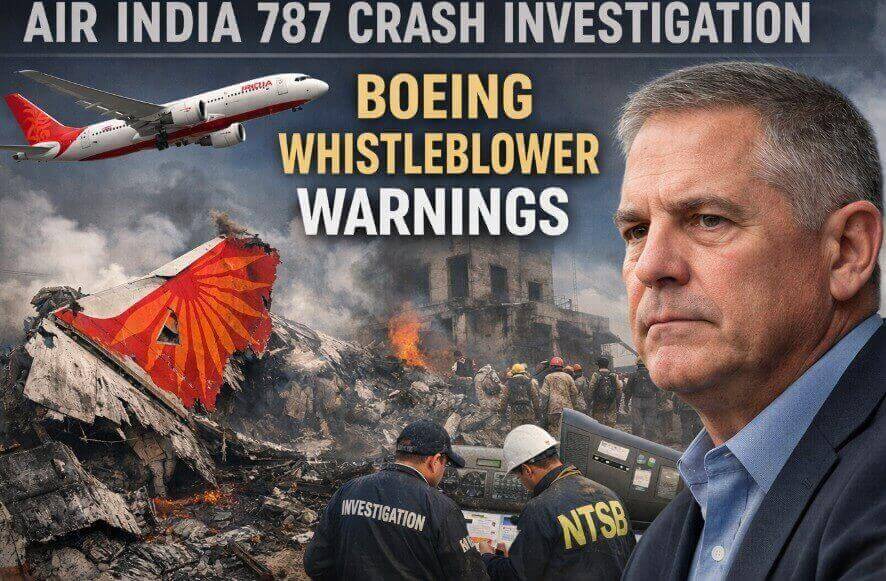
ARLINGTON, Va. — The deadly crash of an Air India Boeing 787 Dreamliner in Ahmedabad has intensified global scrutiny of aircraft safety standards, with a Boeing whistleblower cautioning investigators and the media against drawing premature conclusions about pilot error before fully examining potential aircraft system failures.
The aircraft, operating as Air India flight AI171, went down shortly after takeoff on June 12, 2025, killing more than 260 people, including 242 passengers and crew. As the official investigation progresses, attention has increasingly shifted toward cockpit actions. However, former Boeing senior manager and whistleblower Ed Pierson says that focus risks overlooking deeper, long-standing manufacturing and electrical issues within the 787 program.
Long-Standing Concerns Inside the 787 Program
Pierson, who previously raised internal safety concerns during his tenure at Boeing, has described the 787 Dreamliner as an “electrical monster,” citing its unprecedented reliance on complex electrical systems to replace traditional pneumatic and hydraulic functions.
According to Pierson, this complexity magnifies the consequences of even minor production defects. He argues that investigators must thoroughly assess whether cascading system failures played a role in the Ahmedabad crash before assigning responsibility to flight crews.
Manufacturing Pressure and Quality Control Lapses
At the center of Pierson’s criticism is Boeing’s production culture, which he says placed relentless pressure on workers to meet delivery targets. That environment, he contends, increased the likelihood of errors across critical systems.
Internal quality reports, Pierson has said, repeatedly flagged problems in flight controls, electrical wiring, hydraulics, and pressurization systems. These findings were not isolated incidents but appeared across multiple aircraft and production facilities, raising concerns about systemic weaknesses rather than individual mistakes.
Despite advances in automation, aircraft manufacturing remains heavily dependent on manual labor. Pierson emphasized that fatigue, communication breakdowns, and high-pressure schedules can directly impact safety-critical work on the factory floor.
Early Warning Signs From System Test Failures
Pierson also pointed to repeated failures during system-wide functional tests, which are designed to ensure that all aircraft systems operate correctly before delivery. He linked these issues to early 787 aircraft informally known within Boeing as the “terrible teens,” a group of jets that required extensive rework due to serious manufacturing defects.
In Pierson’s view, the Dreamliner’s tightly integrated electrical architecture increases the risk that a single malfunction could trigger multiple downstream failures, complicating both aircraft operation and accident investigation.
Pushback Against the Pilot Error Narrative
Pierson has been outspoken in rejecting the idea that pilot error should dominate early discussions of the crash. He argues that such conclusions are premature, particularly when the flight crew is unable to respond to or contextualize claims being made.
He has also criticized media coverage that he believes follows a familiar pattern: casting doubt on pilots while technical and regulatory factors receive less immediate scrutiny. According to Pierson, this approach can distort public understanding and undermine trust in the investigative process.
Gaps in the Preliminary Investigation
Concerns have also emerged over what Pierson describes as missing elements in the preliminary report issued by India’s Aircraft Accident Investigation Bureau. He highlighted the absence of detailed information on sensors, stabilizers, and the complete cockpit voice recording.
Additionally, Pierson noted that no data has been released from systems such as ACARS or the aircraft’s health management system, both of which monitor and transmit real-time performance and maintenance data. He characterized the lack of transparency as troubling for both families of victims and the broader aviation community.
Questions Over Oversight and Regulatory Trust
Pierson has questioned the composition of the initial investigation team, asking why experienced pilots and aviation maintenance technicians were not more directly involved. He argues that hands-on technical expertise can provide critical insights that may be missed by design-focused engineers alone.
While coordination between India’s investigators and the U.S. National Transportation Safety Board is expected, Pierson has expressed limited confidence in the process, citing what he sees as weakened regulatory independence following earlier Boeing safety crises. In contrast, he pointed to European regulators as more willing to take decisive safety-first actions.
A Test Case for Modern Aircraft Investigations
At its core, Pierson’s warning reflects a broader concern: that accident investigation frameworks may not be evolving quickly enough to match the complexity of modern, software-driven aircraft.
As families await answers, the Ahmedabad crash is shaping up to be a defining test of whether global aviation safety systems can adapt to the realities of next-generation aircraft design—and whether investigators can balance accountability with a thorough examination of systemic risk
