


Certification Delays Disrupt Premium Cabin Rollout
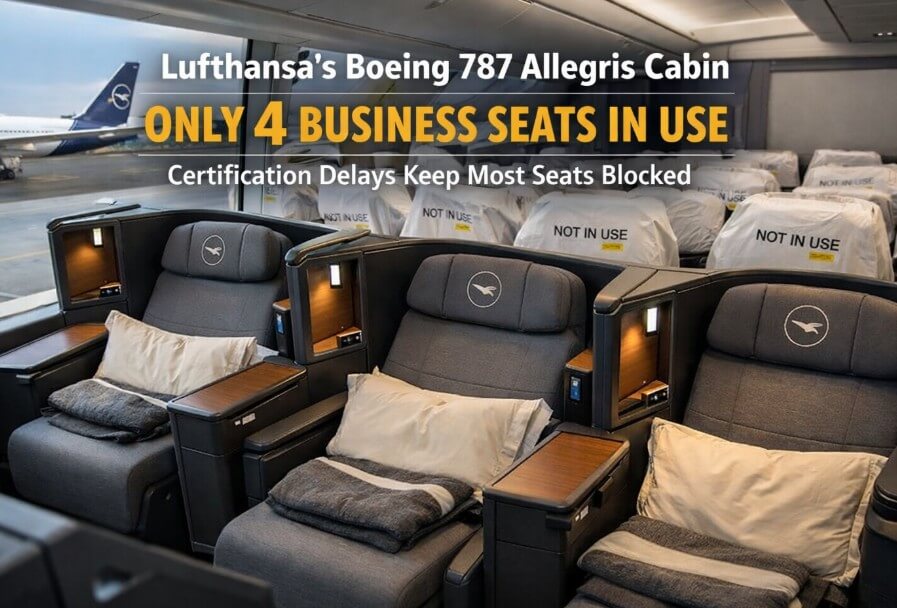
Lufthansa continues to face significant certification challenges with its new Allegris cabin on the Boeing 787-9 Dreamliner, forcing the airline to operate long-haul flights with only four usable business class seats. While the aircraft have entered commercial service on routes including Austin, Bogota, Hyderabad, and Rio de Janeiro, regulators have yet to approve most of the newly installed business class seating.
The certification delays have sharply reduced the revenue potential of the aircraft and complicated Lufthansa’s broader long-haul strategy at a time when premium travel demand has rebounded across key international markets.
Allegris Designed to Redefine Long-Haul Travel
The Allegris cabin program represents Lufthansa’s effort to modernize and standardize its long-haul product across multiple aircraft types. The concept promises direct aisle access from every business class seat, greater personalization, and a more competitive premium experience compared with global rivals.
The rollout began on the Airbus A350 fleet, where business, premium economy, and economy cabins entered service first, followed later by first class. While that phased approach created temporary inefficiencies, Lufthansa was ultimately able to bring the full product online.
The Boeing 787 program, however, has encountered deeper regulatory obstacles that have proven more difficult to resolve.
FAA Rules Create a Bottleneck
At the core of the issue is the Federal Aviation Administration’s requirement that each seat type be individually certified for use on each aircraft model. Lufthansa’s Allegris business class cabin features three different seat variants supplied by separate manufacturers. To date, only one of those seat types has been certified for the 787-9.
As a result, just four of the aircraft’s 28 business class seats—located in the first row—are currently approved for passenger use. The remaining seats are installed but blocked from sale, leaving most of the premium cabin empty on every flight.
Lufthansa executives had already flagged the risk of prolonged delays as early as late 2024, acknowledging that full certification was far from assured.
Fleet Constraints Increase Pressure
The timing of the delays has added strain to Lufthansa’s fleet planning. The airline has roughly 15 Boeing 787s delivered or nearing entry into service, but the restricted business class configuration limits their commercial value.
At the same time, Lufthansa continues to grapple with long-standing aircraft shortages. The Boeing 777X program remains delayed by several years, while earlier supply chain disruptions slowed deliveries of Airbus A350s. With long-haul demand recovering faster than capacity, the airline has limited flexibility to sideline aircraft, even when they cannot be fully monetized.
Operating with Only Four Business Class Seats
Rather than grounding the 787s, Lufthansa began deploying them in October 2025 on select intercontinental routes. Each flight sells a maximum of four business class seats, a fraction of what the market would typically support on these long-haul sectors.
The airline views this approach as a temporary compromise that allows it to maintain network coverage, protect market presence, and avoid parking valuable widebody aircraft. However, the strategy comes at the cost of lower yields and underutilized premium cabin space.
Looking Toward 2026 for Full Approval
Lufthansa has now opened sales assuming full cabin availability for flights departing from May 1, 2026. Management has stressed that this date is a target rather than a firm commitment, and additional delays remain possible depending on the pace of regulatory approvals.
Any slippage beyond May 2026 could complicate booking management, corporate sales agreements, and customer expectations, particularly for travelers specifically seeking the new Allegris product.
Pandemic-Era Decisions Still Echo
Company leadership has also acknowledged that some of the current issues stem from cost-saving measures taken during the pandemic. Spending tied to certification and product development was reduced to conserve cash, and the downstream effects are now becoming visible across the Allegris program.
Despite these setbacks, Lufthansa remains confident that the bespoke nature of the Allegris cabin will ultimately deliver higher yields and strengthen its competitive position once fully deployed.
Broader Implications for the Group
The 787 situation highlights the complexity of launching a new cabin standard across multiple aircraft platforms simultaneously. Similar challenges have emerged elsewhere within the Lufthansa Group, including weight and balance issues affecting Allegris first class on SWISS Airbus A330 aircraft.
For now, the airline’s newest Dreamliners remain constrained by regulatory hurdles, limiting their contribution to profitability. While May 2026 remains the next key milestone, industry observers caution that full certification of all Allegris business class seats should be viewed as an objective rather than a guarantee.
