


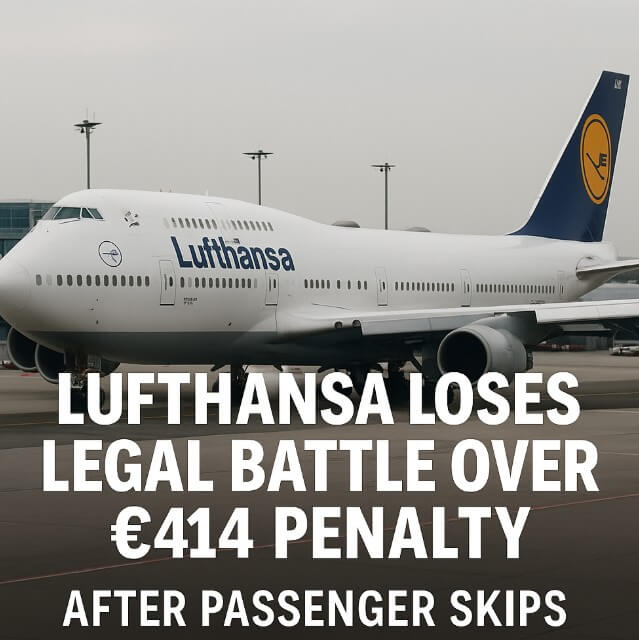
Court Ruling Undercuts Airlines’ Efforts to Police “Throwaway Ticketing”
Lufthansa has suffered a significant legal defeat after Germany’s highest civil court rejected the airline’s attempt to charge a premium HON Circle member €414 for missing a flight segment due to a family emergency. The ruling sharply limits carriers’ ability to enforce so-called “throwaway ticketing” penalties when travelers change plans after booking.
The case began when the passenger, who holds Lufthansa’s highest frequent flyer status, booked a multi-segment itinerary from Greece to Saudi Arabia via Germany. Midway through his April 2025 trip, while in Riyadh (RUH), he learned that a family member had fallen seriously ill in Germany. Seeking to reach them as quickly as possible, he returned to Frankfurt (FRA) and purchased a separate ticket to Düsseldorf (DUS), bypassing his originally scheduled continuation to Athens (ATH).
A Routine Conversation That Sparked a Legal Fight
According to the passenger’s account, the dispute began with an unexpected encounter onboard. Lufthansa flight attendants typically show heightened attention to HON Circle members, and during light conversation on the Riyadh–Frankfurt flight, he mentioned his sudden change of plans. The attendant, reportedly surprised at the itinerary deviation, later filed an internal report alleging a potential fare-rule violation.
More than a week later, Lufthansa’s revenue integrity department notified the passenger that skipping the Athens segment constituted a breach of the fare conditions. The airline demanded €414—arguing that while the original ticket cost €551, the flights actually taken would have cost €965—and gave him two weeks to pay.
The customer retained a lawyer, who filed a declaratory judgment action aiming to set a precedent for passengers facing similar allegations. Lufthansa escalated the matter by naming the flight attendant as a witness and claiming the passenger had admitted he intentionally circumvented fare rules. According to the airline, he told the crew member he “wasn’t planning to connect to Athens because he paid so little by booking this way,” an assertion he disputes.
German Court Rejects Lufthansa’s Position
A hearing was scheduled for November 24, 2025. Days before, Lufthansa attempted to withdraw its objection—an effort to prevent a binding judgment. The Bundesgerichtshof (BGH), however, proceeded with its decision, delivering a sweeping rebuke of the carrier’s penalty approach.
The court ruled that imposing retroactive charges is unjustified when travelers initially intended to use the ticketed itinerary but later altered their plans due to circumstances discovered after booking. It wrote:
“The imposition of a payment obligation for passengers who, at the time of concluding the contract, intended to use the full service and have changed their plans due to subsequently discovered circumstances, is not justified by the legitimate interests of the defendant.”
The court further concluded that Lufthansa’s commercial interests are already protected at the point of sale:
“The legitimate interest in adapting to the respective market requirements and being able to demand the best price achievable on the market is sufficiently taken into account if a passenger who wishes to use a specific service concludes a contract at the price stipulated for that service.
Circumstances that only come to light after the conclusion of the contract and lead to the passenger changing their plans have no influence on the decision to conclude the contract and therefore do not pose a significant threat to the continued existence of the special pricing structure.”
The ruling established that passengers may skip flight segments without penalty when plans change due to events beyond their control.
Lufthansa Updates Its Contract of Carriage
In response, Lufthansa revised Section 3.3.4 of its contract of carriage for residents of Germany and Austria. The new language allows the airline to recalculate fares only when a traveler voluntarily alters the planned sequence of segments. It explicitly exempts genuine post-booking disruptions:
“This does not apply if your travel plans simply change or if you are prevented, due to force majeure, illness or for another reason for which you are not responsible, from commencing carriage on all legs, or on individual legs in the order indicated on the flight ticket.”
The clause also asks passengers to notify the airline as soon as they become aware of such circumstances.
Notably, the updated policy does not apply to customers outside Germany and Austria, leaving global enforcement uneven.
Ruling Highlights Challenge for Airlines
The decision underscores the difficulty airlines face in proving a traveler intended to misuse a fare at the time of booking. Unexpected events—from illness to logistical complications—commonly arise after ticket purchase. Without clear evidence of premeditation, enforcement becomes nearly impossible in jurisdictions following the German precedent.
In this case, Lufthansa’s internal report ultimately backfired. A routine onboard conversation escalated into a corporate investigation that triggered a lawsuit—and a landmark ruling limiting the airline’s own policy tools.
