


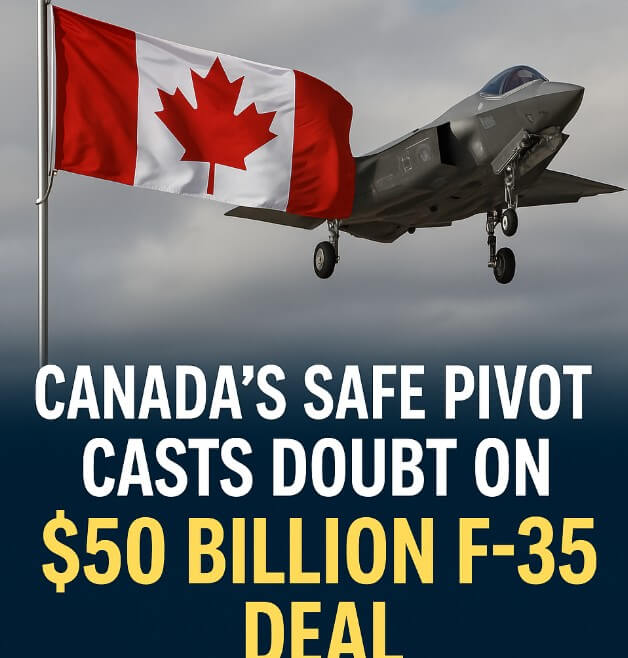
OTTAWA — Canada’s decision to join the European Union’s Security Action for Europe (SAFE) initiative marks a major realignment in its defense strategy, opening the door to new financing tools while raising significant questions about the future of its $50 billion F-35 fighter jet purchase. The move positions Canada as the first non-EU country to join the bloc’s landmark defense modernization program and signals Ottawa’s intent to diversify away from long-standing reliance on U.S.-made systems.
A New Financial and Strategic Framework
SAFE provides access to 150 billion euros in low-interest loans designed to strengthen defense production capacity and spur joint procurement across ammunition, drones, artillery, missiles, and other critical capabilities. For Canada, that funding offers a powerful mechanism to accelerate long-delayed modernization goals and move closer to NATO’s 2 percent defense-spending benchmark. Current spending stands at 1.37 percent.
Participation also gives Canadian firms eligibility for SAFE-backed procurement projects—an immediate competitive advantage over U.S. suppliers due to program rules that limit spending on non-partner equipment to 35 percent of any project.
As the release notes, “SAFE participation also supports Ottawa’s long-term aim to reduce reliance on US-manufactured systems.”
Prime Minister Mark Carney has pressed for a defense portfolio less dependent on the United States. According to the release, Carney wants a procurement mix where no more than 70 percent of capital spending flows to U.S. suppliers. “He has framed this diversification as both strategic and economic, offering Canadian firms broader access to European markets and opening the door to fresh inward investment, Eurasian Times reported.”
Fighter Jet Program Faces New Pressure
The shift toward SAFE financing brings renewed scrutiny to Canada’s 2023 decision to acquire 88 F-35 fighter jets, a program estimated at roughly 70 billion Canadian dollars. The deal is already under review on capability and sovereignty grounds, but aligning with SAFE adds another complication: the U.S.-made F-35 would not qualify for SAFE-backed loans.
That creates a strategic and financial opening for Sweden, whose Gripen fighter was a previous finalist in Canada’s selection process. Stockholm has renewed its pitch aggressively. The release notes that “Sweden has seized the moment to promote the Gripen,” with Saab offering Canada a local production hub and the potential to link manufacturing to future export orders.
The company points to new international demand to bolster its case. “Sweden recently signed an LoI with Ukraine for 100 to 150 aircraft, and Saab claims its proposal could create ten thousand Canadian jobs.” Because Sweden is a SAFE member, Gripen procurement could be directly supported through the initiative’s financing tools.
Shifting from the F-35 to a non-U.S. platform, however, would require costly updates to infrastructure, radar systems, weapons integration, and training pipelines. While challenging, the transition remains “strategically attractive to a government eager to show that it has alternatives to US supply chains.”
SAFE’s Expanding Global Reach
Canada’s entry into SAFE marks a significant milestone for the EU’s ambitions to broaden the program beyond Europe. After the United Kingdom failed to secure an agreement to join, Canada’s participation provides crucial validation for SAFE as a globally relevant defense initiative.
The release observes that Canada’s involvement “may encourage countries such as Australia to consider joining,” further extending European strategic influence across the Indo-Pacific and transatlantic communities.
SAFE also aligns with the EU’s longstanding goal of reducing its dependence on U.S.-made systems—a priority now echoed by Ottawa.
Strains in a Critical Bilateral Relationship
Canada’s pivot arrives at a sensitive moment in U.S.-Canada relations. The two nations share deeply integrated defense and intelligence structures, including NATO, NORAD, and the Five Eyes alliance. A shift away from U.S. fighter platforms threatens to complicate interoperability and shared supply chain planning.
As the release states, “Any shift away from US platforms complicates interoperability, supply chain planning, and long-term force integration.”
At the same time, Ottawa is exploring participation in the proposed U.S. Golden Dome missile defense initiative. Reconciling that cooperation with the procurement incentives embedded in SAFE will require careful political and operational balancing.
A Strategic Hedge for a Volatile Era
Ultimately, Canada’s SAFE pivot reflects a broader trend among middle powers seeking to diversify defense partnerships amid shifting geopolitical conditions. As the release concludes, “For Canada, the choice reflects a pragmatic hedge in a volatile environment.”
By anchoring itself more firmly in European defense structures while maintaining long-standing ties with Washington, Canada is signaling a multi-aligned approach to future force development—one that could reshape the North American defense landscape for decades.
