


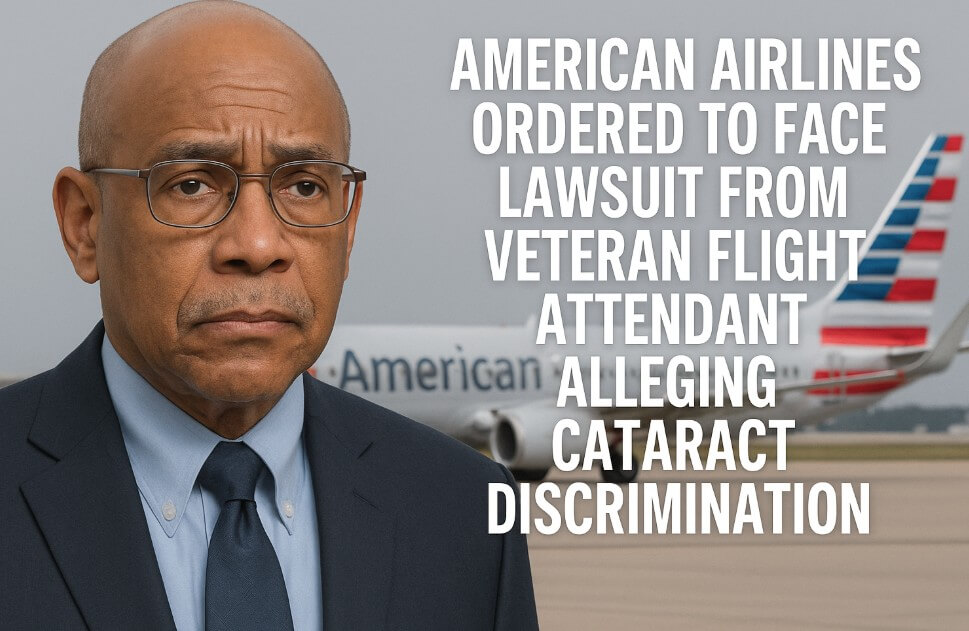
Judge Declines to Dismiss Case, Allowing Full Litigation to Proceed
FORT WORTH — American Airlines is set to defend itself in federal court after a judge refused to dismiss a lawsuit filed by a longtime flight attendant who claims he was wrongfully terminated following a cataract diagnosis. The ruling ensures the case will move into full litigation, extending the airline’s growing legal exposure over disability-related employment practices.
A 20-Year Employee Claims Declining Vision Triggered Harsh Treatment
The plaintiff, Melba Hudson, spent more than two decades with American Airlines, beginning as a ticket agent before moving to the cabin crew in 2000 at Chicago O’Hare. According to the complaint, Hudson developed cataracts shortly after transferring to the Philadelphia base, experiencing increasing difficulty performing his duties. The condition made direct sunlight painful; during one flight he asked passengers to lower their window shades after takeoff so he could work safely.
Hudson informed his supervisor that corrective surgery had been approved and described temporary limitations, noting that he “could see only the outlines of figures if sunlight streamed through aircraft windows.” After this disclosure, he alleges, management began treating him as a liability, issuing disciplinary write-ups for minor issues that he says would not have been enforced against younger and white coworkers.
Those write-ups included an alleged operational delay and other performance critiques that eventually resulted in his termination on December 3. The Association of Professional Flight Attendants challenged the dismissal, pursuing every step of the internal grievance system. When those efforts failed, Hudson filed suit.
Claims of Discrimination and Retaliation
Hudson submitted his lawsuit in July 2025 in Chicago federal court after receiving authorization from the Equal Employment Opportunity Commission. He is alleging disability discrimination, race discrimination, age discrimination, and retaliation. His lawsuit seeks reinstatement with full seniority, back pay, and punitive damages. According to the filing, Hudson argues that American Airlines altered its treatment of him only after learning of his cataracts and medical plans.
A central element of the case involves the Rehabilitation Act, which applies to employers receiving federal funding. Hudson contends that American Airlines falls under this law because it receives payments through the federal Essential Air Service program.
American Airlines countered by attempting to remove the disability claims, arguing that Hudson’s employment had no connection to the program. But U.S. District Judge Robert W. Gettleman ruled that Hudson’s statement regarding EAS funding was sufficient at this stage, denying the airline’s request for dismissal. The judge ordered American Airlines to file a formal response by December 29, reported by PYOK.
A Second Eyesight-Related Case Adds Pressure
The lawsuit is not the only vision-related dispute confronting American Airlines. The EEOC is simultaneously pursuing litigation on behalf of a reservations agent who became permanently cortically blind after a 2012 injury. The agency alleges she could have returned to work with screen-reader accommodations but was kept on medical leave because American Airlines reportedly said it had never employed a fully blind reservations agent. She remained on leave until the start of the COVID-19 pandemic, when the airline dismissed her.
After conciliation efforts failed, the EEOC brought the case to federal court, where it remains active.
Implications for Airline Employment Policies
While early motions to dismiss are standard in workplace litigation, the judge’s ruling signals that American Airlines will have to defend its actions in full rather than sidestep the claims. Judge Gettleman noted that Hudson may need to present additional evidence at later phases to confirm that the Rehabilitation Act applies, but the allegations were strong enough to proceed.
Together, the ongoing lawsuits could influence how airlines evaluate disability accommodations, particularly around visual impairments, and may prompt broader policy reviews across the industry.
Stay tuned with us. Further, follow us on social media for the latest updates.
