


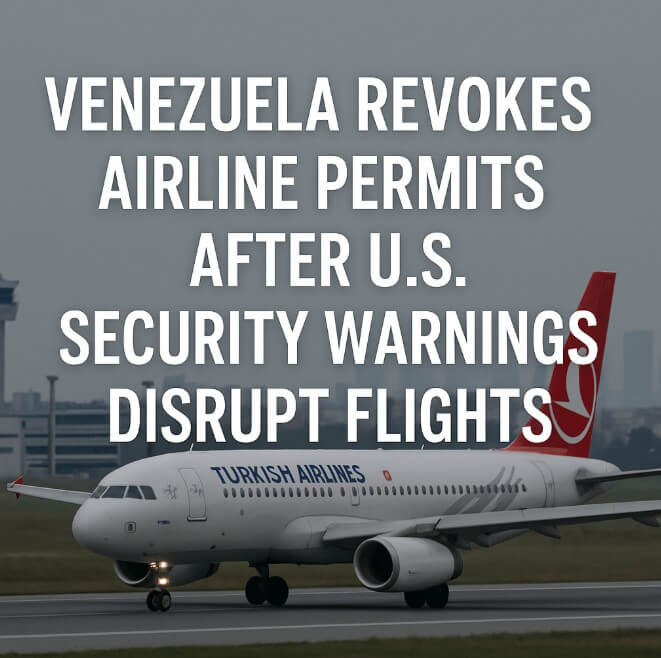
Airlines Pull Back After U.S. Alerts
CARACAS — Venezuela has revoked the flight permits of six major international airlines after the carriers suspended service to Caracas in response to U.S. warnings about increased military activity in the Caribbean. The decision cuts off a number of critical international routes and leaves thousands of passengers scrambling to adjust travel plans during a period of rising geopolitical tension.
Turkish Airlines (TK), Iberia (IB), TAP Air Portugal (TP), Avianca (AV), LATAM (LA), and GOL (G3) halted service to Simón Bolívar International Airport after the U.S. issued security alerts advising civilian aircraft to avoid Venezuelan airspace. When the airlines did not comply with a government order to resume operations, authorities moved to revoke their permits, escalating a standoff that has quickly spilled into the travel and tourism sector.
Caracas Accuses Airlines of Aligning With U.S. Policy
Venezuela’s civil aviation authority announced the penalties in a message posted to Instagram, accusing the carriers of siding with Washington. The airlines were being sanctioned, the agency said, for “joining the actions of state terrorism promoted by the United States government and unilaterally suspending commercial air operations.”
The U.S. alert followed a significant military buildup in the Caribbean that included an aircraft carrier strike group, stealth aircraft, and multiple Navy warships. Washington has said the deployment is part of an anti-drug trafficking effort. President Nicolás Maduro has countered that the move is intended to destabilize or overthrow his government.
FAA Issues Caution as Airlines Reassess Safety
The Federal Aviation Administration deepened airline concerns when it advised civilian aircraft to “exercise caution” over Venezuela due to “worsening security conditions and increased military activity.” This advisory prompted many carriers to suspend or reroute flights to avoid the region.
Turkish Airlines canceled its Caracas service from November 24 to 28 while maintaining flights to Havana. Impacted passengers were rerouted through Bogota, Panama City, Cancun, Mexico City, or Havana. According to Türkiye Today, more than 8,000 travelers have been affected across over 40 flights, citing data from the Venezuelan Association of Travel and Tourism Agencies.
Government Ultimatum and Permit Revocations
Hoping to force the carriers to resume flights, the Ministry of Transport issued a 48-hour ultimatum during a meeting with airline representatives. Officials warned that any airline failing to recommence operations within the designated window would lose its permit.
The deadline expired at noon Wednesday with all six airlines maintaining their suspensions. Authorities responded by immediately revoking each carrier’s operating permission. Officials noted that no airline would be reinstated until it resumed the suspended flights, but did not acknowledge the U.S. guidance as the basis for the service disruptions.
Diplomatic Relations Continue to Deteriorate
The dispute marks the most recent escalation in a steadily worsening relationship between the United States and Venezuela. President Donald Trump authorized the Caribbean military deployment in August, linking the operation to narcotics interdiction and trafficking networks allegedly connected to Maduro’s administration. Venezuela rejected the allegations, calling them fabrication designed to justify regime change.
Since September, the U.S. military has carried out 21 strikes on vessels it identified as drug-trafficking operatives, killing 83 individuals. Critics have said the actions lack legal justification, even as the Trump administration signaled that alleged drug-trafficking sites inside Venezuela could become direct military targets.
Venezuela’s defense minister, Vladimir Padrino López, issued a harsh denunciation, calling the United States “one of the most destructive empires in human history” and warning that the country would respond if threatened.
Travelers Face Growing Disruptions
With multiple major airlines suspended from the Venezuelan market, passengers across Latin America are facing cascading travel disruptions. Refund requests and rebooking demands have surged, overwhelming regional travel agencies and complicating holiday travel planning.
Aviation analysts warn that instability in regional airspace could continue if political tensions remain high, limiting connectivity and potentially discouraging carriers from reentering the market even if permissions are later reinstated.
For now, travelers, airlines, and tourism operators remain caught in the middle of a geopolitical confrontation with no clear timeline for resolution.
