


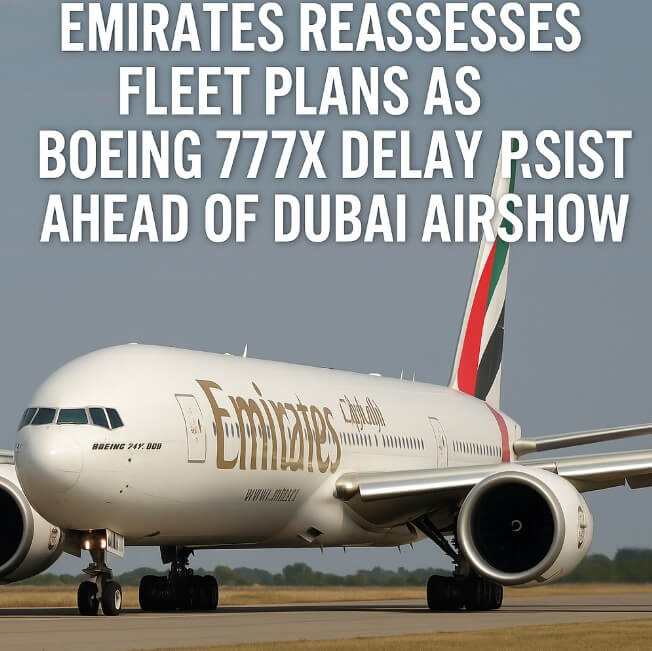
DUBAI — With the Dubai Airshow fast approaching, Emirates Airline finds itself at a critical juncture as continued delays to Boeing’s 777X program force the carrier to reconsider its long-term fleet strategy. The airline, long known for its blockbuster aircraft orders, faces mounting uncertainty as production bottlenecks at both Boeing and Airbus extend delivery schedules into the next decade.
Emirates President Tim Clark confirmed that executives from both manufacturers have been in Dubai ahead of the airshow, which opens November 17 at Al Maktoum International Airport (DWC), working to finalize potential deals. “Both manufacturers are under pressure to deliver,” Clark said, noting that delivery slots for new wide-body aircraft are largely sold out until at least 2033.
For decades, Emirates has used the biennial airshow as a global stage to announce major aircraft purchases. This year, however, discussions are constrained by industry-wide supply chain challenges and certification delays. Despite these headwinds, Clark said Emirates is keeping pressure on both Airbus and Boeing to meet its needs and offer competitive terms.
Boeing’s 777X Woes Test Emirates’ Patience
The setbacks surrounding Boeing’s new 777X aircraft are central to Emirates’ fleet dilemma. The Dubai-based carrier is the program’s largest customer, with 205 aircraft on order—170 of the 777-9 model and 35 of the smaller 777-8. Initially slated for delivery in 2020, the first aircraft are now not expected until 2027, with no firm quarter yet committed.
Clark said the repeated schedule slippages have forced Emirates to adjust its route expansion and capacity plans. “The timeline remains unclear,” he noted, adding that the airline had prepared interiors and cabin fittings in anticipation of deliveries that never arrived. The 777X is intended to replace Emirates’ aging 777s and complement its A380 fleet, production of which Airbus ended in 2021.
To bridge the gap, Emirates has launched a $5 billion retrofit program to extend the life of its existing aircraft. The carrier is also set to introduce 65 Airbus A350-900s, with 13 expected to enter service in the near term. Clark described the A350s as a “temporary measure” to sustain capacity until the 777X finally arrives.
Boeing’s Recovery and the Wider Industry Picture
For Boeing, the 777X delays represent another challenge in a period marked by financial and operational strain. The company recently took a $4.9 billion charge related to the program’s setbacks and ongoing certification hurdles. Clark expressed measured optimism about Boeing’s leadership under CEO Kelly Ortberg and Commercial Airplanes chief Stephanie Pope. He praised their efforts as “Herculean,” but cautioned that full recovery may take years. “It could take until 2030 for Boeing to fully recover its production reliability and reputation,” he said.
While Emirates’ management remains patient, Clark emphasized that the airline’s focus is on receiving aircraft rather than pursuing financial compensation. “Our priority is to get the airplanes, not the damages,” he stated, though he acknowledged that discussions about penalties will occur in due course.
The A380’s Future and Calls for Innovation
The Airbus A380 continues to anchor Emirates’ long-haul network, with plans to keep the superjumbo in operation until at least 2040. Still, Clark has urged manufacturers to consider developing a new large-capacity aircraft to address airport congestion and growing global travel demand. Both Airbus and Boeing have been hesitant to invest in another very-large aircraft, citing the commercial risks after tepid sales of the A380 and 747-8.
Clark voiced frustration at what he sees as a lack of ambition in the aviation industry. He criticized manufacturers’ increasing risk aversion, attributing it to “economic shocks and global instability over the past 20 years” that have made both sides wary of bold new designs.
A Master Negotiator at Work
Behind the scenes, Clark continues to play his trademark role as one of aviation’s toughest negotiators. Known for his precision and depth of knowledge, he describes the negotiation process as a balancing act that “requires deep understanding, quick thinking, and fairness.” His method has helped Emirates secure favorable pricing and influence aircraft design features—most notably in customizing the A380’s interiors.
Clark acknowledged that Airbus, in particular, is “the toughest to negotiate with,” but said that the challenges often lead to “better results and stronger partnerships.” His direct and pragmatic style, he added, helps “cut through unnecessary formalities” and accelerate dealmaking.
Looking Ahead
As the Dubai Airshow opens, Emirates faces a complex mix of opportunity and constraint. The airline is eager to expand its fleet and routes, but must navigate an industry still recovering from supply chain disruptions and shifting economic realities. For Boeing, the stakes are high as it works to regain Emirates’ full confidence and bring the 777X to market after years of delays.
While Emirates remains loyal to both major manufacturers, its strategy now hinges on timing, trust, and the industry’s capacity to deliver on its promises. Whether the airshow brings fresh announcements or simply renewed commitments, one thing is clear: Emirates intends to keep both Airbus and Boeing under pressure—until every promised jet is on the runway.
