


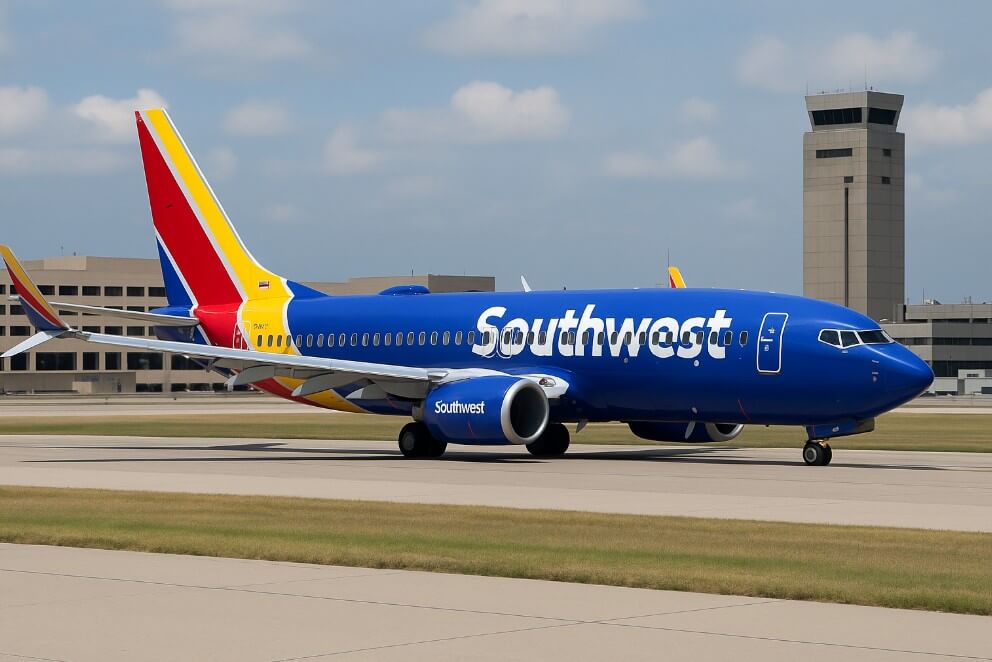
DALLAS — Southwest Airlines Co. (NYSE: LUV) is moving through one of the fastest and most consequential transformations in its history as the Dallas-based carrier confronts weakened employee morale, persistent investor scrutiny, and the need to adapt to a changing travel market.
Chief Operating Officer Andrew Watterson acknowledged in an interview with Airlines Confidential that morale at Southwest’s headquarters hit a low point between February and June 2024, though optimism has since returned. “Morale at Southwest’s headquarters hit a low between February and June 2024,” Watterson said, noting that confidence has improved as the company prepares to unveil its “new positioning” in 2025.
A New Phase for a Legacy Airline
The shift underway at Southwest represents a marked break from its long-standing approach. For more than a decade, the airline was known for prioritizing customer-friendly policies — no bag fees, no seat charges, and flexible flight credits — even when profitability lagged. Watterson indicated that era is ending, describing the current strategy as a move from “unique policies” toward “unique service.”
Southwest plans to emphasize hospitality and experience over blanket perks, investing in upgraded in-flight Wi-Fi, improved coffee offerings, and a phased rollout of assigned seating. Executives believe the effort is already showing progress, pointing to a rebound in the airline’s net promoter score and a gradual recovery in staff morale.
Behind the scenes, however, pressure from activist investors, particularly Elliott Management, has forced leadership to accelerate changes that were originally planned over several years. The investor’s growing influence has reshaped both the pace and scope of Southwest’s overhaul.
Market Realities Drive Change
Southwest’s strength before the pandemic stemmed from its flexibility and appeal to business travelers, who once represented nearly 40 percent of its passengers. That base has since eroded as corporate travel budgets shrank and remote work reduced frequent trips. With fewer high-yield travelers, Southwest has had to compete more aggressively for leisure customers — a market where price sensitivity dominates.
In response, the airline has begun unbundling fares, introducing paid seating options, and reevaluating its once-sacred free bag policy. According to Watterson, internal data and third-party analytics revealed that the “two bags free” message was no longer a significant draw. He said Google Flights data showed “no increase in click-through rates despite the visible ‘two bags free’ tag,” clearing the way for bag fees once deemed unthinkable for the brand.
Competing in the Online Travel Era
Another catalyst for change lies in how travelers now book flights. Southwest long resisted listing fares on third-party platforms, relying heavily on direct bookings through its website. But that strategy disadvantaged the airline in smaller markets where consumers often shop on aggregators like Expedia.
As the company expanded into major hubs such as Denver (DEN), Phoenix (PHX), and Chicago Midway (MDW), exposure to online comparisons revealed that Southwest’s all-inclusive pricing made it appear more expensive than competitors offering stripped-down “basic economy” fares. The carrier’s pivot toward fare unbundling is designed to correct that perception and improve competitiveness in digital marketplaces.
Regulatory changes have also played a role. U.S. regulators ultimately dropped a proposed rule requiring airlines to display all-in fare pricing, removing a visibility advantage Southwest once enjoyed in online searches.
Lounges, Credit Cards, and the Premium Push
Southwest’s evolution is reaching into new territory — airport lounges and premium customer experiences. Historically, lounges were irrelevant to its customer base, but they’ve become increasingly important for maintaining lucrative credit card partnerships. Watterson confirmed internal discussions with Chase about potential lounge developments, starting with Honolulu (HNL), where the airline already holds a lease.
“Today’s lounge users are not just business-class flyers but frequent economy travelers with co-branded cards,” Watterson said, signaling the company’s intent to strengthen its premium positioning and appeal to loyal cardholders.
Looking Ahead
As the airline prepares for 2025, Watterson described Southwest as entering “the next phase” of its transformation — one that could include adding new aircraft types for longer routes, experimenting with first-class seating, and diversifying fare products.
For decades, Southwest’s simplicity — a single aircraft type and straightforward service model — defined its brand. Now, that simplicity risks limiting growth. The challenge ahead lies in modernizing without abandoning the identity that made the airline distinctive.
Southwest’s rapid transformation underscores an industry in flux, shaped by evolving travel patterns, investor expectations, and competitive realities. Whether the airline can balance its heritage of friendliness with a new era of financial discipline will determine its next chapter.
