


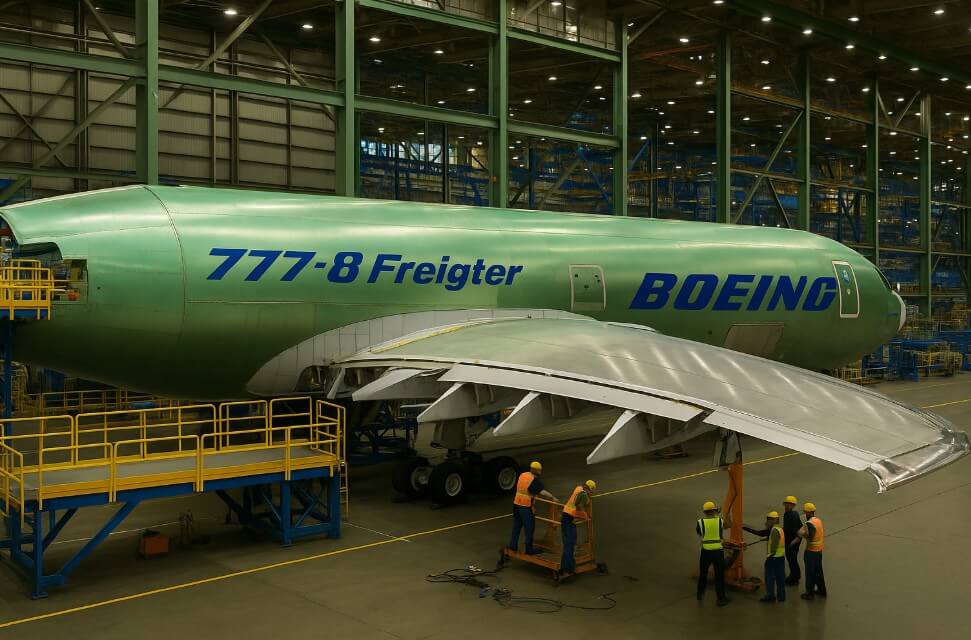
EVERETT, Wash. — Boeing Commercial Airplanes has begun assembling the wings for the first Boeing 777-8 Freighter, marking a pivotal step toward introducing what will become the world’s largest and most capable twin-engine cargo aircraft. The milestone underscores the aerospace giant’s renewed momentum in its widebody production program and highlights the company’s precision-driven approach to aircraft manufacturing at its Everett, Washington, facility.
The new aircraft, part of Boeing’s next-generation 777X family, is engineered to set fresh standards for efficiency and performance in air cargo transport. With a structural payload exceeding 118 tonnes and a range of more than 4,400 nautical miles, the 777-8 Freighter promises to reshape global freight operations by combining long-haul reach with lower emissions and improved economics.
Precision Manufacturing at Boeing Everett
Wing assembly is one of the most complex stages of aircraft production, requiring intricate coordination across teams of engineers and mechanics. Each 777-8F wing consists of 45 ribs, two spars, and two composite panels that stretch more than 100 feet in length. The work is carried out on Boeing’s High Bay Line (HBL), where specialists like mechanic Travis Haegele lead crews in aligning and securing massive structural components with millimeter precision.
According to Boeing Commercial Airplanes President and CEO Stephanie Pope, the progress reflects Boeing’s deep manufacturing expertise and focus on innovation. “The start of wing assembly reflects the company’s long-standing expertise in aircraft manufacturing and its commitment to innovation in commercial aviation,” Pope said in a post shared on LinkedIn.
A New Era for Air Cargo
Once completed, the 777-8 Freighter is expected to deliver unmatched efficiency to global cargo operators. Building on the success of the existing 777 Freighter, the new model incorporates advanced aerodynamics, composite structures, and systems innovations first introduced on the 777X passenger jets. Boeing says these features will help airlines reduce fuel consumption and emissions while maximizing revenue payload.
The aircraft’s capabilities come at a time when global cargo demand is surging. Boeing projects a 70% increase in worldwide air freight traffic over the next two decades, driven largely by e-commerce and express delivery growth. The 777-8F’s combination of range and payload positions it to serve major cargo hubs such as Doha (DOH), Dubai (DXB), and Hong Kong (HKG), where carriers are expanding long-haul networks to meet demand.
Engineering for Efficiency and Sustainability
Boeing has outlined key specifications that distinguish the 777-8F within the freighter market. The aircraft’s gross structural payload reaches 118.2 tonnes, with a revenue payload of 112.3 tonnes. Measuring 232 feet 6 inches in length and with an extended wingspan of 235 feet 5 inches, the aircraft can fly up to 4,410 nautical miles, offering airlines exceptional reach and flexibility.
Designed on the same platform as the passenger 777X, the freighter incorporates advanced materials and folding wingtips that improve aerodynamic performance. Boeing notes that the result is lower fuel burn, reduced emissions per tonne of cargo, and what it claims will be the lowest operating cost per tonne-kilometer in the industry.
Expanding Boeing’s Cargo Portfolio
The 777-8 Freighter will join Boeing’s comprehensive lineup of dedicated cargo aircraft, which includes the long-range 777F, the high-capacity 747-8F, the mid-size 767-300F, and the 737-800BCF for regional routes. Each model serves a distinct market niche, allowing Boeing to offer a full spectrum of solutions for carriers balancing route length, payload, and operational economics.
The 747-8F remains the company’s specialist for heavy and oversized freight, while the 777F and upcoming 777-8F cater to premium, long-haul cargo operations. The 767-300F and 737-800BCF continue to dominate short- and medium-haul markets, supporting regional and standard-body demand. Together, these aircraft reflect Boeing’s strategy to maintain leadership in a sector where capacity, fuel efficiency, and reliability are paramount.
A Milestone During Manufacturing Month
Boeing’s announcement coincides with Manufacturing Month, offering a symbolic moment to recognize the contributions of its production teams. The 777-8 Freighter program, the company says, represents not just a technical achievement but also a testament to the skill and dedication of the thousands of employees shaping the next generation of global cargo transport.
As the first wings take shape in Everett, Boeing’s engineers and mechanics are laying the foundation for what could become a defining aircraft in the modern cargo fleet—one designed to balance performance, sustainability, and profitability in an era of growing global logistics demand.
