


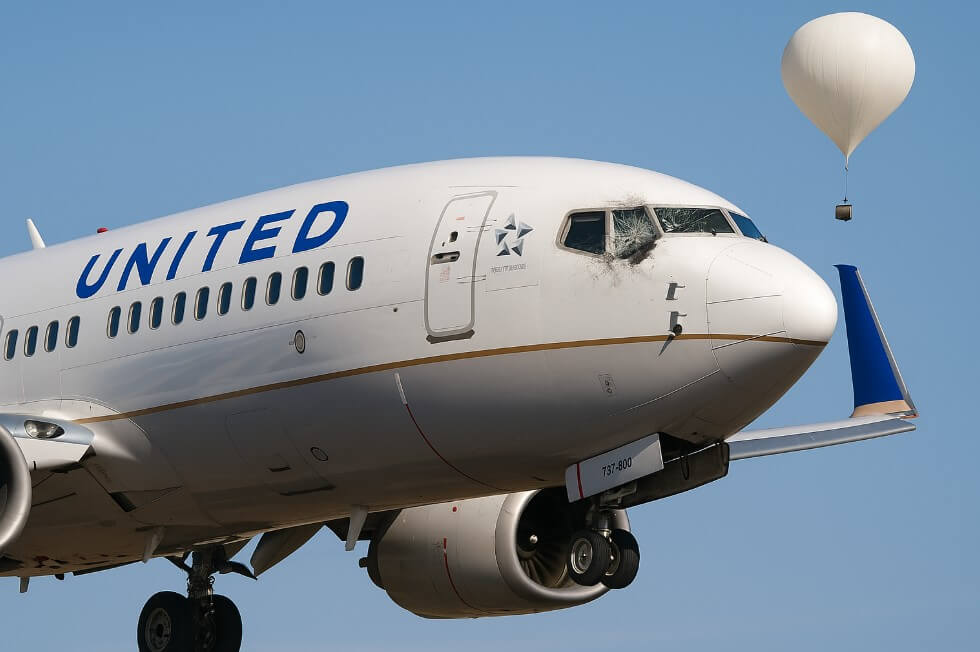
CHICAGO — Federal investigators are examining how a high-altitude weather balloon operated by WindBorne Systems may have struck a United Airlines Boeing 737 MAX, shattering a cockpit window and injuring the pilot mid-flight last week.
United Airlines flight UA1093, en route from Denver (DEN) to Los Angeles (LAX) on October 16, was forced to divert to Salt Lake City (SLC) after the cockpit windshield fractured at 36,000 feet. The Captain sustained minor arm injuries from flying glass but managed to safely land the aircraft.
WindBorne Systems’ co-founder and CEO, John Dean, confirmed late Monday that one of the company’s research balloons was “likely involved” in the incident. “The system is built to avoid posing a danger to human life. No depressurization occurred, and there were no severe injuries, which aligns with FAA and ICAO safety standards,” Dean said.
Federal Investigation Underway
The Federal Aviation Administration (FAA) and National Transportation Safety Board (NTSB) have launched a joint investigation to determine how the unmanned weather balloon entered the commercial jet’s flight path. The agencies are reviewing radar data, flight logs, and WindBorne’s operational records under FAA Part 101 regulations, which govern unmanned free balloons.
Dean said the company learned of the incident Sunday night and immediately began cooperating with authorities. “We are working closely with the FAA and NTSB to confirm the cause,” he said.
What Happened Over Utah
According to preliminary reports, UA1093 was cruising above central Utah when the crew spotted an unidentified object approaching the aircraft. The object struck the upper corner of the First Officer’s windscreen, shattering both the inner and outer glass layers.
Fragments of glass sprayed into the cockpit, injuring the Captain’s arm. Despite the damage, the pilots maintained control, descended to a safer altitude, and diverted to Salt Lake City International Airport. Passengers were later transferred to another aircraft to continue to Los Angeles.
Early speculation pointed to space debris or an untracked drone. Investigators soon ruled those out after WindBorne’s telemetry data showed one of its balloons in the vicinity at the same altitude.
WindBorne’s Safety Measures
WindBorne Systems operates a global network of long-duration, lightweight balloons that gather atmospheric data to improve weather forecasting. Dean explained that the company routinely files Notices to Air Missions (NOTAMs) and adheres to FAA 14 CFR Part 101 limits on payload weight and altitude coordination.
Dean emphasized that WindBorne’s systems are designed to minimize risk even in rare cases of collision. “The system is built to avoid posing a danger to human life. No depressurization occurred, and there were no severe injuries, which aligns with FAA and ICAO safety standards,” he reiterated.
Following the incident, WindBorne has accelerated plans to enhance safety. “The windshield damage is extremely concerning,” Dean said. “We are taking immediate action to prevent future incidents.”
He added that the company has deployed new hardware that is half the weight of earlier models and is developing designs to further reduce collision impact. A recent software update also limits the time balloons spend within commercial flight corridors.
Aviation Safety Context
Though rare, mid-air damage from external objects is not unprecedented. In 2018, a Sichuan Airlines Airbus A319 suffered a full windshield blowout at 31,000 feet, forcing an emergency landing. In 1990, a British Airways Captain was partially ejected through a missing cockpit window when a panel detached mid-flight, though the crew saved both the pilot and the aircraft.
These incidents underscore the ongoing need for rigorous safety standards — not only for aircraft design but also for coordination between aviation and scientific operators using shared airspace.
Industry experts say the FAA may now reexamine how unmanned atmospheric research devices are tracked, particularly as balloon-based technologies become more common for climate and communications research.
Looking Ahead
Dean reiterated WindBorne’s commitment to safety and transparency as investigations continue. “We take this very seriously,” he said. “Our mission is to advance atmospheric science without compromising air safety.”
Federal investigators have not yet released an official cause but are expected to issue preliminary findings in the coming weeks. United Airlines has confirmed that the aircraft is undergoing repairs and that no passengers were seriously injured.
As scrutiny intensifies over the safety of high-altitude research systems, the incident may prompt broader industry discussions on how to balance innovation with the realities of crowded skies.
