


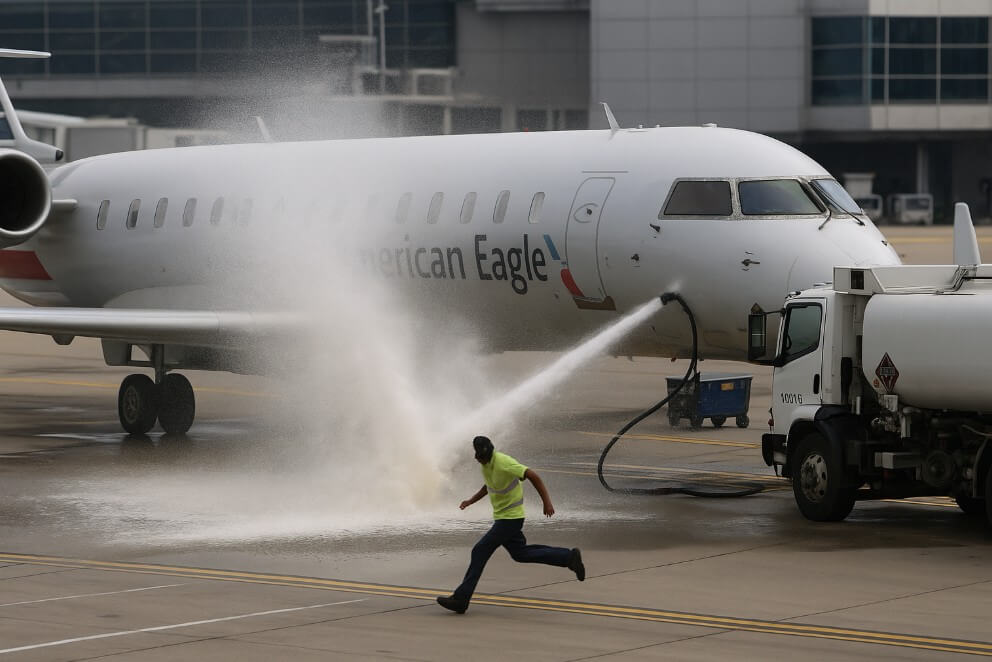
Dallas, Texas — Passengers on an American Eagle regional jet escaped a potentially catastrophic situation late Monday night at Dallas Fort Worth International Airport (DFW) when a ground worker lost control of a refueling hose, sending jet fuel spraying across the aircraft and tarmac in a chaotic scene captured on video.
The dramatic incident, which unfolded during refueling operations for a late-night American Airlines Eagle (AA) flight, has since gone viral on social media. The footage shows the moment highly flammable jet fuel burst from the hose, shocking viewers and raising new concerns about ground safety at one of the world’s busiest airports.
Fuel Spill Sparks Chaos on the Ramp
According to witnesses, the mishap occurred as a ground worker was completing the refueling process for a Bombardier CRJ-900, registered as N593NN. The aircraft, which has been in service with American Eagle since May 2016, was preparing for departure when the worker attempted to disconnect the hose from the plane’s underbelly.
However, the hose was still under pressure. “The worker appeared unaware that fuel was still flowing,” one ramp agent familiar with the video told reporters. As the hose detached, it whipped violently, spraying fuel in a powerful arc across the aircraft, nearby ground equipment, and parts of the ramp area.
The worker, visibly doused in fuel, stumbled backward but managed to regain control and reach the refueling truck, where he quickly shut off the pump — an action experts say likely prevented a fire or explosion.
Multiple videos from airport surveillance and passenger cell phones show the spray lasting several seconds before the flow was halted. The clips have been shared widely online, drawing alarm from aviation workers and passengers alike. “Videos of the incident have gone viral, showing the moment highly flammable fuel burst from the hose, leaving viewers stunned by the near-miss at one of the world’s busiest airports,” the airline said in a statement.
Ground Crew Reaction and Early Investigation
As images of the spill circulated, ramp agents and ground crew members across the U.S. began weighing in, offering theories about what went wrong. Many aviation workers suggested the problem may have stemmed from equipment failure rather than human error.
“Ramp agents across the U.S. have weighed in on the footage, with many suggesting the accident likely stemmed from a mechanical fault—such as a damaged hose or faulty pump—rather than human error,” the report said.
Observers noted that the speed and force of the fuel spray appeared consistent with a pressure malfunction in the fueling system. Early indications point toward a possible mechanical issue that allowed fuel to continue flowing even as the hose was being detached.
Investigators have yet to confirm an exact cause, and American Airlines has not released details on whether refueling operations were briefly suspended in the affected area. Airport fire services responded swiftly but reported no injuries and no fire resulting from the spill.
While investigations continue, safety experts say the incident serves as a reminder of how quickly things can escalate on the ramp. “The worker’s quick response in shutting off the pump likely prevented a serious fire or explosion,” an aviation safety analyst said. “Fuel handling is one of the most dangerous operations in aviation because there’s no room for error.”
Industry Context and Similar Incidents
Although such accidents are rare, refueling mishaps do occur occasionally at major airports. Nearly a year ago, a Eurowings flight at Düsseldorf Airport (DUS) faced a similar emergency when a refueling truck struck a bollard, puncturing the tanker and spilling jet fuel across the ramp. That situation was swiftly contained by airport fire services using absorbent pads and safety barriers.
Aviation fuel is handled under strict safety regulations due to its volatility and the high pressures involved in pumping. Even minor equipment malfunctions can lead to serious hazards if not detected early. Incidents like the one at DFW underscore the importance of continuous maintenance, equipment testing, and rigorous procedural oversight for ground crews.
Experts note that while technology has reduced the frequency of fueling-related accidents, the industry continues to emphasize human vigilance and procedural compliance as critical safeguards.
“Incidents like these underscore the importance of rigorous ground safety checks and equipment maintenance,” the American Airlines report said. “Aviation fuel handling involves high pressure and flammable materials, leaving zero margin for error. Even minor technical faults can escalate rapidly if not identified in time.”
Airport authorities and the airline have not provided a timeline for the completion of the investigation, but officials confirmed that the aircraft has been taken out of service pending inspection.
For now, passengers and employees are crediting quick thinking and safety training for averting what could have been a far worse outcome.
