


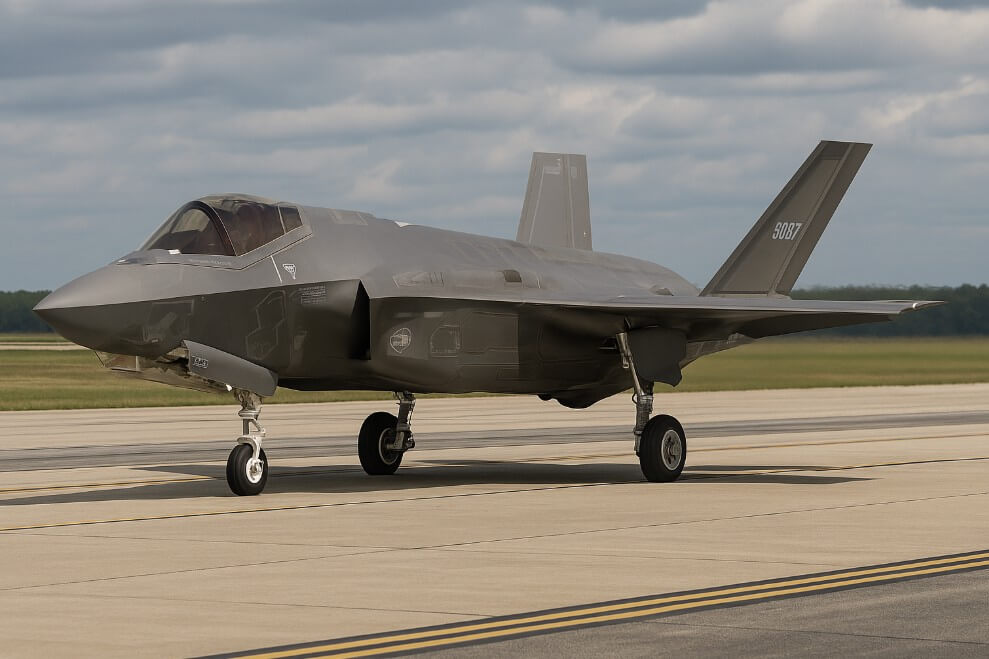
MARYLAND — The world’s most expensive fighter jet program is again confronting delays. Pratt & Whitney, the Raytheon subsidiary responsible for building the F135 engines that power all variants of Lockheed Martin’s F-35 Lightning II, will postpone delivery of its next production lots by roughly six months, pushing the timeline from fall 2025 to spring 2026.
The setback follows only weeks after the U.S. Department of Defense finalized a $24 billion agreement with Lockheed Martin for two additional lots of the advanced stealth aircraft. The delay underscores persistent challenges in a program that has drawn both global demand and recurring scrutiny for schedule slippages and escalating costs.
Delivery Delayed, Questions Unanswered
Pratt & Whitney’s F135 afterburning turbofan produces up to 43,000 pounds of thrust and is the sole powerplant for all three versions of the F-35 — the Air Force’s conventional-takeoff F-35A, the Marine Corps’ short-takeoff-vertical-landing F-35B, and the Navy’s carrier-based F-35C.
The company and the Pentagon have offered no public explanation for the revised production schedule. The lack of transparency has fueled concern among defense analysts and lawmakers who have long criticized the Joint Strike Fighter program for cost overruns, maintenance hurdles, and slow delivery rates.
The adjustment could ripple through operational units such as Hill Air Force Base in Utah, home to the 421st Fighter Squadron, which flies the F-35A. While the current fleet remains active, any slowdown in engine deliveries may constrain expansion plans and depot maintenance schedules for both U.S. and allied forces.
A spokesperson for the Joint Program Office confirmed to Air and Space Forces Magazine, “We plan to definitize Lot 18 and award the Lot 19 contract for engines in spring 2026.” Earlier this year, officials had anticipated a “handshake deal” on the engine production contracts by year-end.
A Program Built on Commonality
The F-35 program’s core advantage lies in its shared platform. Operating a common fifth-generation airframe allows the United States and 19 partner nations to coordinate more effectively across missions, maintenance, and training.
Despite ongoing controversy over procurement costs, supporters point to the aircraft’s advanced capabilities—low observability, sensor fusion, and secure data-sharing—as critical assets for modern warfare. The interoperability provided by a unified fleet simplifies logistics and enhances coalition readiness, a factor increasingly vital as global security dynamics shift.
The F-35’s networked architecture enables joint mission planning and real-time threat sharing across the NATO alliance and other partners, creating what defense strategists call a “combat multiplier.” That capability is viewed as essential in contested regions such as the Indo-Pacific, where the aircraft’s reach and stealth provide deterrent power amid rising tensions with China.
While Russia’s Su-57 and China’s J-20 fighters aim to compete technologically, both programs remain limited in scale and operational maturity. In contrast, Lockheed Martin’s expanding F-35 fleet—supported by the industrial base of multiple allied nations—continues to represent the centerpiece of Western air superiority.
Mounting Pressure on the Supply Chain
The latest production slip adds to pressure on the F-35’s sprawling supply chain, already strained by post-pandemic material shortages and integration challenges among subcontractors. Each delay compounds the risk of further cost growth, forcing the Pentagon to balance near-term readiness with long-term modernization goals.
Defense analysts note that even minor setbacks can cascade through the program’s global ecosystem, affecting training pipelines, maintenance throughput, and allied delivery schedules. For Lockheed Martin, maintaining credibility with partner governments has become as critical as meeting technical milestones.
Strategic Importance Remains Intact
Despite its troubles, few doubt the strategic weight of the F-35 enterprise. The jet remains the most advanced multirole fighter in production, combining stealth and data-centric warfare in a single platform adaptable to multiple missions.
For the United States and its allies, the program’s value lies not only in cutting-edge technology but in the scale of collaboration it enables. Shared maintenance hubs, standardized software, and common pilot training make the fleet a linchpin of future coalition air operations.
The delay in F135 engine deliveries to spring 2026 thus serves less as a technological setback than as a reminder of the program’s complexity. Managing the world’s largest fighter-aircraft production network—spanning hundreds of suppliers across multiple continents—continues to test even the most seasoned defense contractors.
As the Pentagon and industry partners work to finalize the next engine contracts, the F-35 remains central to U.S. and allied airpower strategy. Its promise of interoperability and global reach still defines the future of Western air dominance—even if that future will now arrive a few months later than planned.
