


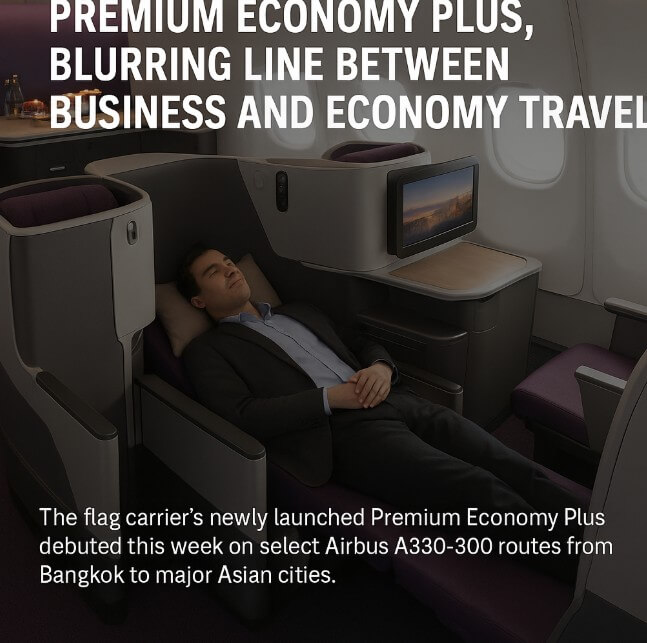
BANGKOK — Thai Airways has introduced a new cabin class designed to redefine the middle ground between traditional economy and business travel. The flag carrier’s newly launched Premium Economy Plus debuted this week on select Airbus A330-300 routes from Bangkok (BKK) to major Asian cities, marking what industry observers say could be the first split within the premium economy segment itself.
The new product, featuring lie-flat seats arranged in a herringbone configuration, occupies a unique position in the market. It offers more comfort than standard premium economy but stops short of full business class service. The move, insiders say, reflects the growing demand among corporate travelers for flat-bed comfort within company policy limits that often prohibit business-class bookings.
According to Live and Let’s Fly, Thai Airways announced the cabin through its official Facebook page, showcasing its expanded seating and amenities. The airline described Premium Economy Plus as a “bridge between classes,” highlighting spacious seats, increased privacy, and an exclusive forward cabin lounge.
A Step Toward Hybrid Comfort
The introduction comes as Thai Airways continues to rebuild its network and brand following restructuring efforts in recent years. The new cabin takes advantage of aircraft leased from Virgin Atlantic, incorporating the British carrier’s former Upper Class seats into Thai Airways’ design language.
Passengers in Premium Economy Plus will enjoy lie-flat beds, each with direct aisle access and privacy dividers. The seats, measuring 38 inches in both pitch and width, represent a 50 percent increase in personal space compared to economy class. The recline extends to a fully horizontal position, catering to overnight travelers seeking restful long-haul experiences.
Meals are drawn from Thai Airways’ well-known culinary program, complemented by premium beverage offerings that include Thai-inspired cocktails. The cabin also features a compact lounge at the front, allowing passengers to stretch, enjoy snacks, or socialize mid-flight—a concept typically reserved for business-class flyers.
Additional touches include mood lighting designed around circadian rhythms, noise-canceling headphones, and high-speed Wi-Fi connectivity. Each seat is fitted with a 16-inch touchscreen loaded with recent movies and television series, reinforcing the carrier’s focus on comfort and entertainment.
Competitive Positioning and Global Context
The Premium Economy Plus concept reflects a growing trend toward tiered cabin segmentation among full-service airlines. Competitors such as Air New Zealand and Delta Air Lines have experimented with similar products—lie-flat seating at lower price points—under labels like “Business Lite” or “Basic Business.”
Delta’s “Basic Business” initiative, for example, pares down perks like lounge access while preserving the core benefit of a lie-flat seat. Likewise, American Airlines and Air France have tested premium upgrades at the front of their economy cabins, signaling the industry’s move toward more granular fare differentiation.
Virgin Atlantic, whose aircraft Thai Airways now leases, previously deployed these same herringbone seats on Boeing 787-9 routes between London Heathrow and Los Angeles. Reviewers at the time praised the layout for delivering “solid premium economy value despite business-class branding.”
JetBlue has also explored expanded “elite economy” sections, while carriers such as Singapore Airlines continue to maintain clear distinctions between their mid-tier and ultra-luxury offerings, including its renowned Suites class.
Rollout and Booking Information
For now, Thai Airways is limiting Premium Economy Plus to flights between Bangkok and key Indian destinations such as Delhi (DEL) and Mumbai (BOM). The use of leased A330-300 aircraft allows the airline to introduce the product quickly without large-scale fleet modifications. Bookings are already available via Thai Airways’ website and mobile app, though pricing and mileage redemption details under the Royal Orchid Plus program are still pending.
Star Alliance partners may soon integrate these fares into their mileage systems, enabling cross-airline benefits for frequent travelers. Thai Airways is also expected to offer standard premium cabin privileges—such as priority boarding and enhanced baggage allowance—once the product is fully integrated into its booking structure.
The launch, conducted quietly through social media rather than a major press event, has nonetheless sparked curiosity across aviation circles. Analysts suggest the understated debut may reflect Thai Airways’ cautious rollout strategy as it gauges market response.
Industry Implications
The unveiling of Premium Economy Plus may mark a pivotal moment for cabin segmentation in Asia. “This introduction marks the first known split within a premium economy cabin, potentially inspiring rivals to layer offerings further,” noted one aviation analyst.
By providing lie-flat comfort at a reduced premium, Thai Airways is catering to corporate clients balancing cost constraints with employee satisfaction. The product also offers a more attainable upgrade path for leisure travelers seeking elevated experiences without business-class fares.
As details continue to emerge, the airline is expected to evaluate passenger feedback and possibly expand Premium Economy Plus to other Asian routes in 2026. Industry observers believe this evolution could influence how airlines structure cabins going forward—making mid-tier travel more customizable than ever before.
With Premium Economy Plus, Thai Airways not only enhances its competitive edge but also signals a broader shift in how carriers define comfort, value, and flexibility for the modern traveler.
