


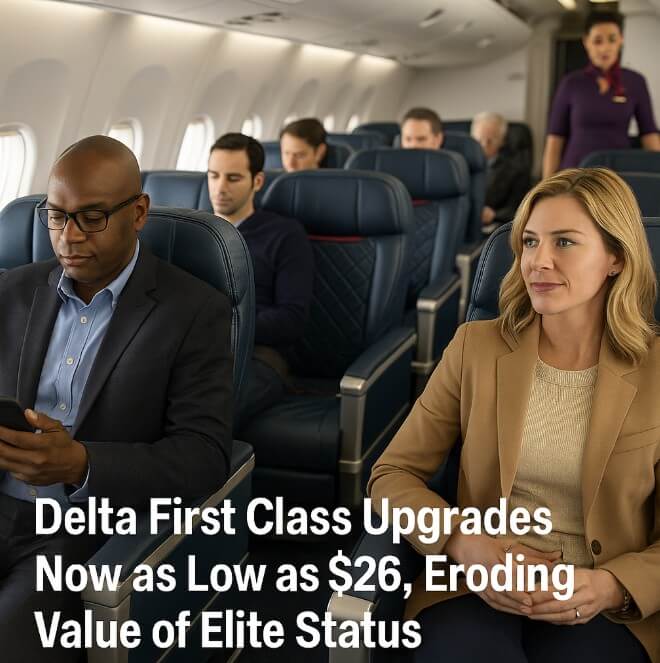
ATLANTA — Delta Air Lines is offering first class upgrades for as little as $26 on select routes, signaling a dramatic shift in how U.S. carriers monetize premium cabins and redefining the value of frequent flyer status.
Travelers departing from major hubs like Atlanta’s Hartsfield–Jackson International Airport have reported historically low upgrade prices, with some able to move from economy to first class for less than the cost of an economy seat assignment. The development highlights how aggressively Delta has pushed to convert once-complimentary perks into revenue streams.
“Twenty years ago, about 90% of Delta’s first class seats were filled by status-based complimentary upgrades. Today, only 13% are awarded this way, with the rest sold at prices ranging from tens of dollars to under $50,” according to aviation blog View From the Wing, which first reported on the trend.
The Decline of Free Upgrades
For decades, frequent flyer programs thrived on the promise of free upgrades for loyal travelers. Elite members who spent heavily with Delta, American Airlines, or United Airlines could reasonably expect to ride up front on many domestic flights. That system has now largely unraveled.
United pioneered low-cost domestic upgrades, while American later followed with its own aggressive pricing strategy. Delta, however, has gone furthest in reducing the role of complimentary upgrades, making discounted cash offers the default path to premium cabins.
The strategy has reshaped the economics of loyalty programs. Where once a traveler’s status might guarantee a higher likelihood of first class, today, a casual flyer may buy into the same seat for the price of a checked bag.
Why Travelers Are Taking the Deal
Despite the erosion of loyalty perks, the appeal of a $26 to $37 upgrade is hard to ignore. Even on short-haul flights, the benefits often outweigh similar economy add-ons.
Among the most attractive perks:
-
Free checked bags — which alone can exceed the cost of the upgrade.
-
Priority boarding — allowing access to scarce overhead bin space.
-
Wider seats and more legroom — a noticeable step up from economy or extra-legroom options.
-
Complimentary cocktails and enhanced service — amenities not available in standard coach.
By comparison, economy passengers might pay $20 just for a standard seat assignment or $40 for extra legroom without gaining the additional perks bundled with first class.
Impact on Loyalty and Spending
The flip side of low-cost upgrades is the diminishing value of elite loyalty. Business travelers who spend $20,000 to $30,000 annually with Delta may find their chances at complimentary upgrades dwindling, while leisure travelers who spend a fraction of that can buy their way into premium cabins.
Analysts note this shift has accelerated across all major U.S. carriers. “Elite status offers fewer tangible rewards, with early boarding, baggage, and upgrade perks all increasingly tied to direct purchase instead of loyalty,” one aviation industry observer noted.
The decline in traditional benefits has also influenced the onboard experience. With airlines collecting only an extra $26 to $40 per passenger for an upgrade, carriers have little incentive to invest heavily in catering or amenities. First class service, once a signature differentiator, has narrowed as airlines focus on maximizing revenue per seat.
The Bigger Picture: Revenue Over Loyalty
The trend is part of a larger industry-wide shift powered by artificial intelligence-driven revenue management, basic economy fares, and dynamic seat pricing. Airlines have learned that selling every seat — at almost any price — generates more predictable revenue than giving them away.
For Delta, American, and United, this new model represents the “good, better, best” structure that now dominates U.S. airline pricing. Complimentary perks are increasingly rare, replaced by a hierarchy of paid options designed to extract value from every traveler.
“Selling every seat at any price produces more revenue than giving them away to loyal customers,” View From the Wing reported.
As airlines continue to unbundle their products, some analysts expect first class itself may be further redefined. Complimentary checked bags, once considered standard for premium passengers, could eventually become another upsell.
Looking Ahead
For travelers, the message is clear: loyalty is no longer the key to the front of the plane. Instead, the question has become how little they are willing to pay for an upgrade.
For Delta and its peers, the strategy is working. Discounted upgrades generate incremental revenue and fill otherwise empty seats. But for frequent flyers who once valued status as a ticket to comfort, the trade-off is stark.
Elite status, once the cornerstone of airline loyalty, is now just another line item in an evolving business model where even first class can come at a bargain-bin price.
