


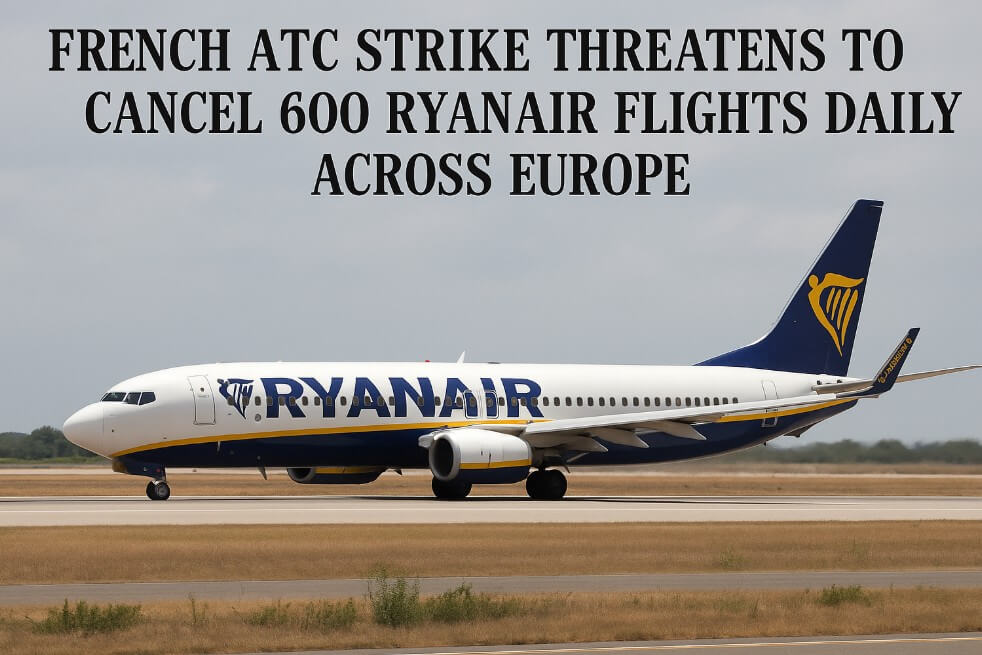
DUBLIN — Europe’s largest budget carrier, Ryanair, is warning of severe disruption across the continent as a planned French air traffic control (ATC) strike threatens to cancel up to 600 flights per day between October 7 and October 10. The airline estimates as many as 100,000 passengers daily could be stranded, with ripple effects across key hubs such as London Gatwick and Madrid.
The walkout, organized by the SNCTA, France’s main ATC union, is expected to sharply reduce capacity in French and western European airspace. While domestic services within France are protected by law, overflights — such as routes from London Heathrow to Madrid, Rome, and Athens — will bear the brunt of cancellations. Ryanair Chief Executive Michael O’Leary says the policy unfairly penalizes international travelers while shielding local routes.
“We cannot have a situation where we close that market every time the French go on strike,” O’Leary said in an online statement. He urged European Commission President Ursula von der Leyen to intervene, warning her leadership could be at stake if she fails to enforce protections for overflights.
Thousands of Flights in Jeopardy
According to Ryanair, the strike will run from the morning of October 7 until the night of October 9, extending into October 10. With roughly 900 Ryanair flights transiting French airspace daily, two-thirds may face cancellation. That means routes from the UK to popular Mediterranean destinations such as Spain, Italy, and Greece could be heavily disrupted.
Airlines are often given final cancellation orders only hours before scheduled departures, complicating both logistics and customer planning. Recent precedent underscores the stakes: on September 18, more than 190 Ryanair flights were delayed, leaving 35,000 passengers stranded, while a smaller strike last week grounded 30 Ryanair services.
O’Leary has called for Eurocontrol, the body that coordinates Europe’s ATC network, to reroute overflights during labor disputes. He argues that existing protections for French domestic traffic distort the EU’s single market, placing disproportionate pressure on foreign carriers.
Industry-Wide Fallout
The strike is not only Ryanair’s concern. EasyJet and British Airways have already issued warnings to passengers, urging them to monitor schedules closely. Airlines for Europe, the industry’s leading trade group, described the recurring stoppages as “intolerable,” particularly during peak travel seasons.
The strikes come on top of structural challenges already weighing on European aviation. Air traffic control centers continue to grapple with post-pandemic staffing shortages, technical outages, and restricted access to Ukrainian and Russian airspace due to the war. These pressures have tightened flight corridors, raising the likelihood of further congestion and delays.
Ryanair Rallies Support for Reform
Ryanair has spearheaded a campaign demanding EU-wide reform. The airline is calling for binding arbitration mechanisms for ATC disputes and legal protections to ensure overflights can continue during strikes, measures already in place in Spain, Italy, and Greece.
The company’s petition, “Protect Overflights: Keep EU Skies Open,” has gathered more than two million signatures from passengers who have faced disruptions. O’Leary has warned that without reform, French ATC strikes could recur weekly, crippling Europe’s interconnected aviation network.
Advice for Travelers
Budget travelers bound for destinations like Barcelona or Rome are expected to face the greatest difficulties, as overflights through France form the backbone of these routes. While Ryanair will provide rebooking or refunds under EU air passenger rights, the carrier advises passengers to rely on its mobile app for real-time updates.
Other carriers, including EasyJet and British Airways, are withholding detailed cancellation forecasts but have encouraged customers to check directly with airlines before traveling. Authorities are advising passengers to arrive early at French airports such as Paris Orly and Charles de Gaulle, and to avoid non-essential travel through French airspace during the strike period.
A Broader European Challenge
Labor disputes are only part of a wider crisis confronting the continent’s air travel industry. Staffing shortfalls, lingering pandemic effects, and geopolitical instability have combined to push delay risks 20% higher than in 2019, according to Eurocontrol estimates.
Carriers are taking steps to improve resilience. Ryanair is expanding bases outside France to bypass the country’s congested skies, while EasyJet is investing in more direct links between the UK and Mediterranean destinations.
For now, however, airlines and passengers alike remain at the mercy of political negotiations. O’Leary’s calls for intervention highlight the ongoing tension between protecting workers’ rights and safeguarding the seamless travel expectations of Europe’s borderless market.
