


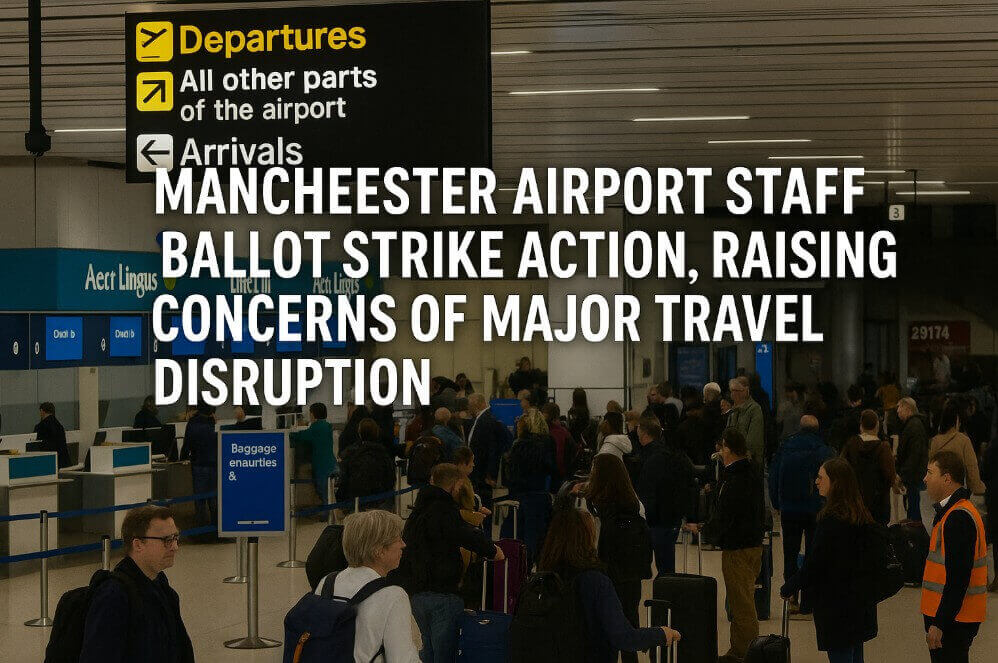
MANCHESTER — Manchester Airport could soon face significant disruption after staff at Terminal 2 began voting on whether to stage strike action in a pay dispute, raising the prospect of delays, cancellations, and knock-on effects across the aviation network.
The ballot, organized by Unite the Union, involves nearly 130 Aer Lingus UK employees responsible for check-in, boarding, and baggage handling at the terminal. While no strike dates have been set, airport authorities are warning passengers to monitor flight updates closely as the outcome of the vote is awaited.
Dispute Over Pay Could Escalate Into Walkouts
The workers involved are part of Aer Lingus UK’s ground operations team at Manchester. The dispute centers on pay, with union members voting on whether to authorize industrial action in the coming weeks.
“Almost 130 workers based at Terminal 2 are expected to take part if the strike goes ahead,” according to Unite. While that number may appear modest, analysts warn that concentrated staff losses in a single terminal could cause serious operational bottlenecks.
Terminal 2 is one of the busiest parts of the airport and handles a significant portion of Manchester’s passenger traffic. If employees down tools, the impact could quickly ripple across the wider airport network.
Potential Impact on Operations
If approved, strike action could severely slow check-in, boarding, and baggage handling, forcing airlines to push back departure times or cancel services altogether. The potential for disruption comes at a sensitive time: autumn half-term travel, a busy period for both leisure and business travelers.
“Even a short strike could mess up thousands of people’s travel plans,” one industry analyst noted, pointing to the timing as a key risk factor.
Disruption at Manchester would not only affect departing flights but also risk cascading delays across airline networks. Past strikes at major European hubs have shown how even localized industrial action can quickly spill over into widespread operational challenges.
Passengers Face Uncertainty
For passengers, uncertainty is already creating anxiety. Airport officials have warned that walkouts could cause long queues at check-in counters, slower security procedures, and boarding delays. Baggage operations could also be hit, leading to an increased risk of late or missing luggage.
Airlines may be forced to reroute or reschedule flights if sufficient staffing cannot be maintained. For long-haul travelers connecting through Manchester, the risks include missed onward flights and disrupted itineraries.
“In recent years, strike action in the aviation industry has shown how quickly disruption can spread,” aviation experts observed. “Even if only one carrier is directly affected, the impact often spills over into other flights as resources are diverted and gates reallocated.”
Manchester’s Strategic Importance
Manchester Airport is the primary international gateway for northern England, handling more than 28 million passengers in 2024. Its role as a major hub makes it particularly vulnerable to labor disruptions.
Even a limited shortage of ground staff could cause widespread delays. Industry watchers say a single delayed departure can have a knock-on effect across the global air travel network, compounding the problem for airlines and travelers alike.
“Similar incidents at other hub airports have shown how a single delay can multiply into many, turning local issues into widespread operational chaos,” one analyst said.
What Travelers Should Do
Authorities advise travelers to stay alert for updates from both airlines and the airport. Manchester Airport’s website and social media channels provide live updates, while most airlines now offer mobile apps with real-time flight notifications.
“For travellers, check directly with your airline before leaving home,” officials said. “While carriers are expected to notify passengers of any disruption, those messages can sometimes arrive late or not at all.”
Those with flexibility may want to consider alternatives, such as flying out of Liverpool or Leeds Bradford, though these airports have smaller route networks. Some travelers may even need to rebook flights if disruption escalates at Terminal 2.
With the strike ballot still underway, uncertainty hangs over one of the UK’s busiest airports. The results could determine whether Manchester becomes the latest European hub to face industrial turmoil — and whether thousands of travelers will soon have their journeys thrown into chaos.
