


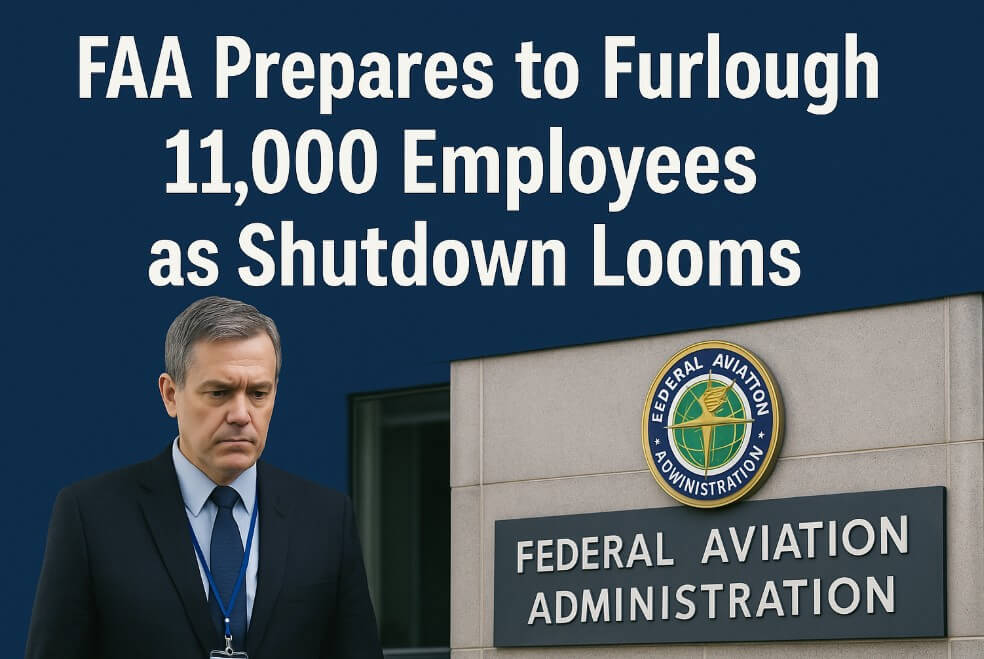
WASHINGTON— The U.S. aviation system is bracing for significant disruption as the Federal Aviation Administration (FAA) warns it may be forced to furlough more than 11,000 employees if government funding lapses at midnight. The move, which represents nearly a quarter of the agency’s 45,000-person workforce, would come amid warnings from airlines and industry groups that a partial government shutdown could ripple across air travel and the broader economy.
Airlines Sound Alarm on Potential Impact
Major U.S. carriers, including United Airlines (UA), Delta Air Lines (DL), American Airlines (AA), and Southwest Airlines (WN), have cautioned that a funding lapse could strain flight operations nationwide. With both air traffic controllers and Transportation Security Administration (TSA) officers required to work without pay, executives fear a repeat of past shutdowns that led to delays, cancellations, and long lines at airports.
Key hubs such as New York’s John F. Kennedy International Airport (JFK) and Chicago O’Hare (ORD) could see the earliest impacts, where already thin staffing levels leave little margin for disruption.
FAA: Controllers Stay on Duty, Without Pay
The FAA confirmed that approximately 13,000 active air traffic controllers would continue working through any shutdown to maintain safety standards. However, like their TSA counterparts, they would not receive pay until the impasse ends.
The agency is already facing a shortage, with staffing levels sitting about 3,800 controllers below target. That gap has raised concerns in recent months as airlines ramp up post-pandemic schedules.
In a notable shift from past shutdowns, the FAA said it plans to continue hiring and training controllers despite the funding lapse. During the 2019 shutdown, recruitment and training programs were suspended, worsening long-term staffing challenges.
Still, experts warn that delayed paychecks could drive absenteeism. In 2019, a surge in unpaid worker callouts forced authorities to slow air traffic around New York’s LaGuardia Airport (LGA) and extended security wait times nationwide.
TSA Officers to Work Without Pay
The Transportation Security Administration, which employs roughly 50,000 officers nationwide, said its workforce will remain on duty to keep airport checkpoints open. But as in 2019, morale and attendance could quickly become an issue.
That year, unpaid TSA shortages created longer screening lines at major airports, frustrating travelers and increasing political pressure to resolve the stalemate.
Industry leaders are already anticipating similar effects if the shutdown stretches into weeks. Airlines for America, the trade group representing the country’s largest carriers, has warned that schedules may need to slow down, reducing efficiency and inconveniencing millions of passengers.
Travel Sector Faces $1 Billion Weekly Loss
The U.S. Travel Association estimates that the economic fallout could reach $1 billion per week if a shutdown occurs. The group, which represents airlines, hotels, car rental companies, and other travel-adjacent businesses, has stressed that the impact would extend far beyond airports.
“Shutdowns inject unnecessary uncertainty into the travel system at a time when both business and leisure travel are critical to the nation’s economy,” the association said in a recent statement.
The Transportation Department, which oversees the FAA and TSA, has said that of its 53,717 employees, about 12,200 would be furloughed in the event of a funding lapse. The FAA’s 11,000 staff cuts would make up the largest share.
Even so, essential safety-related functions — such as the certification of aircraft, engines, and commercial space launch oversight — would continue.
A Familiar Crisis for U.S. Travelers
For travelers, the looming shutdown carries a sense of déjà vu. During the 35-day closure in late 2018 and early 2019, the nation’s longest ever, air travel slowed under the strain of unpaid workers and suspended programs. Industry leaders say the effects of that episode are still being felt today in staffing shortfalls and training backlogs.
With the clock ticking toward midnight, business groups and travel advocates are urging lawmakers to strike a deal. Until then, the aviation system remains in a precarious position, balancing safety requirements with a workforce caught in the middle of political gridlock.
