


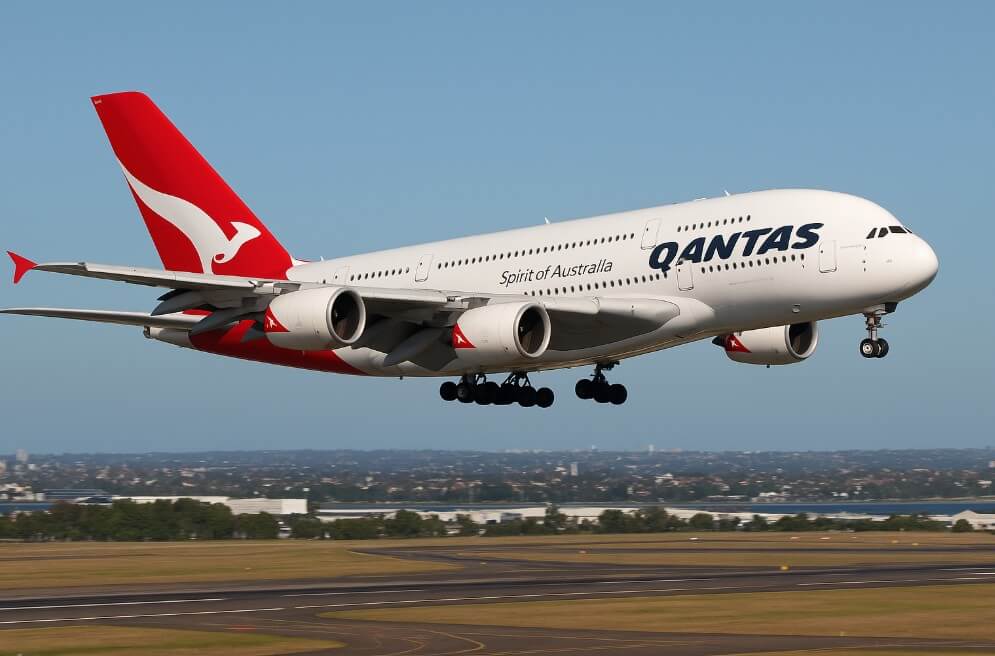
SYDNEY — A Qantas Airways Airbus A380 carrying more than 400 passengers was forced to make a mid-flight U-turn on Tuesday after a technical fault disrupted the aircraft’s satellite communications system, prompting the crew to return to Sydney as a precaution.
The flight, QF63 from Sydney Kingsford Smith Airport to Johannesburg, had been in the air for nearly four hours when the issue arose. The aircraft was flying south of Tasmania, over remote stretches of ocean, when the crew decided to abandon the journey and head back to Australia.
Qantas confirmed the incident but emphasized that at no time was there an immediate safety threat. “The Airbus A380 did not issue a mayday call, and no immediate safety threat to passengers or crew was reported,” the airline said in a statement.
Precautionary Decision
Satellite communication systems are essential for ultra-long-haul flights, particularly those traversing regions with limited or no radar coverage, such as the Southern Ocean. These systems allow flight crews to maintain constant contact with air traffic control and airline operations.
According to Qantas, the crew’s decision to return was made out of caution rather than emergency. “Satellite communications are essential for maintaining contact while crossing remote regions such as the Southern Ocean,” the airline said. Without that connection, the flight would have been unable to proceed safely across vast stretches of ocean.
The A380 landed safely back in Sydney at 8:32 a.m. UTC on December 26. All 410 passengers were disembarked and provided overnight hotel accommodation. Engineering teams immediately began inspecting the aircraft, with plans to return it to service once the fault is identified and corrected. Qantas arranged a replacement aircraft to carry affected travelers to Johannesburg the following day.
Aircraft and Route Details
Flight QF63 had departed Sydney at 11:18 p.m. UTC on December 25 aboard an Airbus A380-842 registered as VH-OQG, a 15-year-old aircraft powered by four Rolls-Royce Trent 900 engines. Delivered in 2009, the aircraft is one of the older A380s in the Qantas fleet, which currently includes 10 of the double-deck jets.
For the continuation service, Qantas deployed another Airbus A380, VH-OQA, the first A380 delivered to the airline in 2008. The Sydney–Johannesburg route is one of Qantas’s longest and most demanding services, with a scheduled flight time of more than 14 hours. The carrier also relies on its A380s for other high-demand international routes such as Sydney–Los Angeles and Sydney–London Heathrow.
A Growing Reliance on Connectivity
The incident highlights the critical role of satellite connectivity in modern aviation. While the aircraft itself remained mechanically sound, airlines cannot operate across oceanic sectors without redundant and reliable communications.
“Without reliable satellite connectivity, airlines may be unable to operate safely across vast oceanic regions, making redundancy and system reliability critical,” aviation experts note.
This is not the first time Qantas has faced mid-flight technical challenges on its A380 fleet. On previous occasions, precautionary returns have been made after system alerts, though such events remain rare relative to the airline’s overall safety record.
Passenger Impact and Response
Though the return disrupted holiday travel plans, Qantas stressed that safety takes precedence over convenience. The airline offered hotel accommodation and rebooked passengers on the replacement flight, minimizing delays to their final destination.
One passenger, interviewed after disembarkation, said the turnback was handled calmly and professionally by the crew. “The announcement explained the technical issue clearly, and everyone stayed pretty relaxed knowing there wasn’t an emergency,” the traveler said.
Qantas continues to face scrutiny over its aging fleet as it awaits delivery of new long-range aircraft, including Airbus A350s, intended to serve ultra-long-haul flights such as Project Sunrise. For now, the carrier maintains its A380s as workhorses on key international routes, balancing demand with operational challenges.
Looking Ahead
As inspections on VH-OQG proceed, the airline is expected to complete its technical review before returning the aircraft to active service. For passengers, the disruption was an inconvenience but a reminder of the high safety standards that define international aviation.
The event underscores how modern airlines manage technical risks in real time—prioritizing safety, maintaining transparency, and deploying backup resources to keep global networks moving.
