


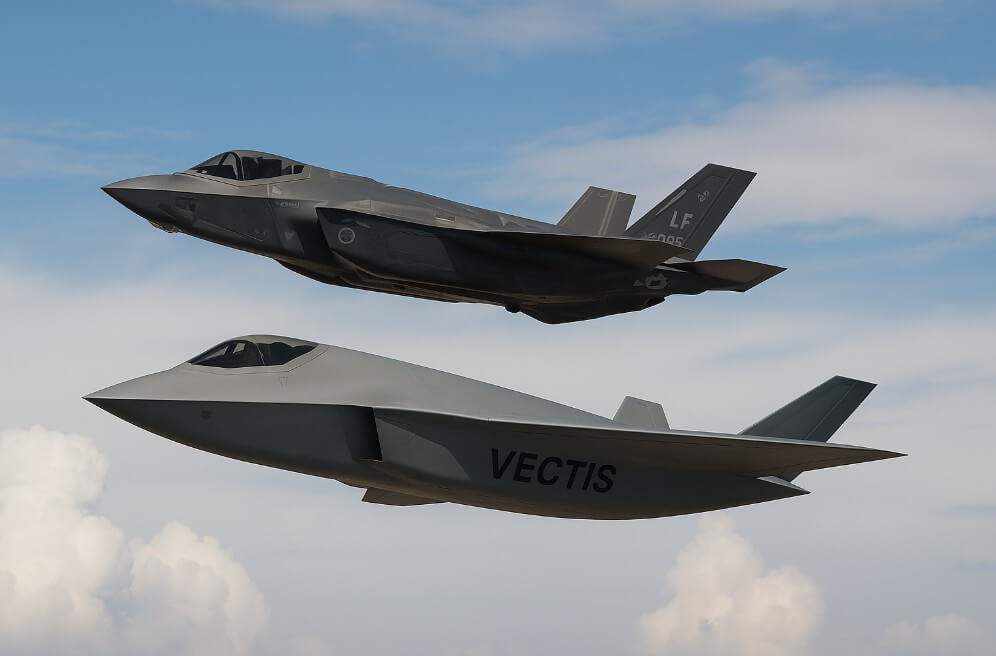
WASHINGTON — Lockheed Martin has introduced its latest autonomous combat aircraft, Vectis, a stealth drone designed to work alongside the F-35 fighter jet in a wide range of missions. The move signals the defense contractor’s effort to strengthen its role in the U.S. military’s push toward crewed-uncrewed teaming, a concept expected to shape future air combat.
Developed by the company’s famed Skunk Works advanced projects division, Vectis is intended to provide the F-35 and potentially the F-22 with additional capabilities in intelligence, surveillance, reconnaissance (ISR), electronic warfare, and strike missions. Lockheed Martin said the first prototype should take flight within the next two years.
A Platform Built for Versatility
Vectis is being positioned as an affordable, survivable drone that can take on multiple mission roles. According to Lockheed, the aircraft is envisioned for offensive and defensive counter-air operations, precision strike, ISR, and electronic warfare. Its modular design allows it to integrate payloads and mission systems from suppliers beyond Lockheed Martin, broadening its potential for adaptability.
Artist renderings show a sleek, blended-wing body design with a single dorsal air intake and delta wing configuration. Lockheed says the airframe leverages stealth shaping elements honed from decades of experience in low-observable technologies. Supersonic speed is not a requirement, the company noted, but survivability is a key goal.
“Vectis leverages Lockheed Martin’s decades of experience in stealth and low-observable systems to deliver best in CCA class survivability,” the company said.
Designed for Affordability and Scale
The U.S. Air Force has made affordability a cornerstone of its Collaborative Combat Aircraft (CCA) program, seeking drones that can complement expensive fighters like the F-35 without driving up costs. Lockheed said Vectis is designed with a target price under $20 million per aircraft, in line with competing CCA concepts.
Development is already underway, with parts ordered and assembly of the first prototype scheduled to begin soon. While key specifications—such as engine type, speed, and payload capacity—remain undisclosed, Lockheed maintains that the design balances capability with cost efficiency.
Strategic Implications for the U.S. and Allies
The unveiling of Vectis comes as the U.S. Air Force and its allies accelerate investments in autonomous combat systems. Several prototypes from rival contractors are already in or approaching flight testing, underscoring the competitive nature of the emerging market.
Lockheed has not yet officially entered Vectis into all CCA competitions, but executives suggested the aircraft could participate depending on future requirements. The company also sees potential interest from international partners, citing the drone’s compatibility with global missions and fifth-generation fighters.
Analysts note that if successful, Vectis could significantly enhance the operational flexibility of the F-35, the most expensive fighter program in history. By pairing the stealth jet with a lower-cost, attritable wingman, militaries could extend combat reach and reduce risks to human pilots.
Risks and Uncertainties
As with all advanced military development programs, hurdles remain. Certification, cost management, and integration with existing platforms could all delay deployment. Details about the drone’s propulsion, endurance, and performance remain sparse, leaving questions about how Vectis will ultimately measure against competitors.
Still, Lockheed is moving quickly to position its offering. The company says the next two years will be critical to validating Vectis’ design promises and cost targets.
The Bottom Line
While prototypes are still on the drawing board, Lockheed Martin’s Vectis represents a potential shift in air combat strategy. By pairing high-end fighters with autonomous, multi-role drones, the U.S. and its allies could gain new levels of survivability and flexibility. If the company delivers on its timeline, Vectis could join the next generation of collaborative combat aircraft sooner than expected.
