


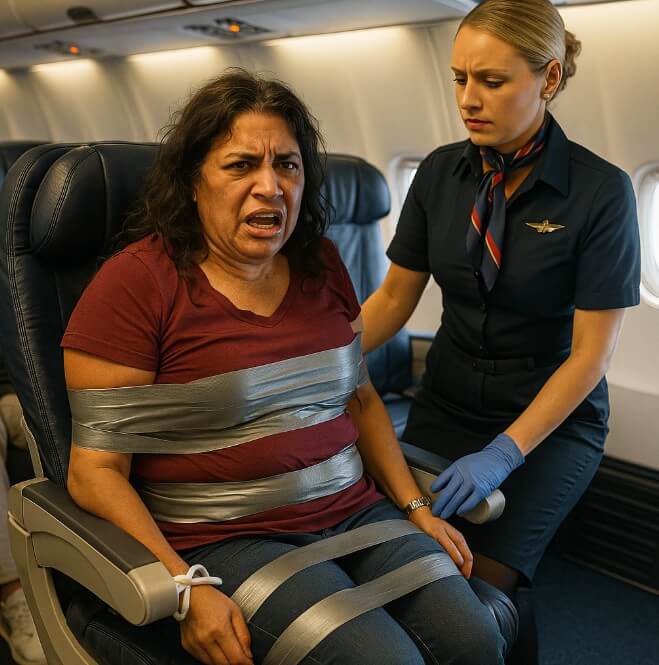
FORT WORTH – An American Airlines flight from Charlotte to Las Vegas was the scene of a violent disturbance this week after a passenger threatened and attacked crew members, forcing attendants to use duct tape to restrain her until landing.
On September 16, 2025, American Airlines flight 2470 encountered what authorities described as a “serious disruption” involving 47-year-old Las Vegas resident Ketty J. Dilone. According to airline officials and federal investigators, the incident unfolded midway through the cross-country journey, drawing alarm from both passengers and crew.
Escalation in the Cabin
Witness accounts and official reports state that Dilone left her seat during the flight, walked the aisle, and began filming the cabin despite repeated instructions to stop. When confronted, she issued threats, shouting, “I will kill you b**h!”* at flight attendants.
Crew members initially attempted to restrain her using flex cuffs and her seatbelt. But as Dilone continued to resist, attendants used duct tape to secure her to her seat. The situation escalated further when she kicked a flight attendant twice, once in the calf and once behind the knees, causing the crew member to fall. Her legs were taped to prevent additional assaults.
While restrained, Dilone shouted that the restraints were causing her pain and delivered a disturbing outburst referencing her childhood. “So if anybody wants to kill somebody, put rat poison in it, but make sure it’s not expired and make sure you put a lot of it, because it didn’t work for my daddy. He just fell asleep.”
Out of caution, the crew moved nearby passengers to other rows and positioned volunteers beside Dilone until the flight landed. Despite the chaos, the aircraft reached Harry Reid International Airport on schedule without diversion.
Arrest Upon Landing
Authorities were waiting at the gate in Las Vegas. Las Vegas Metropolitan Police boarded the plane, and FBI agents arrested Dilone on federal charges. As officers took her into custody, Dilone reportedly threatened to spit on them, prompting the use of a spit hood, a mesh covering designed to block bodily fluids while allowing normal breathing. She also requested that music be played during her arrest, according to law enforcement accounts.
Dilone was transferred to Henderson Detention Center in Henderson, Nevada. She faces charges of interference with flight crew members and assault by striking, beating, or wounding—offenses that could carry a sentence of up to 20 years in prison if convicted. She appeared in U.S. District Court for the District of Nevada on September 18, with no trial date yet set. The FBI confirmed that the case remains under investigation.
Troubling Background
Court records show that Dilone has a prior criminal history. In 2005, she was arrested on felony domestic violence charges. She ultimately pleaded guilty to a misdemeanor, receiving a suspended 30-day jail sentence, waived fines, and a mandate for six months of counseling.
Social media activity in the days leading up to the flight has also drawn attention. On September 15, Dilone posted a video of herself staring into the camera with what she described as an “evil eye,” sparking speculation about her mental state. Passengers’ bystander footage of the in-flight incident, later posted to TikTok, further fueled public discussion, with tags suggesting possible mental illness. However, no official medical diagnosis has been disclosed.
Crew and Passenger Response
American Airlines praised the flight attendants for their handling of the situation. In a statement, the company emphasized its commitment to safety and applauded the crew’s professionalism under difficult circumstances. The assaulted crew member sustained minor injuries but continued working through the remainder of the flight.
Passengers reported being shaken by the confrontation, with some volunteering to assist the crew by sitting near Dilone after her restraint. The airline did not announce compensation or further action for affected passengers.
Broader Industry Concerns
The case underscores ongoing challenges for airlines in addressing disruptive passenger behavior. While incidents peaked during the COVID-19 pandemic—often linked to mask disputes or intoxication—such confrontations remain a concern in 2025. Airlines rely on tools like flex cuffs and duct tape as last-resort measures when passengers become violent or pose safety risks.
According to travel industry observers, the episode illustrates the fine balance airlines must strike between maintaining order in the cabin and avoiding disruptions to flight schedules. Flight 2470 proceeded without delay or diversion, but the disruptive event highlighted the importance of crew preparedness and training.
As federal investigators continue their review, the case of Ketty J. Dilone adds to a growing record of high-profile incidents that place renewed focus on passenger screening, onboard safety, and the well-being of airline staff
