


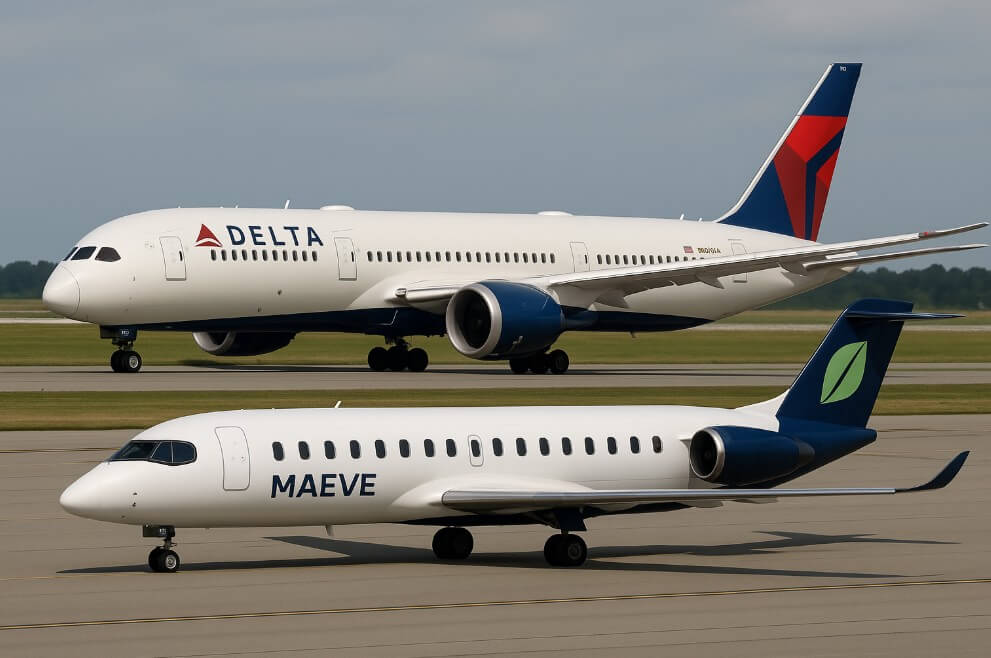
Delta Air Lines is stepping further into the future of sustainable aviation with a new partnership aimed at reimagining regional travel. The airline announced it is teaming up with Netherlands-based Maeve Aerospace to help develop the MAEVE Jet, a hybrid-electric aircraft designed to reduce emissions and fuel consumption on short-haul flights.
The collaboration underscores Delta’s broader push to decarbonize its fleet and achieve net-zero emissions by 2050, while providing a glimpse of what the next generation of regional aircraft could look like.
A New Vision for Regional Travel
The MAEVE Jet is designed to cut fuel use and emissions by up to 40% compared with current regional aircraft when operating on conventional jet fuel. The aircraft will also be compatible with sustainable aviation fuel (SAF), allowing even deeper lifecycle emission reductions.
Delta will act as Maeve’s North American global airline partner, providing operational insight to help shape the aircraft for U.S. markets. The jet introduces a five-abreast, single-aisle layout that aims to bring narrow-body comfort and efficiency to regional routes. Maeve Aerospace calls the design a game-changer for sustainable short-haul travel.
“Delta is thrilled to partner with Maeve to redefine regional aviation and advance sustainability,” said Kristen Bojko, Delta’s Vice President of Fleet. “Maeve’s bold innovation aligns with our vision for transformative technologies that improve efficiency, enhance customer and employee experiences, and reduce emissions. We’re committed to shaping a safer, more sustainable future for flight while strengthening our network.”
Expanding Delta’s Sustainable Skies Lab
Maeve becomes the fifth partner in Delta’s Sustainable Skies Lab, a program launched as part of the airline’s 2023 Sustainability Roadmap. The lab acts as an incubator for technologies that could change how airlines operate in a lower-carbon future.
The Maeve partnership joins Delta’s portfolio of experimental projects that includes JetZero’s blended wing body aircraft for longer routes and Joby Aviation’s electric air taxi service designed to streamline trips between home and the airport. Together, these efforts allow Delta to explore sustainability solutions across regional, mainline, and urban mobility markets.
“Delta’s expertise in fleet innovation and sustainability is unmatched. We’re proud to collaborate on tailoring the MAEVE Jet for the U.S. market,” said Martin Nuesseler, Chief Technology Officer at Maeve Aerospace.
Hybrid-Electric Design
The MAEVE Jet’s hybrid-electric system is engineered to optimize efficiency during low-altitude operations such as takeoffs and climbs, which are typically the most fuel-intensive phases of flight. By providing power assistance in those moments, the aircraft is expected to enable more efficient wing and power plant designs, reducing overall fuel burn.
The flexibility to operate with both conventional jet fuel and SAF means the MAEVE Jet could help airlines transition more smoothly toward sustainable operations, without requiring immediate infrastructure changes. Industry observers say this dual-fuel capability could be a key advantage in the early years of hybrid-electric aviation.
Broader Sustainability Strategy
The partnership reflects Delta’s three-pillar approach to decarbonization: investing in new aircraft technologies, improving operational efficiency, and scaling up the use of alternative fuels. Beyond hybrid-electric aircraft, Delta is working to optimize flight operations, reduce onboard weight, and accelerate the adoption of SAF.
In parallel with the Maeve collaboration, Delta is also working with Green Taxi Aerospace to explore electric taxiing technology. The initiative, also part of the Sustainable Skies Lab, is designed to cut emissions, fuel use, and costs associated with ground operations.
By leveraging its operational expertise across these initiatives, Delta is positioning itself not only as a customer but also as an early shaper of aviation’s next technological chapter.
Looking Ahead
While the MAEVE Jet is still under development, the partnership highlights Delta’s growing role as both investor and influencer in the evolution of sustainable aviation. If successful, the aircraft could serve as a template for how airlines modernize their regional fleets while reducing carbon footprints.
For Maeve Aerospace, the collaboration provides access to one of the world’s largest carriers and an important proving ground in the U.S. market. For Delta, it represents a continuation of its strategy to make immediate progress on sustainability while betting on technologies that could define air travel for decades to come.
