


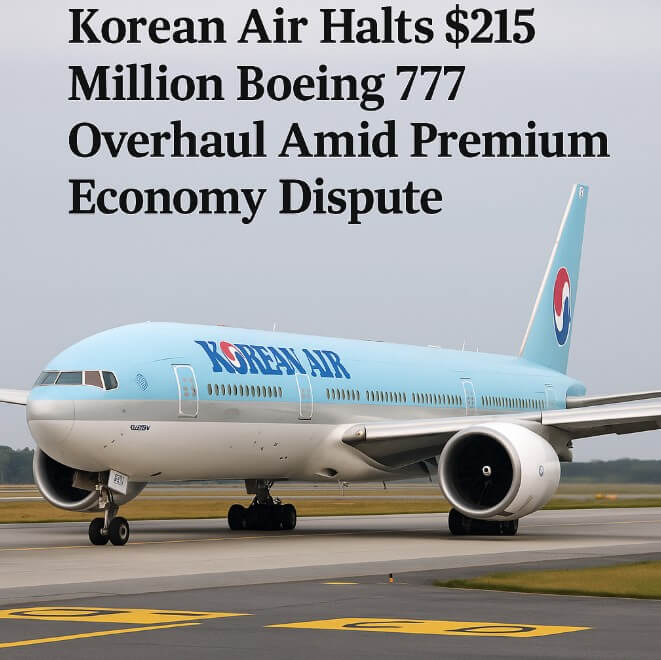
Seoul — Korean Air has suspended a $215 million plan to upgrade its Boeing 777-300ER fleet after a dispute over seating changes sparked passenger backlash and regulatory scrutiny, raising fresh questions about how airlines balance profitability with customer expectations.
The program, unveiled in early August 2025, was billed as one of the airline’s most ambitious cabin modernization efforts in years. The overhaul aimed to introduce a new premium economy cabin while refreshing business and economy class across 11 aircraft. But less than two months after its announcement, the plan is now largely on hold, with only one jet fully converted.
A Plan to Boost Comfort and Profits
At an estimated cost of about 300 billion Korean won ($215–216 million), the original plan called for the addition of a 40-seat premium economy section arranged in a 2-4-2 configuration. The product, marketed as “Premium Class,” was targeted at travelers willing to pay more for extra comfort without stretching to business class. Korean Air scheduled the first aircraft to debut in mid-September.
Alongside the new cabin, the airline intended to modernize its business class with upgraded seats and refresh economy cabins to extend the lifespan of its long-haul fleet. Industry analysts saw the move as part of a broader effort to remain competitive against rivals like Emirates and Singapore Airlines, both of which offer well-established premium economy products.
Yet the proposal contained a controversial element: a reconfiguration of economy seating from the airline’s long-standing 3-3-3 layout to a denser 3-4-3 arrangement.
Passenger Pushback
For decades, Korean Air has marketed its 777 economy cabins as more spacious than those of its peers. The switch to a 3-4-3 design would have reduced seat width by roughly 2.5 centimeters, while thinner cushions would have squeezed in additional passengers. Although the layout mirrors that of many global competitors, loyal customers saw the change as a betrayal of the airline’s reputation for comfort.
Reaction was swift and overwhelmingly negative. Frequent flyers complained on social media, warning that the denser layout would erode service quality. Some went as far as pledging to book with competitors if the plan went forward. Travel bloggers and aviation forums amplified the criticism, framing it as a clear example of profit-driven densification at the expense of passengers.
Regulatory Roadblock
The backlash coincided with a separate set of concerns from South Korea’s Fair Trade Commission (FTC), which is reviewing Korean Air’s pending acquisition of rival Asiana Airlines. As part of the merger process, regulators have imposed conditions requiring Korean Air to maintain certain service standards. The FTC argued that the economy class reconfiguration could violate those commitments by reducing comfort levels on key routes.
That regulatory scrutiny added significant pressure. With public opinion turning against the plan and regulators questioning its compliance, Korean Air was forced to reconsider.
Airline Pulls Back
In a swift reversal, the airline announced that it would abandon the densification plan on 10 of the 11 targeted aircraft. Those jets will retain the original 3-3-3 seating arrangement, effectively halting most of the overhaul. Only one aircraft has been fully refitted with the new layout, including both premium economy and the controversial 3-4-3 economy design.
Korean Air defended its updated configuration on that jet, noting that the layout aligns with “industry standards” and mirrors competitors such as Emirates and Singapore Airlines. Still, the airline offered no timeline for when, or if, the rest of the fleet would be converted.
Industry Context
The episode highlights the tension facing airlines globally: the need to maximize revenue per square foot of cabin space while maintaining customer loyalty. Premium economy has grown into a lucrative segment, appealing to both corporate travelers seeking comfort and leisure passengers willing to trade up. But the economics of introducing the cabin often involve difficult choices in economy class, where most passengers sit.
For Korean Air, the timing is especially delicate. The Asiana merger represents one of the most significant consolidations in Asian aviation in decades, and regulators are watching closely for any sign that service quality could decline. Industry observers say the carrier’s handling of the overhaul could set a precedent for how regulators assess other changes during the merger process.
Looking Ahead
For now, Korean Air’s $215 million vision for its Boeing 777 fleet remains in limbo. The lone aircraft outfitted with the new design offers a glimpse of the intended future, but the broader plan has stalled under the weight of passenger discontent and regulatory concerns.
The airline’s leadership faces a difficult balancing act: delivering innovation and profitability without eroding the service standards that helped build its brand. Whether Korean Air can salvage its premium economy initiative while preserving customer trust and meeting regulatory obligations will determine how quickly, if at all, the overhaul resumes.
Until then, the airline’s flagship wide-body fleet will continue flying mostly in its familiar configuration, a reminder that in the competitive world of aviation, even well-intentioned upgrades can ground ambitious plans.
