


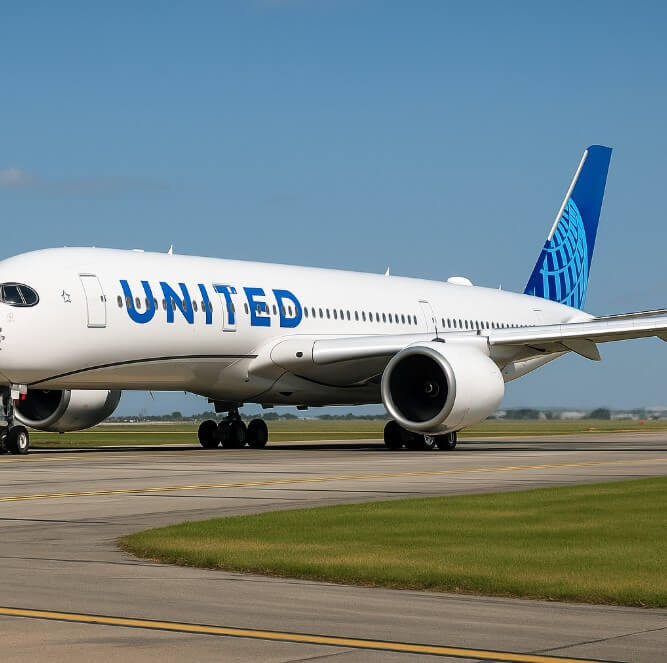
United Airlines is weighing a long-delayed pivot in its wide-body strategy, with CEO Scott Kirby signaling the carrier may finally move ahead with its order for Airbus A350-900 aircraft. The move, disclosed at the APEX Global Expo this month, would mark a significant shift in the U.S. airline’s fleet planning and could reshape its long-haul operations.
A Turning Point in Fleet Renewal
United has relied heavily on Boeing jets for decades, but many of its Boeing 777s are approaching the end of their service life. Kirby suggested the Airbus A350 could fill the gap, telling aviation journalist Brian Sumers that United “might finally take the airplane,” citing favorable economics.
United originally ordered 25 A350-900s in 2009, later expanding the order to 45 by 2017. But the airline repeatedly pushed back delivery dates as it focused on bringing in Boeing 787 Dreamliners. Those deferrals pushed the A350 timeline as far back as 2030, sparking speculation the airline might cancel the order entirely.
Now, with its Boeing 767 fleet due for retirement by the end of the decade and pressure mounting to modernize its 777s, United appears to be revisiting its Airbus commitment. Kirby noted that pilot retraining costs—a major factor in transitioning to a new aircraft type—will be unavoidable regardless of which plane the airline ultimately chooses.
Why the A350 Stands Out
The Airbus A350-900 is designed for long-haul routes, with advanced fuel efficiency, lower maintenance requirements, and a modern passenger experience. For United, which competes heavily in premium international markets, the A350’s quiet cabins and spacious layout could be a key differentiator.
The plane is positioned as a direct competitor to Boeing’s 787 and 777X programs, offering similar range and capacity while delivering better fuel economy compared with older aircraft. “Might finally take the airplane” was how Kirby characterized United’s changing stance, underscoring the A350’s appeal at a time when airlines worldwide are prioritizing sustainability and efficiency.
Rivals such as Emirates and Qatar Airways have already incorporated newer, more efficient fleets into their operations, leaving U.S. carriers to play catch-up in global markets. United, by exploring the A350, is signaling it wants to narrow that gap.
Competitive and Policy Pressures
Kirby framed the fleet decision within the broader challenges U.S. airlines face internationally. He has argued that American carriers are at a disadvantage against foreign competitors, which often benefit from government support and younger aircraft.
He also raised concerns about what he described as a “trade deficit” in international routes, where U.S. airlines frequently find themselves outmatched on both product and cost. While calling on Washington to step in to level the playing field, United is moving forward with its own steps to stay competitive.
Deploying the A350 could strengthen United’s hand on high-demand routes across Europe and Asia, where efficiency and passenger experience are critical to winning premium travelers.
Decision Expected by 2025
United is expected to make a final decision on the A350 order by the end of 2025, aligning with the company’s need to plan for wide-body retirements and meet rising international demand. Kirby indicated that United’s pilots have already been briefed on the potential move, signaling that management is seriously evaluating the transition.
A firm order would mark a historic shift for United, which has traditionally favored Boeing aircraft. It would also give Airbus a foothold in a fleet long dominated by Boeing, reinforcing Airbus’s growing influence in the global wide-body market.
Looking Ahead
For passengers, the adoption of the A350 could mean a more comfortable travel experience, with quieter cabins and upgraded amenities. For the airline, the aircraft represents an opportunity to cut fuel costs, reduce emissions, and sharpen its competitive edge in the international arena.
If United proceeds, the A350 would serve as a cornerstone of the airline’s long-haul future, balancing its fleet across both Airbus and Boeing platforms. For now, Kirby’s comments mark the clearest signal yet that United is preparing to enter a new chapter in its global operations.
As the industry watches closely, the decision could redefine United’s long-haul strategy for the next generation of travelers.
