


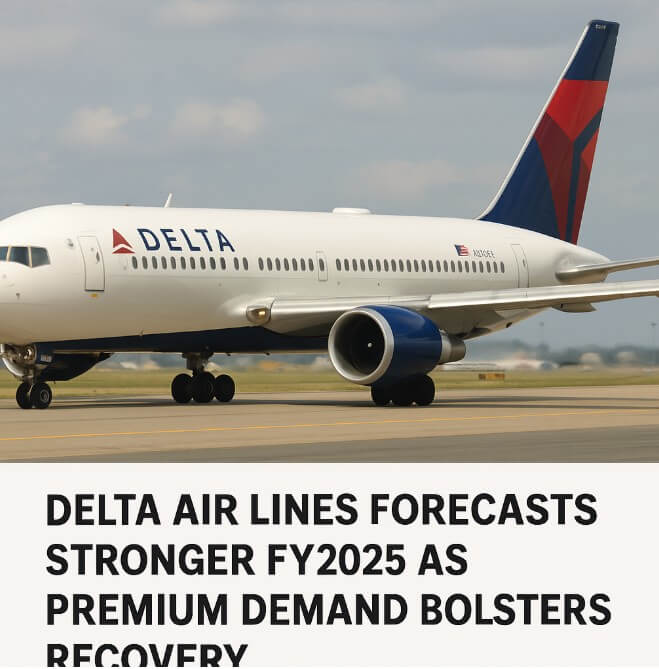
ATLANTA — Delta Air Lines is signaling a stronger year ahead, reaffirming its financial guidance for the third quarter and pointing to robust demand across premium cabins and domestic routes. The Atlanta-based carrier expects revenue growth of 2% to 4% compared with last year, a notable improvement after earlier uncertainty tied to tariffs and consumer hesitation.
The forecast reflects an airline industry adapting quickly to shifting demand patterns, while leveraging efficiency gains and new technology to navigate unpredictable markets.
Demand Recovery After a Rocky Start
Delta entered 2025 with a cautious outlook. In April, the company warned that revenue might remain flat or grow only modestly, citing steep declines in domestic demand following the announcement of U.S. tariffs. But travel appetite has strengthened since then, particularly among high-yield passengers.
According to PYOK, Delta has witnessed “significant improvements in travel demand, with both premium and domestic bookings driving growth.” Premium passengers in Business and First Class have been central to the rebound, providing the strongest revenue gains and offsetting softness in the Main Cabin.
Long-haul international routes have also remained resilient, buoyed by premium seat sales. Meanwhile, loyalty benefits and Delta’s longstanding partnership with American Express continue to generate steady income, giving the airline another layer of stability.
Tariffs and Market Adaptation
The impact of tariffs on consumer behavior was evident earlier in the year. Bookings dropped sharply after policy announcements, forcing Delta to issue a warning to investors. Chief Executive Ed Bastian criticized the move, calling it the “wrong approach.”
Despite those challenges, recovery in the months since underscores the resilience of premium travelers, who have sustained bookings even as Main Cabin demand lagged behind. That adaptability, coupled with what Delta calls “industry supply rationalization” — a balancing of flight capacity across U.S. carriers — has created cost savings and contributed to stronger operational results.
Shifting Booking Patterns
One of the more striking changes in 2025 has been consumer booking behavior. A growing number of Main Cabin passengers are waiting until the last minute to purchase tickets, complicating revenue forecasts. In contrast, premium travelers continue to book well in advance, giving Delta a reliable revenue base amid uncertainty.
This divergence poses both challenges and opportunities. For the Main Cabin, Delta must balance pricing strategies against unpredictable demand, while still maximizing ticket revenue. The relative stability of premium bookings, however, provides a cushion for the airline’s overall financial performance.
Technology and Pricing Innovation
To manage this unpredictability, Delta has rolled out an AI-powered pricing platform that it plans to apply to up to 20% of domestic fares by year’s end. The system builds on decades of dynamic pricing practices in the airline industry, adjusting fares in real time based on competition, capacity, and market dynamics.
The innovation has sparked debate among policymakers, with some concerned that algorithms could tailor prices to individuals’ perceived spending power. Delta has pushed back on that criticism, clarifying that its AI system does not profile customers but instead reacts solely to market conditions. The company argues that faster, automated adjustments will help it better match demand and supply while keeping fares competitive.
Outlook for the Rest of the Year
Looking ahead, Delta’s trajectory appears cautiously optimistic. The airline expects premium demand, loyalty-driven revenue streams, and operational efficiencies to continue supporting results. Yet risks remain. Main Cabin demand is less predictable than in prior years, and tariff-related factors could still weigh on consumer behavior heading into the fall.
Even so, Delta’s adaptability may prove to be its strongest asset. With disciplined cost management, enhanced efficiency, and new pricing tools, the carrier is positioning itself to capture revenue opportunities more effectively than earlier in the year.
While the broader travel market remains uneven, Delta’s strategy emphasizes flexibility and premium growth. As one of the largest U.S. airlines, its performance will also serve as a bellwether for the sector’s ability to manage economic headwinds in 2025.
