


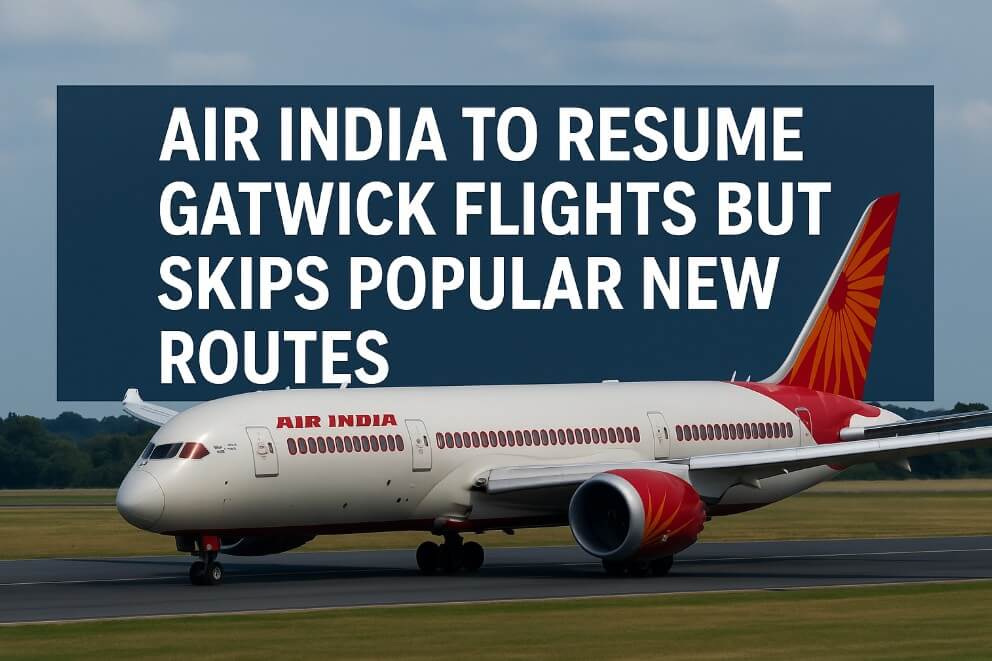
MUMBAI — Air India, the Tata Group-owned full-service carrier, will restart services from London Gatwick during the Winter 2025–26 season, operating flights to Amritsar and Ahmedabad. The move restores key links for diaspora communities in northern and western India but leaves questions about the airline’s broader international strategy as it passes on other potential growth markets.
Aviation analyst and blogger Ravreet Singh confirmed the airline’s plans, noting that bookings have reopened for Amritsar and Ahmedabad but remain closed for Goa, signaling that the leisure destination will not return at this time.
A Balancing Act at Gatwick
The decision highlights the strategic crossroads Air India faces as it tries to balance limited widebody capacity with profitability. Amritsar and Ahmedabad provide steady visiting-friends-and-relatives (VFR) traffic, but such routes are typically lower-yield and heavily reliant on point-to-point demand.
“Both Amritsar and Ahmedabad are high-volume markets connecting diaspora communities in the UK with northern and western India,” Singh observed. Maintaining these flights ensures brand visibility in crucial expatriate hubs, yet risks allocating scarce aircraft to routes that may not deliver optimal returns.
Goa’s absence from the lineup reflects the tension between market presence and commercial performance. Although the state remains a strong leisure draw, its highly seasonal, price-sensitive demand has made it a less attractive choice for Air India compared to other long-haul opportunities. Singh added that sharper alignment between fleet deployment and high-yield markets is essential for the carrier.
New Openings in the UK Market
The United Kingdom remains a critical battleground, and analysts see Manchester as an underexploited market. Sources cited by Singh indicate that IndiGo, India’s largest airline, plans to launch non-stop Delhi–Manchester flights by November 2025 with three weekly Boeing 787-9 services.
For Air India, moving ahead with its own Delhi–Manchester operation could pre-empt competition while diversifying its UK footprint beyond Heathrow and Gatwick. “Beyond tapping into the strong point-to-point demand between northern India and the UK’s second-largest metropolitan area, the carrier could leverage its extensive Southeast Asia network,” Singh noted. Transit connections via Delhi could enhance yields and help offset the relatively low profitability of Gatwick routes.
Beyond the UK: The Bali Opportunity
Industry observers also point to Southeast Asia as fertile ground for expansion. Mumbai–Denpasar (Bali) is one of the largest unserved leisure routes from India. According to Singh, more than 145,000 passengers flew between the cities in 2024, but none had the benefit of a nonstop service.
The market is overwhelmingly leisure-driven but has potential for premium cabin uptake, making it attractive for Air India’s mixed service model. Singh reported that IndiGo is also targeting the route, with plans to begin operations in early 2026 using 787-9s before transitioning to narrowbody A321XLRs. If Air India were to act sooner, it could establish itself as the first mover, capturing higher-value traffic and strengthening its international leisure profile.
Flexibility as Strategy
While scaling back Gatwick operations may appear as retreat, analysts argue it reflects a more flexible approach. “What matters most now is aligning resources with higher-yield opportunities that boost profitability and strengthen the overall network,” Singh explained.
Air India’s investment in Gatwick is unlikely to be abandoned permanently. Instead, it may choose to redeploy resources into markets that provide stronger financial returns in the near term, before revisiting Gatwick with greater competitive strength.
A nimble strategy, Singh argued, is vital. “A strategy centered on agility—seizing routes like DEL–MAN and BOM–DPS before competitors—would allow Air India to safeguard market share, diversify its portfolio, and enhance long-term competitiveness,” he said.
For now, Air India is keeping its foot in the Gatwick door with Amritsar and Ahmedabad, but the bigger story may be how quickly it adapts to opportunities elsewhere. The carrier’s future growth will depend less on nostalgia-driven diaspora routes and more on bold plays in markets where yields and connections align with its global ambitions.
