


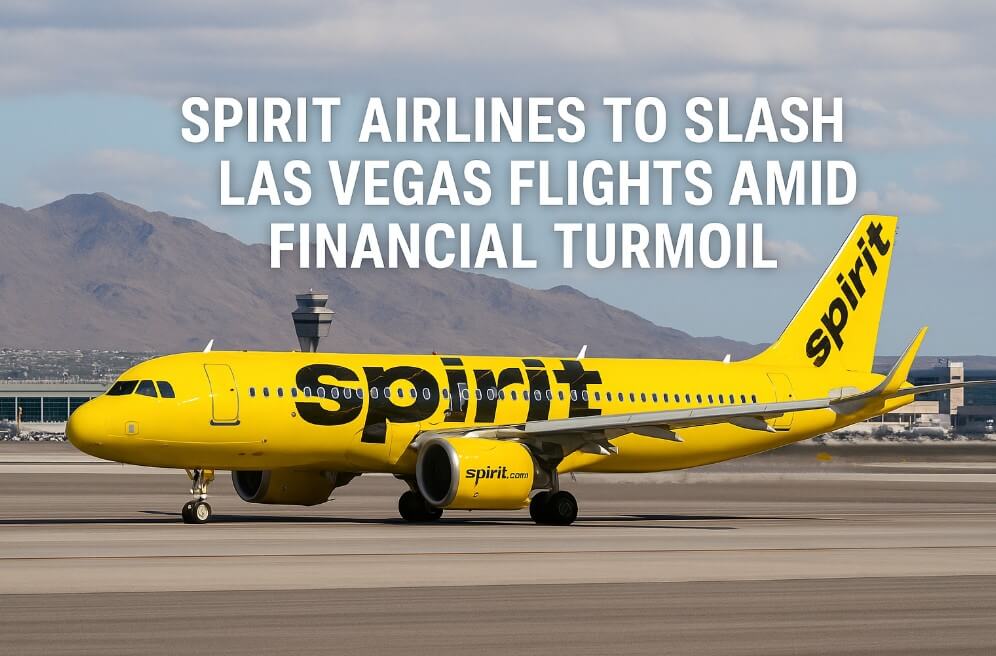
Florida — Spirit Airlines (NK) will cut more than half of its Las Vegas flights this winter as part of a sweeping restructuring plan aimed at addressing deep financial troubles. The ultra-low-cost carrier said it will reduce 54% of its Las Vegas operations starting October 2, 2025, marking one of the steepest pullbacks at a major U.S. airport in recent memory.
The cuts will eliminate service from Harry Reid International Airport (LAS) to eight cities: Albuquerque, Boise, Portland, Salt Lake City, Sacramento, Oakland, San Diego, and San Jose. The move comes on the heels of Spirit’s second Chapter 11 bankruptcy filing within a year, underscoring the airline’s struggle to regain financial stability.
Targeting Costs and Shifting Strategy
The Las Vegas reductions form part of Spirit’s broader plan to shrink its fleet and focus on higher-yield markets. According to the airline, the changes will lower capacity by 3.9% in October, eliminating more than 3,000 scheduled flights across its network.
Despite the significant pullback, Spirit insists it will continue to prioritize affordability. The airline said it will keep offering “high-value travel options” across the U.S., Latin America, and the Caribbean.
Las Vegas, however, will feel the sharpest impact. By dropping eight routes from its Nevada hub, Spirit is ceding ground in a city where low-cost carriers have long been a draw for budget-conscious tourists and gamblers. Still, many of the affected destinations are also served by Southwest Airlines, Delta, and other competitors, leaving travelers with alternatives.
Impact on Passengers
For customers already booked on discontinued routes, the changes raise immediate questions about refunds and rebooking. Under U.S. Department of Transportation rules, travelers on canceled flights are entitled to a full refund. Spirit has urged affected passengers to contact the airline for assistance.
The company, which has struggled with operational reliability in recent years, will need to manage the transition carefully to avoid further damaging its reputation. Its financial distress has already eroded consumer confidence, analysts say.
Competitors Step In
Other carriers are wasting no time filling the gap. United Airlines (UA) announced it will expand its Las Vegas schedule in January 2026, adding new flights from Chicago and Houston. The move is widely seen as an effort to capture displaced Spirit customers and strengthen United’s footprint in a competitive leisure market.
The response highlights the dynamic nature of U.S. aviation, where capacity shifts often trigger swift competitive reactions. “When one airline pulls back, another usually sees opportunity,” said an industry analyst not involved with either carrier. “United’s move reflects that.”
Financial Pressures Mount
The reductions underscore the precarious financial position Spirit finds itself in. The airline reported a $245.8 million net loss in the most recent quarter and has struggled to stabilize following its initial bankruptcy filing in 2024.
As part of its latest restructuring, Spirit is prioritizing operations at airports it considers more profitable, including Fort Lauderdale-Hollywood International Airport (FLL), Detroit Metropolitan Wayne County Airport (DTW), and Orlando International Airport (MCO). Executives argue that a leaner, more focused Spirit will have a better chance of surviving long-term.
Still, skepticism remains. Analysts warn that the airline’s persistent losses and reliance on deep discounting make recovery uncertain. “Spirit maintains that this bankruptcy is a step toward long-term success, but further cuts may be inevitable,” one analyst said.
Outlook
The winter reductions in Las Vegas may only be the start of more painful changes for Spirit’s network. With two bankruptcies in as many years, the airline faces the dual challenge of repairing its balance sheet while retaining customer trust.
For passengers, the immediate impact is fewer ultra-low-cost options out of Las Vegas. For the industry, the shake-up presents both risks and opportunities as rivals maneuver to capture market share.
As Spirit charts its path forward, its decisions in the coming months will likely determine whether the airline can sustain operations or faces deeper turbulence ahead.
