


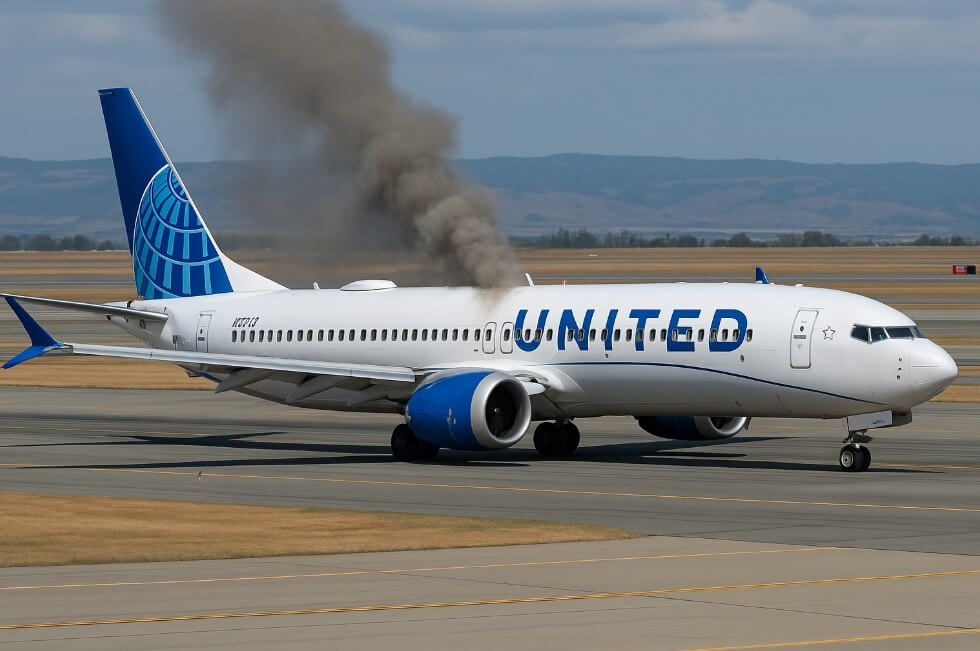
United Airlines was forced to turn back a Boeing 737 MAX 9 on Tuesday after smoke was reported inside the cabin shortly after takeoff from San Francisco International Airport, the latest safety incident involving the jet model that has faced years of regulatory scrutiny.
The aircraft, operating as United Flight 2664 to Baltimore/Washington International Airport, departed San Francisco at 9:46 a.m. local time on Sept. 2, according to flight tracking data. About 30 minutes into the climb, the crew halted the ascent at 33,000 feet and initiated a return to San Francisco, citing the presence of smoke.
The jet, identified as tail number N37527, landed safely on runway 28R just under an hour after departure. No injuries were reported, and the airline deployed a replacement aircraft to complete the scheduled service to Baltimore later that day.
FAA Confirms Investigation
The Federal Aviation Administration confirmed the incident and said it has opened a review.
“United Airlines Flight 2664 safely returned to San Francisco International Airport around 10:40 a.m. local time Tuesday, Sept. 2, after the crew reported smoke in the cabin. The Boeing 737 MAX-9 was travelling to Baltimore/Washington International Airport in Maryland. The FAA will investigate,” the agency said in a statement.
The cause of the smoke has not been disclosed, and neither the airline nor regulators immediately provided details on whether the source was mechanical, electrical, or environmental.
Aircraft and Service Details
The aircraft involved is a Boeing 737 MAX 9 delivered to United Airlines in January 2021. At 5.9 years old, the plane is among the younger aircraft in United’s narrow-body fleet. The model, a stretched version of Boeing’s best-selling single-aisle jet, is typically configured to carry between 178 and 193 passengers, depending on the airline’s cabin layout.
United has been one of the largest U.S. operators of the MAX family, which returned to service in late 2020 after a nearly two-year worldwide grounding. The grounding followed two fatal crashes involving the MAX 8 variant in Indonesia and Ethiopia, which were later linked to a flight control system flaw.
While Tuesday’s incident did not involve a loss of control or emergency landing, it highlights the ongoing attention regulators and carriers are paying to operational safety issues across the MAX fleet.
Operational Response
United said in a statement that the aircraft landed “without further incident” and that maintenance teams were inspecting the jet. The carrier emphasized that a replacement aircraft ensured customers could continue to Baltimore with only a short delay.
Industry analysts noted that while smoke or odor events occur periodically across airline fleets, they can carry heightened attention when associated with the MAX. “Anytime you have a MAX involved in an in-flight issue, it’s going to attract outsized scrutiny,” said one aviation consultant. “Even if the root cause turns out to be unrelated to the aircraft’s design.”
Broader Context
The 737 MAX family has been under an intense spotlight in recent months. Boeing has faced supply chain disruptions and additional safety audits following earlier incidents, including a January 2025 cabin panel blowout on an Alaska Airlines MAX 9 that forced regulators to temporarily ground dozens of aircraft for inspection.
For airlines, the MAX remains critical to domestic and transcontinental route networks because of its fuel efficiency and seating capacity. United alone operates more than 70 of the MAX 9 variant, which is typically used on medium-haul routes such as San Francisco to Baltimore.
Analysts said Tuesday’s diversion is unlikely to disrupt United’s overall operations, though it underscores the operational and reputational risks airlines carry when high-profile safety events occur. “For passengers, it’s reassuring that the crew identified the issue early, executed a safe return, and the FAA is investigating,” the consultant added.
Looking Ahead
The FAA has not set a timeline for its review of Flight 2664. United said it will cooperate fully with regulators and provide updates as information becomes available.
As for the aircraft itself, it will remain out of service pending inspection and any necessary repairs. Boeing, which continues to work under tight regulatory oversight, did not immediately respond to a request for comment on the incident.
With the flight returning safely and a replacement dispatched, the disruption for passengers was relatively contained. Still, for an industry balancing recovery, growth, and persistent scrutiny over safety, the episode adds another reminder of the high stakes facing carriers and manufacturers alike.
