


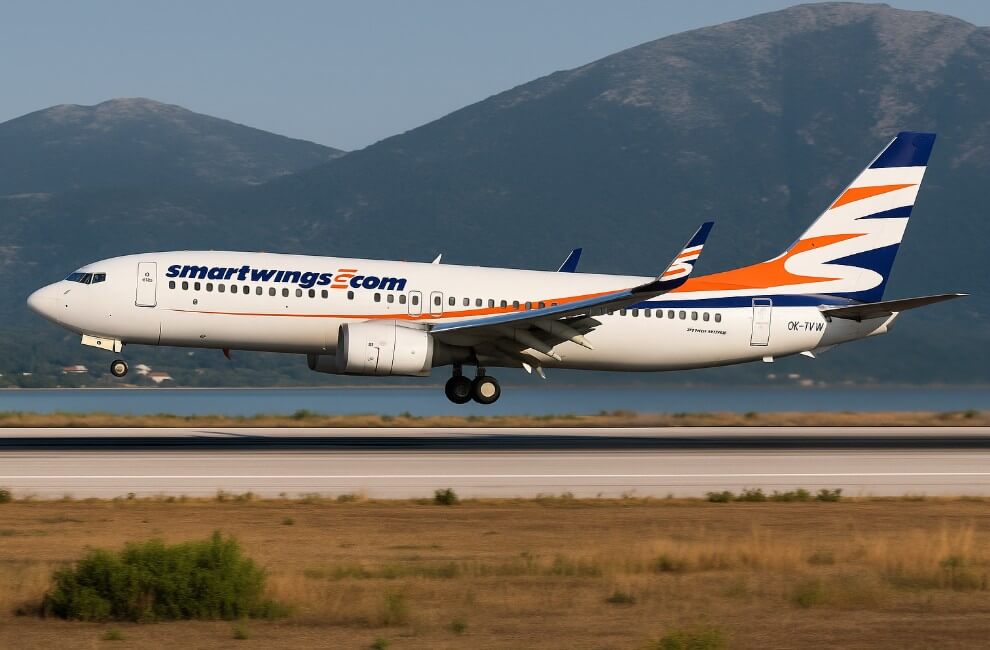
Preveza, Greece — A Smartwings Boeing 737-800 bound for the Czech Republic was forced to divert to Greece on August 28 after one of its engines shut down shortly after takeoff from Corfu International Airport.
The aircraft, operating as Smartwings flight QS2301, had departed Corfu at 5:07 p.m. local time on a scheduled service to Brno-Tuřany Airport (BRQ). Minutes into its climb, witnesses on the ground reported seeing streaks of flame and hearing loud bangs from the right-hand engine.
In response, the flight crew aborted its climb at 4,000 feet and entered a holding pattern south of Corfu to burn off fuel before diverting to Preveza Aktion National Airport (PVK).
The aircraft landed safely on runway 24 at Aktion approximately 45 minutes after departing Corfu. No injuries were reported among passengers or crew.
Emergency Response and Diversion
According to flight data, the crew acted quickly to stabilize the aircraft following the reported engine failure. The Boeing 737-800 leveled off at a low altitude to minimize risk while holding in Greek airspace. The decision to divert to nearby Preveza, rather than return to Corfu, ensured a controlled landing at an airport with suitable facilities.
The flight landed without further incident, underscoring what aviation experts often describe as the industry’s well-rehearsed protocols for single-engine operations.
Smartwings dispatched a replacement aircraft to complete the service to Brno, allowing passengers to continue their journey later the same evening. The original aircraft was declared unserviceable pending further inspection.
Aircraft and Operational Details
The Boeing 737-800 involved in the incident was registered OK-TVW. At 20.9 years old, the narrow-body jet has been part of the Smartwings fleet since June 2012.
Prior to joining the Czech carrier, the aircraft was operated by Swiss-based Privatair following its initial delivery from Boeing in November 2004. Despite its age, the aircraft type remains a workhorse for short- and medium-haul flights across Europe.
Smartwings, headquartered in Prague, operates a fleet of Boeing 737 variants on scheduled and charter services throughout Europe and beyond. Like many airlines, it has faced pressure to maintain operational reliability amid increasing passenger demand during the peak summer travel season.
Industry Context
Engine-related diversions are not uncommon in commercial aviation, particularly among older fleets where wear and tear require frequent monitoring. The Boeing 737-800, part of the Next Generation (NG) series, has a solid safety record, with aircraft regularly flying well beyond two decades in service.
Aviation analysts note that incidents like QS2301 typically highlight the effectiveness of airline safety protocols rather than systemic risk. “The fact that the crew was able to level off, hold, and divert without further issue demonstrates how well these situations are trained for and managed,” said one industry expert not affiliated with Smartwings.
Passenger Impact and Next Steps
Passengers aboard QS2301 faced delays but were accommodated on the replacement aircraft, according to the airline. Smartwings has not released further details about the number of passengers or the specific cause of the engine malfunction.
The aircraft will undergo inspection and maintenance before returning to service. Regulatory authorities in Greece and the Czech Republic are expected to receive operational reports on the diversion, though no formal investigation has yet been announced.
For Smartwings, the event comes at a time when European carriers are contending with increased scrutiny over fleet age and maintenance practices. While many airlines are phasing in newer aircraft such as the Boeing 737 MAX or Airbus A320neo, older 737-800s remain common across the continent.
Conclusion
Flight QS2301’s diversion to Preveza on August 28 stands as a reminder of the resilience of modern aviation systems. What began as a routine summer flight from a busy Greek holiday destination to a Central European city quickly turned into an unscheduled detour, handled with professionalism by the crew and without harm to passengers.
While the cause of the engine shutdown has yet to be publicly disclosed, Smartwings’ swift response in deploying a replacement aircraft and managing the diversion ensured minimal disruption. For passengers, it was an unexpected stopover on the Ionian coast; for the airline, another demonstration of how contingency planning can turn potential crises into controlled outcomes.
