


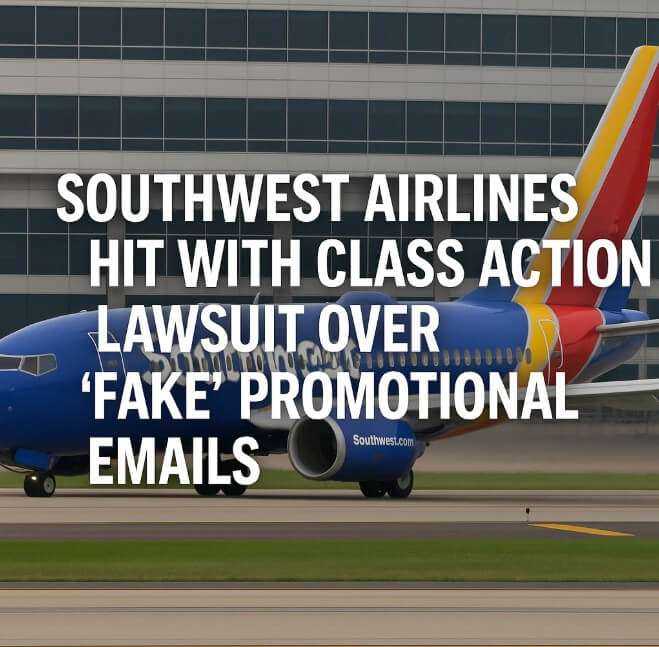
DALLAS — Southwest Airlines Co. (NYSE: LUV) is facing fresh legal turbulence after a Washington state passenger filed a proposed class action lawsuit alleging the carrier misled consumers with marketing emails containing deceptive deadlines.
The suit, filed in King County Superior Court by resident Karleasa Mitchell, accuses the Dallas-based airline of violating state law by sending promotional emails that used false expiration dates to pressure travelers into making quick purchasing decisions.
Allegations of Misleading Promotions
At the center of the complaint are repeated email campaigns that Mitchell says exploited consumer urgency. According to the filing, Southwest “repeatedly sent out marketing messages that pressured travelers with false cut-off dates, only to extend the offers the very next day.”
Mitchell cites a February 2025 campaign as a prime example. On February 18, Southwest sent an email promoting a special Companion Pass offer with an apparent expiration date of February 20. On that final day, Mitchell received another message warning it was the “LAST DAY” to secure the pass. But the very next morning, February 21, the airline issued a follow-up email stating the promotion had been extended.
Her attorneys argue this was not an isolated occurrence but part of a pattern. By manipulating deadlines, the complaint claims, Southwest engineered a “fear of missing out” that induced passengers to act hastily. “By manipulating deadlines, the airline allegedly created an illusion of scarcity, pushing consumers into rushed decisions they might not otherwise make,” the filing states, citing reporting by PYOK.
Legal Basis and State Statute
The case is being brought under Washington’s Commercial Electronic Mail Act (CEMA), which bars companies from sending emails to state residents with false or misleading subject lines. The statute has previously been used to challenge aggressive marketing campaigns that blur the line between urgency and deception.
A key precedent comes from a lawsuit against Old Navy over emails touting “limited-time” discounts that extended beyond their stated deadlines. In a narrow 5-4 decision, the Washington Supreme Court ruled that CEMA applies broadly, covering any misleading subject lines—not just those obscuring the commercial nature of an email. That ruling could prove pivotal in shaping Southwest’s defense.
Plaintiff’s Stated Goal
Mitchell emphasizes that she is not seeking to block Southwest’s promotional communications altogether. Rather, she wants assurances that the airline’s subject lines reflect genuine deadlines.
“Mitchell makes clear that the lawsuit isn’t about avoiding Southwest’s promotional messages altogether. Instead, she states she would like to continue receiving truthful information from the airline without being misled by exaggerated subject lines,” the complaint reads.
The suit proposes to represent all Washington residents who received similar marketing emails from the airline. If certified, the class could be sizable given the airline’s presence in the Seattle market. The filing seeks statutory damages of $500 per violation for each class member.
Potential Industry Impact
Southwest has not yet issued a public response. Legal experts say the combination of consumer protection law and precedent from the Old Navy case presents challenges for the carrier.
“Legal analysts note that the Old Navy case sets a precedent that may complicate the airline’s defense,” the complaint states.
Beyond potential damages, the outcome could have wide-ranging implications for the airline industry’s marketing practices. Carriers frequently rely on time-limited promotions to spur bookings and fill seats quickly. A ruling against Southwest may compel the industry to adopt stricter compliance measures around promotional deadlines.
“If successful, the lawsuit could reshape how Southwest and other U.S. carriers design promotional campaigns,” the filing notes. “Airlines frequently rely on limited-time offers to fill seats quickly, but this case may draw sharper boundaries around what is legally permissible.”
Looking Ahead
As the case moves forward, both consumer advocates and competitors are likely to watch closely. While email-driven urgency has long been a staple of airline promotions, regulators and courts may now scrutinize whether such tactics cross into deception.
For Mitchell, the dispute is straightforward: she wants honest marketing. “The core issue, according to her complaint, is that passengers cannot distinguish between genuine offers and emails designed to mislead,” the filing argues.
The lawsuit highlights a broader trend in digital advertising where urgency-based marketing strategies face increased legal and consumer pushback. If the Washington case succeeds, it could mark a turning point for how far airlines can go in engineering scarcity-driven campaigns.
