


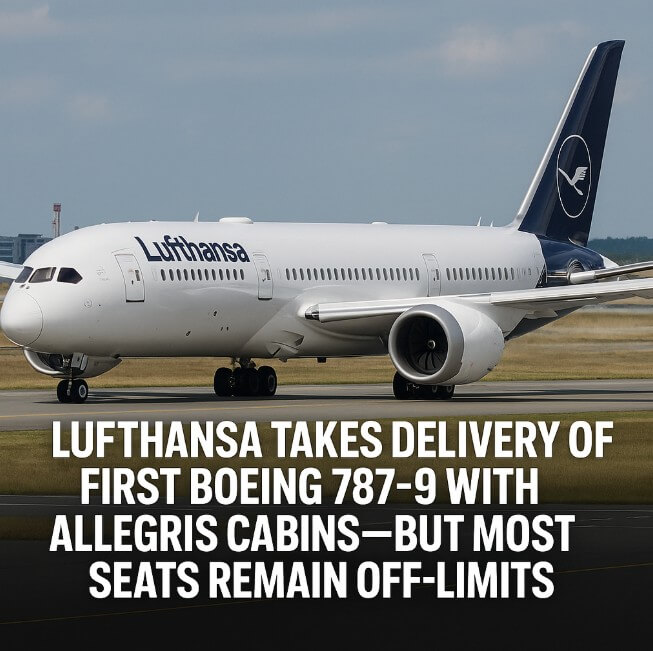
FRANKFURT – Lufthansa has officially welcomed its first Boeing 787-9 fitted with the airline’s long-anticipated Allegris cabin interiors, marking a milestone in the German carrier’s fleet renewal strategy. But while the aircraft represents the future of Lufthansa’s long-haul offering, the debut comes with a caveat: most of its new business-class seats cannot yet be used due to certification delays.
A New Era for Lufthansa’s Dreamliners
The delivery introduces Lufthansa’s proprietary Allegris design to the fleet for the first time. The Star Alliance member has 34 Boeing 787-9 aircraft on order, all of which are expected to carry the new cabins. Previous 787s in its fleet were inherited from Hainan Airlines, arriving with interiors not designed for Lufthansa’s brand. Those jets are eventually slated to transfer to Austrian Airlines, another Lufthansa Group subsidiary.
“This delivery is a landmark for our fleet modernization,” the airline said in a statement, emphasizing the role of Allegris in reshaping its product for international competition.
The first of the new deliveries, registered as D-ABPF, departed Boeing’s Everett facility in Washington as flight LH9789, covering 5,081 miles to Frankfurt. It is the first of several Allegris-equipped Dreamliners awaiting entry into service, with more already completed but held back by the ongoing certification process.
Cabin Certification Delays
The Allegris rollout has been slowed by regulatory hurdles, particularly involving the certification of the redesigned business-class seats. Out of 28 seats in the premium cabin, only four—those located in the first row—are currently cleared for passengers.
The limitation places Lufthansa in a difficult position. Deploying the aircraft before full certification means forgoing revenue opportunities in a critical cabin, yet delaying entry into service risks setbacks in its fleet renewal program.
For now, Lufthansa plans to operate the new 787-9 on European routes before moving it to long-haul service later in the year. The airline expects to begin transatlantic operations with the Allegris aircraft in October, though the full business-class product will not be available until regulators sign off. Lufthansa has expressed hope certification will be secured by the end of the year, but timelines remain uncertain.
Strategic Importance of the 787-9
Despite the short-term challenges, the Boeing 787-9 is central to Lufthansa’s long-haul growth strategy. The aircraft’s fuel efficiency and passenger comfort are key to the airline’s sustainability goals, while the Allegris cabins are designed to raise its competitive standing in the transatlantic and Asia-Europe markets.
The Allegris configuration does not include a first-class section but introduces fully redesigned business-class, premium economy, and economy cabins. Lufthansa has positioned the product as a “step-change” in the passenger experience, aligning with rivals that have modernized their fleets in recent years.
Industry analysts say the new interiors will be essential for Lufthansa to maintain market share against U.S. and Middle Eastern competitors. “The introduction of Allegris represents a reset for Lufthansa’s premium strategy,” one aviation analyst noted. “But until certification is complete, the rollout remains symbolic rather than transformative.”
Looking Ahead
Lufthansa’s broader modernization effort spans not only the 34 incoming 787-9s but also future Airbus A350 deliveries, many of which will also feature Allegris cabins. Once certification is finalized, Lufthansa expects to rapidly expand its Allegris-equipped fleet. According to travel industry publication OMAAT, the airline could double the number of long-haul aircraft offering the new cabin “overnight.”
For passengers, the arrival of the Dreamliner signals the beginning of a new onboard experience, though most will need to wait until certification is finalized to see the Allegris product in its intended form.
In the meantime, Lufthansa faces the balancing act of integrating partially usable aircraft into its schedule while preparing for a broader Allegris rollout. The challenges underscore the complexity of launching new premium products in a heavily regulated industry.
Bottom Line
The arrival of Lufthansa’s first Allegris-equipped Boeing 787-9 is a major milestone in the carrier’s long-haul renewal strategy. Yet with only four business-class seats currently certified for use, the debut highlights both the promise and the pitfalls of modernizing an airline fleet.
Passengers can expect to see the new aircraft in service within Europe soon and on transatlantic routes later this year. But the full Allegris experience—and Lufthansa’s competitive edge—will not be realized until regulators approve the remainder of the cabin.
