


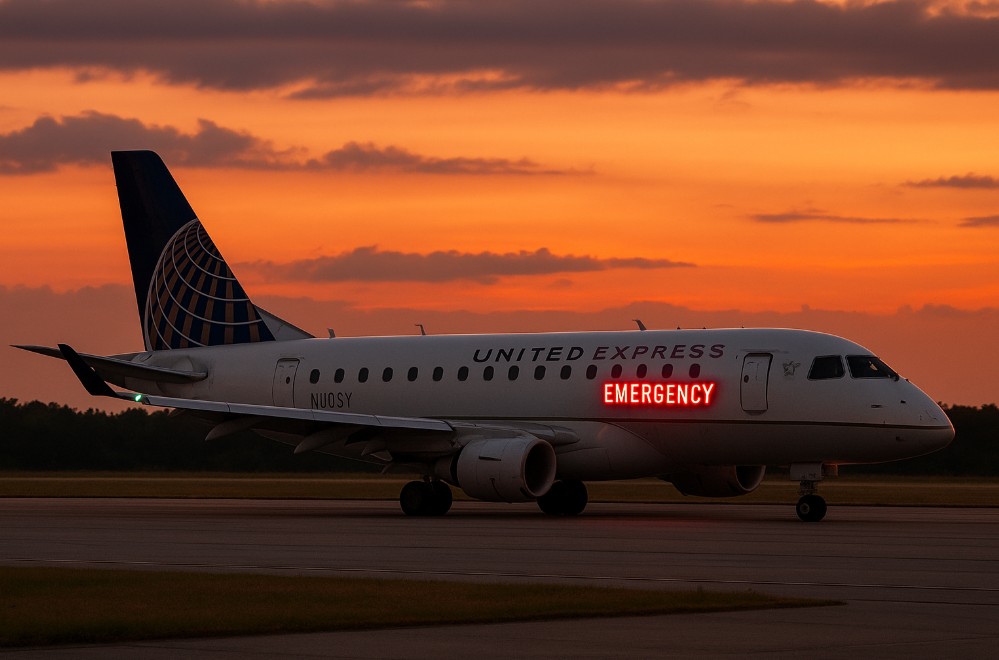
Austin, Texas — A United Express flight traveling from Aspen, Colorado, to Houston declared an emergency late Thursday and diverted to Austin–Bergstrom International Airport, where it landed safely, according to flight data and air traffic control reports.
United Express flight UA5971, operated with an Embraer E175 regional jet, had been en route to Houston George Bush Intercontinental Airport when the crew signaled distress by squawking the emergency transponder code 7700. The alert occurred while the aircraft was cruising at 39,000 feet near Dallas, prompting air traffic controllers to clear the jet for an emergency diversion to Austin.
Safe Diversion to Austin
At approximately 00:56 UTC, the aircraft began its descent toward Austin, dropping below 10,000 feet as it lined up for approach. Four minutes later, at 01:00 UTC, the flight touched down on runway 18R at Austin–Bergstrom International Airport without incident.
“The flight crew followed standard emergency protocols and landed the aircraft safely,” an airport operations official familiar with the situation said. “All passengers and crew disembarked normally.”
The specific nature of the emergency has not yet been disclosed. United Airlines did not immediately respond to requests for comment regarding the incident or whether mechanical issues, onboard medical needs, or another factor triggered the diversion.
Delayed Departure from Aspen
Records show that UA5971 had already experienced scheduling complications before declaring the emergency. The flight’s scheduled departure time from Aspen Pitkin County Airport was 1:25 p.m. local time on August 28, but actual takeoff did not occur until 5:02 p.m.
Despite the delay, the aircraft initially proceeded normally, climbing to its assigned cruising altitude of flight level 390 for the southbound journey to Houston. The diversion began only after the flight passed abeam of Dallas, at which point the crew initiated descent and transmitted the emergency code.
Aircraft and Operations Data
The Embraer E175 operating the flight is registered N110SY, an 11.3-year-old aircraft in service with United Express. The E175 is a widely used regional jet in North America, typically configured to seat between 76 and 88 passengers. Industry experts note that while the type has a solid safety record, aging aircraft require regular maintenance to remain in compliance with federal safety standards.
Aviation analyst Robert Mann noted that diversions of this nature, while rare, are a reminder of the industry’s strong safety culture. “Declaring an emergency ensures the flight crew gets priority handling and the safest possible outcome,” Mann said. “It does not necessarily indicate a catastrophic situation but is a precautionary measure.”
Emergency Code 7700
The squawk code 7700, broadcast by the crew during the incident, is a universal transponder setting that signals an aircraft in distress to all air traffic control facilities in range. The declaration automatically grants the flight priority handling, enabling expedited routing and clearance to the nearest suitable airport.
“Once a crew squawks 7700, everyone in the system knows that plane requires immediate assistance,” said John Cox, a former airline captain and aviation safety consultant. “It’s a way of clearing the skies and getting the aircraft safely on the ground as quickly as possible.”
Impact on Passengers and Operations
While details on passenger counts were not immediately available, United Express typically deploys the Embraer E175 on routes linking smaller regional markets to larger hubs. Flights from Aspen to Houston are frequently used by both leisure travelers and business passengers connecting through Houston to other domestic or international destinations.
Operations at Austin–Bergstrom were not significantly disrupted by the emergency landing. Airport officials said other flights experienced only minor delays during the brief diversion window. United is expected to provide onward accommodations for passengers, either through continuation of the flight or rebooking on alternate services.
Broader Aviation Context
Emergency diversions such as Thursday’s event underscore the aviation industry’s emphasis on layered safety protocols. The Federal Aviation Administration (FAA) requires airlines to report emergency declarations, and investigations typically follow to determine the underlying cause.
The event comes during a busy summer travel period, when U.S. carriers have faced a combination of operational strain, high passenger volumes, and weather-related disruptions. While diversions attract public attention, data from the FAA shows they remain uncommon relative to the number of flights operated daily.
As of early Friday, UA5971’s diversion remained under review. The aircraft was on the ground in Austin, and United had not released additional details on the status of the jet or whether it would return to service quickly.
