


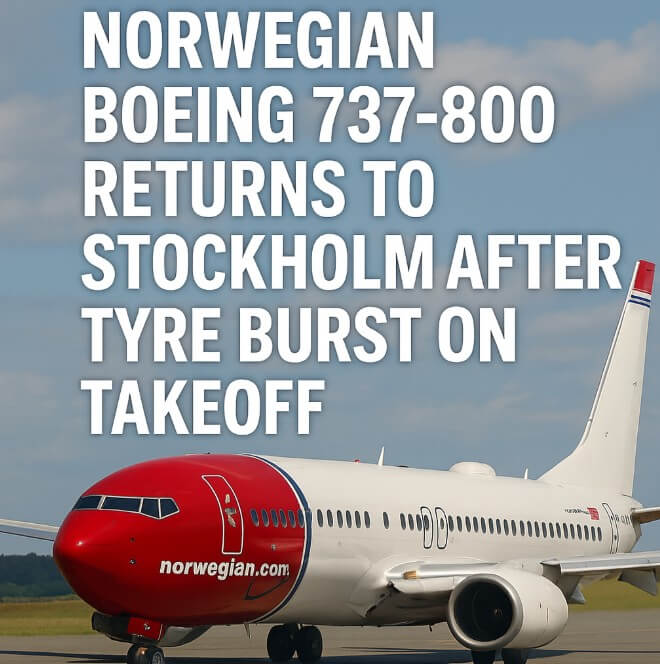
A Norwegian Air Shuttle flight bound for Paris was forced to return to Stockholm on Wednesday after suffering a tyre burst during takeoff, prompting an hour-long precautionary operation before landing safely.
Flight D82046, operated by a Boeing 737-800, had departed Stockholm Arlanda Airport’s runway 19R at 9:26 a.m. local time on August 27. The scheduled service was en route to Paris Charles de Gaulle Airport when the incident occurred.
Tyre Failure Detected After Takeoff
According to flight data, the aircraft had just lifted off when a tyre on the main landing gear burst, causing significant vibrations throughout the airframe. Passengers on board described a sudden noise and shaking. “A loud bang and strong vibrations occurred during the takeoff procedure,” several passengers reported.
Despite the abnormal event, the flight crew continued with the takeoff roll and initial climb before halting their ascent at flight level 160 (approximately 16,000 feet). The pilots then entered a holding pattern northeast of the airport while assessing the situation and coordinating with air traffic controllers.
The Aviation Herald reported that controllers at Arlanda also heard what they described as a “tyre explosion” during the departure. Ground crews later discovered debris from the failed tyre on the runway surface.
Safe Return to Stockholm
After holding at 8,000 feet, the crew elected to return to Stockholm as a precautionary measure. The Boeing 737-800 touched down safely on the same runway, 19R, approximately one hour after its initial departure. No injuries were reported among passengers or crew.
The 14-year-old aircraft, registered SE-RRS, belongs to Norwegian Air Sweden, a subsidiary of Norwegian Air Shuttle. The model is a widely used narrowbody jet, capable of carrying around 186 passengers on European routes.
Passenger Service Disruption
The damaged aircraft was declared unserviceable following the incident. Norwegian quickly arranged a replacement aircraft to complete the flight to Paris Charles de Gaulle. While the airline has not issued a formal statement, passengers were able to continue their journey later in the day.
For the affected travelers, the experience was unsettling but ultimately uneventful in outcome. “We could feel the vibrations immediately,” one passenger told local media. “But once we were in the air, the crew kept us calm, and the landing back in Stockholm felt normal.”
Operational and Safety Considerations
Tyre bursts during takeoff, while uncommon, are a known risk in commercial aviation. High speeds and heavy loads place extreme stress on aircraft tyres, particularly during rotation. In most cases, modern airliner designs allow for safe continuation of the flight or a return to the departure airport, as demonstrated in this incident.
Aviation safety experts note that flight crews are trained extensively for tyre-related emergencies. By choosing to continue the climb before returning, the pilots ensured they had time to evaluate aircraft systems, burn fuel, and prepare for a safe landing.
The recovery operation at Arlanda also included clearing debris from the runway, a necessary step to prevent damage to subsequent departing or arriving aircraft.
Broader Context for Norwegian
Norwegian Air Shuttle, headquartered in Fornebu, Norway, operates a fleet of Boeing 737s across Europe. The airline has been rebuilding operations following the pandemic, focusing on short-haul flights within the continent. While the incident caused a temporary disruption to its schedule, it is unlikely to have broader operational impact.
As of Wednesday evening, the airline had not publicly confirmed whether Sweden’s Accident Investigation Authority would open a formal inquiry into the tyre failure. In similar cases, regulators typically review maintenance records, tyre condition, and flight crew actions to assess whether further safety measures are necessary.
Conclusion
For the 186 passengers on board flight D82046, what began as a routine morning departure quickly turned into an anxious wait in the skies above Stockholm. Thanks to quick decision-making by the flight crew and coordination with air traffic control, the situation ended without injuries or major damage beyond the failed tyre.
The incident underscores both the vulnerabilities and resilience of modern air travel—where mechanical failures, though rare, can occur, but are often managed safely through training, technology, and procedure.
