


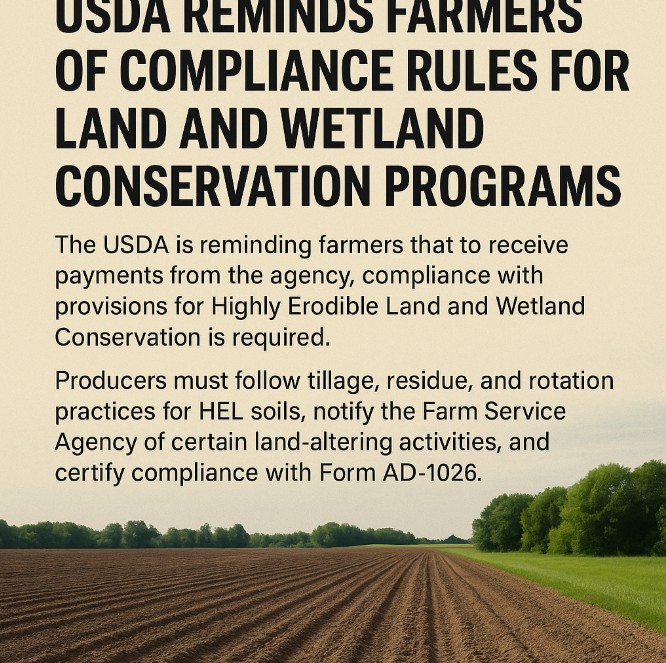
The U.S. Department of Agriculture (USDA) is reminding farmers and landowners that compliance with conservation requirements remains a condition for receiving key federal farm payments, loans, and crop insurance subsidies. The notice focuses on Highly Erodible Land (HEL) and Wetland Conservation (WC) provisions, which are central to the agency’s efforts to balance agricultural production with environmental protection.
Under USDA rules, landowners and operators must adhere to conservation standards if they wish to remain eligible for payments administered through the Farm Service Agency (FSA) and the Risk Management Agency (RMA). Producers farming on soils designated as highly erodible are required to follow specific tillage, crop residue, and rotation practices outlined in their conservation plans.
“Farmers with HEL determined soils are reminded of tillage, crop residue, and rotation requirements as specified per their conservation plan,” the agency stated in its reminder.
Conservation Standards Tied to Federal Support
The USDA emphasized that producers must notify their local FSA office before initiating land-altering activities such as breaking sod, removing trees, or undertaking drainage projects like tiling or ditching. These activities can trigger compliance reviews, and failing to update certifications risks the loss of federal benefits.
“Producers are to notify the USDA Farm Service Agency prior to breaking sod, clearing land (tree removal), and of any drainage projects (tiling, ditching, etc.) to ensure compliance,” the statement said.
To formalize compliance, farmers must complete Form AD-1026, which certifies whether their actions affect highly erodible soils or wetlands. Neglecting to file or update this certification can carry steep financial consequences.
According to USDA, “Failure to update certification of compliance, with form AD-1026, triggering applicable HEL and/or wetland determinations, for any of these situations, can result in the loss of FSA farm program payments, FSA farm loans, NRCS program payments, and premium subsidy to Federal Crop Insurance administered by RMA.”
Broad Reach Across Farm Programs
The compliance rules touch nearly every corner of federal farm support. Beyond direct FSA farm program payments, violations could also disqualify farmers from Natural Resources Conservation Service (NRCS) programs designed to fund conservation practices. Additionally, operators who rely on federally subsidized crop insurance—a widely used risk management tool—could lose access to premium subsidies, raising the cost of coverage substantially.
For many producers, those subsidies are a critical safeguard. Industry data show that crop insurance subsidies reduce producers’ premium costs by an average of 60 percent, making coverage far more affordable. Losing that support could significantly increase risk exposure, especially for farmers facing volatile weather and market conditions.
Balancing Agriculture and Conservation
The HEL and Wetland Conservation provisions, sometimes referred to collectively as “conservation compliance,” were first introduced in the 1985 Farm Bill and remain a cornerstone of USDA policy. They are designed to protect vulnerable soils from erosion, maintain water quality, and safeguard wetlands from drainage and degradation.
For farmers, the requirements translate into practical field-level decisions. HEL rules often mean leaving more crop residue on the soil after harvest, adopting no-till or reduced-till practices, or rotating crops to minimize erosion risks. Wetland compliance, meanwhile, limits the conversion of natural wetlands into crop fields, ensuring those ecosystems continue to provide flood control, wildlife habitat, and water filtration.
Importance of Staying Current
The USDA’s reminder underscores the importance of proactive communication between producers and their local FSA offices. While conservation compliance has been a longstanding requirement, recent shifts in land use—such as the conversion of marginal ground into crop production amid high commodity prices—can trigger new compliance obligations.
By emphasizing the need to notify the agency before making changes to land use, USDA is seeking to prevent situations where producers inadvertently jeopardize their eligibility. For farm operators, the takeaway is clear: staying current with conservation certifications is not just about protecting natural resources but also about protecting the bottom line.
